
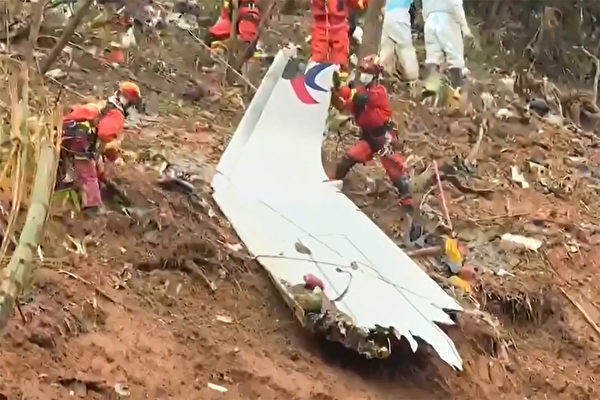
The latest data released by the US National Transportation Safety Board (NTSB) in response to public demand revealed that before the China Eastern Airlines Boeing 737-800 aircraft, which crashed into a mountain in 2022 causing the deaths of all 132 people on board, both engines were shut down and there was a violent struggle in the cockpit.
The report details the data recorded by the flight data recorder of the aircraft. NTSB’s involvement in the investigation of this China Eastern incident is because both the aircraft and engines were manufactured by American companies, and US investigators are considered top experts in analyzing black boxes worldwide.
According to a report by the Associated Press on May 7th, after the air disaster, Chinese investigators claimed they did not find any aircraft malfunctions, but there were news reports at the time suggesting that the accident may have been caused by the flight crew. The NTSB report provides the most comprehensive explanation of the accident so far and confirms the media speculation at the time.
In the report, aviation safety experts unanimously believe that the data shows someone intentionally shut off the fuel supply to both engines, causing the aircraft to pitch down and roll 360 degrees. However, because the Civil Aviation Administration of China (CAAC) has not released the final report, the report did not disclose the exact sequence of events of the accident. International standards dictate that investigators should strive to release reports around one year after an air disaster.
John Cox, CEO of Safety Operating Systems, stated that the design of the 737 aircraft requires the fuel control levers to be manually pulled out to shut off, otherwise they would not accidentally shut down. However, the investigation revealed that in the China Eastern aircraft incident, the control levers were locked, indicating that someone likely deliberately moved them to the off position.
The report revealed that after the flight data recorder and all hydraulic systems of the aircraft lost power, the aircraft was still at an altitude of 26,000 feet (7,900 meters) before data interruption. The cockpit voice recorder, due to the backup battery still functioning, could provide some clues, but since the release of these details is determined by the Chinese authorities, the NTSB did not disclose the contents of these recordings.
Jeff Guzzetti, who has investigated plane crash accidents for the NTSB and the Federal Aviation Administration (FAA), analyzed that the flight data suggests a struggle occurred on board, possibly leading to suicidal behavior by the pilots.
Previous similar incidents include the 2015 crash of a Germanwings aircraft due to pilot suicide, resulting in the deaths of all passengers on board. In 1999, an EgyptAir aircraft’s first officer deliberately crashed the plane into the waters near New York, causing a major air disaster. In a failed crash incident in 2023, a relief pilot who had taken hallucinogenic mushrooms days earlier attempted to shut down the engines during his off-duty time, and so on.
Guzzetti speculated that typically, to make an aircraft roll, the control wheel should smoothly turn in one direction, but in the China Eastern crash, the control wheel was oscillating back and forth, indicating someone may have been trying to prevent the aircraft from rolling. While the specific reason cannot be determined definitively at this time, there were indeed signs of a struggle in the cockpit.
The details of the China Eastern Airlines crash have raised concerns about the mental health of pilots. Experts stated that pilots experiencing mental health issues could lose their professional certification and be grounded, and regaining certification could take several months or even longer, during which time they would have no income. Some countries also prohibit pilots from taking common psychiatric medications such as antidepressants.
According to online sources in China, the China Eastern crash was caused by First Officer Zhang Zhengping developing a retaliatory mindset due to demotion and salary reduction, deliberately causing the suicide plane crash.
After taking off from Kunming, the aircraft suddenly descended at around 8,800 meters (29,000 feet), seemed to recover momentarily, but then crashed into a mountainside, creating a 65-foot (20-meter) deep crater on the ground, followed by a forest fire.
The crew reported everything was normal before losing contact with air traffic control. The Chinese authorities’ investigation stated that no abnormalities were found in the aircraft, crew, or external factors such as adverse weather. The latest NTSB report also indicated that there were no issues with the aircraft.