
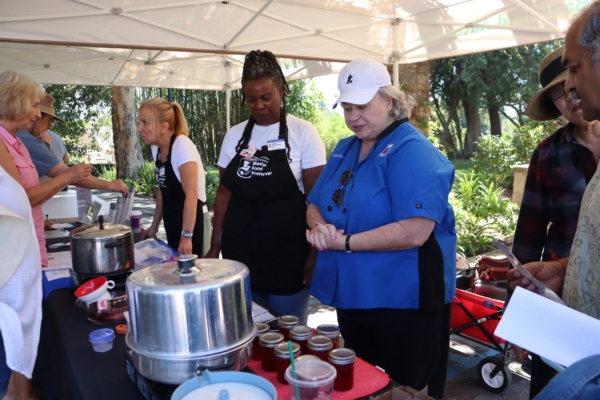
On March 21, the University of California’s “Master Food Preserver” team partnered with the Orange County Parks (OC Parks) to hold a community event in the George Key Ranch Historical Park, offering a hands-on workshop to teach residents how to make jam using fresh strawberries and kiwis.
The “Master Food Preserver” program has been a public service initiative of the University of California for over forty years. Trained volunteers provide scientifically validated guidance on home food preservation and safety to residents, while also exploring healthy eating habits. The keynote speaker for the event, Professor Pamela Jones, said, “I have taught food science and home economics, covering cooking, child development, marriage and family relationships, and now in semi-retirement since 2019, I serve as a ‘Master Food Preserver’.” Two other team members demonstrated the entire jam-making process on site.
Jones emphasized that freshly harvested foods processed into canned goods on the same day hold nutritional value comparable to fresh foods. She mentioned that once someone tastes homemade jam, they may question why they should spend money on store-bought alternatives.
Jones shared that she purchases fresh fruits from regular supermarkets and sometimes requests larger quantities, such as 25 pounds of apples, from the vendors. She recommended people participate in activities to receive practical recipes, watch the production process firsthand rather than relying on social media influencers’ videos. Ingredients for making jam include the two fruits of the day, classic pectin powder, fresh ginger, lemon juice, and sugar, with precise measurements and various techniques and tools involved.
Key points discussed included people’s preference for jam with fruit chunks, timing of ingredient additions, boiling to the “rolling boil” stage, skimming off foam, canning methods, and ensuring a sealed jar. Jones mentioned, “We use a serrated-edge ruler to determine the ‘headspace’ between the canned food and the jar opening. Most jams should have about 1/4 to 1/3 inch of space from the bottle cap. After canning, reheating will evaporate the air inside the jar, creating a sterile environment.”
For individuals living in higher altitude regions, the food processing time needs to be adjusted accordingly. Additionally, labeling the finished jars with the production date is essential, with the general shelf life lasting around 18 months. An Indian couple in attendance expressed their intention to follow the recipe and techniques learned, noting the challenge of maintaining homemade jam for an extended period and praising the appealing color of the jam made during the event. Tastings were not offered during the activity.
The George Key Ranch Park is one of the seven historical parks owned by the Orange County Parks Department, established in 1893 in Placentia. It was listed on the National Register of Historic Places in 1975. The park is open from Tuesday to Saturday, with guided tours on Saturday afternoons providing in-depth insights into the surroundings.
The park’s manager highlighted that the ranch originally spanned 20 acres, primarily cultivating Valencia oranges. The current park spans 2.2 acres, featuring a Victorian-style residence built in 1898, a collection of farming tools and handicrafts, approximately one acre of citrus groves, and a 3/4-acre poetic garden called the Verse Garden. Visitors are welcomed by a cool atmosphere, tall trees providing ample shade, continuous bird songs, as well as sightings of hummingbirds and butterflies.
During the rural era in Orange County, residents personally cultivated fruits and vegetables for self-consumption and raised livestock. The manager mentioned that food preservation was an essential aspect of the Key family’s daily life. They would can harvested crops kept in the basement for use during non-growing seasons.
The Keys and their neighbors formed the “Placentia Orange Growers” association, eventually joining various Southern California groups to establish the “Sunkist” brand. Oranges labeled as Sunkist at the time symbolized sweet taste, top quality, but were relatively expensive. Comparing fruit prices from that era to the present, it appears that fruits were remarkably cheaper back then.
Back in 1886, rural areas like Southern California saw women wearing wedding dresses in colors other than white due to dusty dirt roads—Brown was considered a more practical choice for attire in those times. George Key from Canada and Mary from Little Rock, Arkansas, met and married at the ranch. Mary spent three months sewing her brown wedding dress, which she wore at subsequent events and celebrations. They raised eight children, a total of ten family members, with each article of clothing, from shirts to socks to undergarments, all sewn by Mary herself.
The house’s original layout has been mostly preserved, with slight kitchen rearrangements and added collections like a hand-crank phonograph, homemade icebox, iron, and stove. Historical photos displayed the first school in the neighborhood, children riding in school carts (horse-drawn carriages), as well as desks attached to chairs. The changes witnessed by children from gas lamps to electric lights, horse-drawn carriages to automobiles, outdoor outhouses to indoor flushing toilets, and entertainment shifting from self-played pianos to listening to broadcasts and record players were noted by the manager.