
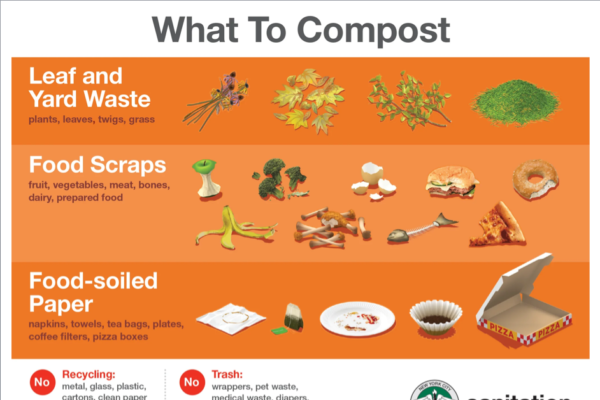
Recently, the New York City government has resumed issuing fines for improper food waste sorting. Data from the Department of Sanitation (DSNY) shows that this year, 516 fines have been issued, more than 13 times the total number of fines issued from May to December 2025, indicating a significant increase in enforcement efforts following the end of the enforcement pause by former Mayor Adams last year.
The food waste separation policy officially took effect in April 2025, requiring residents and property owners to separate food scraps from general waste and use designated containers for recycling. Under the current regulations, owners of small residential properties will be fined $25 for a first offense; for multiple violations involving buildings with more than 8 units, the fine can be increased to a maximum of $300.
According to statistics, the city government has collected at least $13,000 through related fines. From April to December 2025, the Department of Sanitation issued a total of 42,844 warning notices mainly for awareness and education purposes; whereas this year, only 4 warnings have been issued so far, signaling a shift from a primarily warning-based approach to a more fine-centric enforcement model.
As the policy approaches its one-year mark, some elected officials and community members believe that citizens are not fully prepared to adapt to the regulations. City Council members David Carr, Frank Morano, and Kamila Hanks from Staten Island recently sent a joint letter to the city government expressing support for the food waste recycling program but indicating it might be too early to increase fines. They pointed out, “The current enforcement method may unfairly penalize residents who have not received sufficient notice and guidance” and urged the city to prioritize strengthening education and awareness efforts.
Furthermore, some landlords and property managers criticize the policy for being difficult to implement in practice, noting that residents often dispose of trash through garbage chutes, making it challenging to trace the source and potentially increasing management costs and manpower burdens.
The city government emphasizes that if food waste ends up in landfills, it will generate a large amount of methane, but through sorting recycling and composting, greenhouse gas emissions can be effectively reduced. According to data from the Department of Sanitation, the program has shown significant results from the outset, collecting approximately 3.8 million pounds of food waste in the first week of implementation, setting a historic record.