
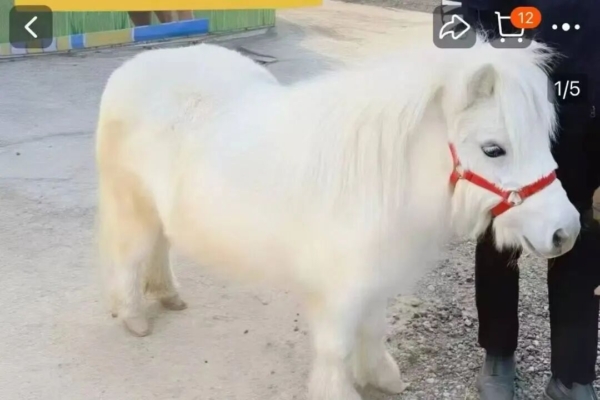
As the Yellow Calendar Horse Year approaches, in recent times, a kind of miniature horse has become a sensation on the mainland Chinese internet, with prices ranging from 6000 to 10000 yuan. However, some horse owners have pointed out that the hidden costs are astonishingly high.
This small horse, less than one meter tall with a cute appearance, has become popular on social media platforms in China due to its resemblance to the animated character “My Little Pony,” becoming a new “internet celebrity pet.” Many netizens have expressed their admiration, saying, “It’s adorable” and “I want to buy one.”
There are numerous merchants selling miniature horses on e-commerce platforms. In the product descriptions, the temperament being “gentle and suitable for children to ride and accompany” has become a major selling point. As for the difficulty of raising miniature horses, the sellers repeatedly emphasize that it is “very simple.”
Regarding feeding, merchants often promote that it only costs “2-3 yuan a day for grass, 3-5 square meters of space is enough, no need to walk them, easy to care for,” and they even promise a “70-80% buyback guarantee if you can’t keep them.”
The merchants also mention that, “You need to walk a dog, but you can just leave a miniature horse in the yard, it can be walked or not.”
Is it really as easy and feasible as the store owners describe? Experienced horse owners bluntly state, “Easy to care for” simply means they are hard to die, not necessarily worry-free or economical.
Many netizens also remind others to “be cautious when buying, and people who buy them should cherish them and not just act on a momentary impulse.” Additionally, many local urban planning regulations clearly prohibit keeping horses, cattle, sheep, pigs, and other livestock in urban and city managed areas.
According to a report by “News Square,” a horse owner named Zhou Yiran (alias) has been involved in equestrianism for several years and currently owns a horse kept in a club. Zhou Yiran believes that although miniature horses are small in size, “most of them actually have sensitive personalities.” Regarding the claim by merchants that they are “easy to care for,” she believes it often means they are simply “hard to die.”
“Raising them in an unsuitable environment could result in health or emotional issues, which may not be noticeable in the short term. By the time the problems become evident, they are often serious and irreversible.”
Miniature horses require continuous feeding for 14-16 hours a day; fasting for a few hours may lead to stomach issues. Moreover, they should not be fed just any roadside grass but high-quality alfalfa/hay/clover, costing around 1500-2000 yuan per month. In addition, they need supplements, vitamins, and minerals, with annual feed costs amounting to approximately 3000-5000 yuan.
Apart from food expenses, there are various other costs, with one significant aspect being hoof care. Since horse hooves grow continuously like nails and must be professionally trimmed/shod to avoid deformities, turning, or limping, the cost ranges from 400 to 2000 yuan per session, averaging 4800 to 24000 yuan annually.
Dealing with waste is also a major challenge. Zhou Yiran states that a decent standard horse stable requires a separate space of 4 meters by 4 meters, with the ground covered by about 15 centimeters of padding made of materials like hay, wood chips, rice husks, or sawdust, to provide a comfortable, non-slip standing and lying environment for the horses and absorb waste. Horses have a rapid metabolism, defecating more than ten times a day, requiring professional stable attendants to clean the area every two hours, which is clearly impractical in a city residential environment.
Due to these reasons, horse owners generally opt to have their horses kept in professional clubs, some of which also accommodate miniature horse breeds. According to Zhou’s information, the boarding fees at domestic clubs range from a minimum of 3000 yuan to a maximum of 15000 yuan, covering stable accommodation, padding, fodder, and basic care.
From a professional perspective, Zhou Yiran does not recommend individuals or families to keep horses in urban environments. She explains that horses are herd animals, and socialization is essential. Ideally, they should be kept in pairs, and solitary keeping may easily lead to psychological issues.