
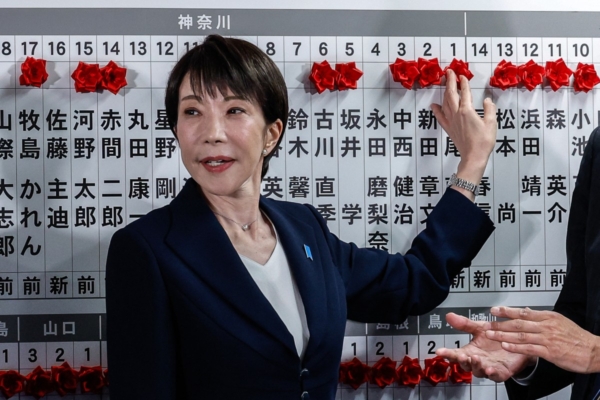
In the Japanese House of Representatives election held on Sunday (February 8th), Prime Minister Sanae Takai led the Liberal Democratic Party (LDP) through challenges and secured at least two-thirds of the seats, setting a new record for a single party in post-war Japan. This victory is expected to accelerate the implementation of Takai’s conservative policy agenda.
With 465 seats in the House of Representatives, the number of seats won by the LDP has surpassed the absolute majority threshold of two-thirds (310 seats), making it the first party in post-war Japan to achieve this milestone.
This significant advantage enables the LDP to proceed with constitutional revisions. Even if a bill is rejected by the House of Councillors (where the ruling coalition remains in the minority), Takai can overturn the results by using the LDP’s over two-thirds majority in the House of Representatives, ensuring the passage and implementation of legislation.
Compared to the House of Councillors, the House of Representatives holds substantial power in Japan.
The LDP’s number of seats has significantly increased from 198 before the election, clearly benefiting from Takai’s immense popularity, paving the way for her to continue as prime minister.
In this election, the ruling coalition composed of the LDP and the Komeito Party secured over three-quarters of the seats in the House of Representatives, further aiding Takai in advancing her agenda in the lower house. The election results indicate that the ruling coalition led by Takai will have enough seats to hold all chair positions in the House of Representatives committees.
Against a backdrop of persistent inflation and increasingly challenging international circumstances, Takai has pledged to implement a “responsible and proactive” fiscal policy and enhance the country’s defense capabilities.
Following the announcement of the LDP’s victory, Takai appeared on Japanese television programs stating, “We bear significant responsibility and must focus on steadily fulfilling our campaign promises.”
She also hinted on another program that she would maintain the current cabinet without making major adjustments to its composition. Since its establishment over three months ago, the cabinet has maintained relatively high public approval ratings.
However, she expressed hope that the Komeito Party would “fulfill its responsibilities within the cabinet.” The Komeito Party decided not to hold ministerial positions when forming the coalition government.
The Asahi Shimbun noted that in this House of Representatives election, the LDP significantly increased its seats, while the largest opposition force, the Constitutional Reform Alliance (CRA), suffered a devastating loss, leading to a “multi-party” opposition, indicating that the House of Representatives is likely to resemble the “one strong, multiple weak” parliamentary structure seen during Shinzo Abe’s second term as prime minister.
(based on reports from Kyodo News)