
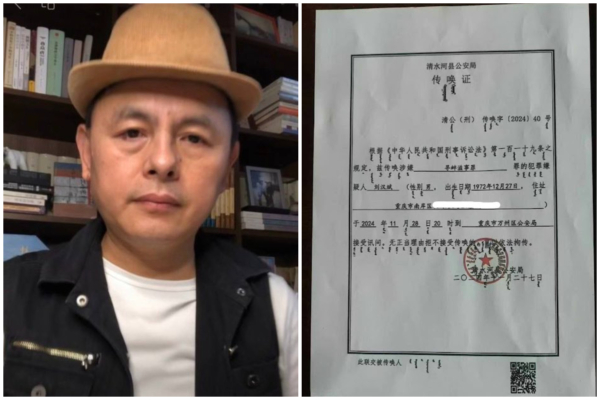
Recently, the self-media commentator Liu Hanbin (online alias Literary Offender 1984) from Chongqing attracted public attention after being arrested by the local public security bureau in Inner Mongolia’s Qingshuihe County on charges of “provocation and trouble-making” for exposing land occupation in a photovoltaic project.
On November 29 last year, Liu Hanbin was arrested by the Criminal Police Team of Qingshuihe County Public Security Bureau in Inner Mongolia and brought from Chongqing to Hohhot overnight, where he was detained in the First Detention Center. According to sources, on the evening of January 5, Liu Hanbin was released on bail pending trial and returned to his home in Chongqing. The police indicated that the case is still under investigation and bail will remain until the completion of the investigation.
Before his arrest, Liu Hanbin had noticeably lost weight. He underwent medical checks for high blood sugar, but inexplicably needed to take antidiabetic medication while in detention, as informed by sources.
One document, “Notice of Refusal to Amend Compulsory Measures,” indicated that Liu Hanbin’s bail pending trial application had been received. Due to the “significance and complexity of the case, involving multiple individuals and difficulties in obtaining evidence,” the public security authorities decided not to change the compulsory measures. The notice was signed by the Qingshuihe County Public Security Bureau and stamped with an official seal, dated December 6, 2024.
So, what major incident was Liu Hanbin involved in? Various sources suggest that Liu Hanbin might have gotten into trouble because of his articles. Liu Hanbin is a self-media person with his own WeChat public account and video platform.
Liu Hanbin’s wife, Ms. Nie, mentioned that Liu Hanbin began his self-media activities around February or March last year, focusing on current affairs both domestic and international, including issues like campus bullying and food safety. The family was initially concerned about potential risks he might face, but Liu Hanbin’s response was, “When this sort of thing happens to someone else, what would we do if we faced it ourselves?” Therefore, as a wife, she chose to support him.
Ms. Nie revealed that there are several noteworthy issues in Inner Mongolia, such as an illegal sand mining incident in Ulat Middle Banner that Liu Hanbin had visited, and a case of unpaid construction fees in Tongliao. The arrest by the Qingshuihe County police may be related to the problems exposed concerning the photovoltaic project introduced by the local secretary, issues with compensation to farmers, and interests of certain individuals in higher positions.
She mentioned that among those arrested were also a journalist named Zhang Lei from a former Hohhot newspaper and someone named Sun He. Liu Hanbin, however, had not been to Qingshuihe County but had obtained relevant materials.
In his article “Special Police, Special Privileges, Special Projects – Questions Regarding the Photovoltaic Project in Qingshuihe County, Inner Mongolia,” Liu Hanbin highlighted three major doubts about the Qingshuihe photovoltaic project. The full name of the project is “Inner Mongolia Hohhot City Qingshuihe County Loess Hill Gully Soil Conservation Area (along the Yellow River) Reclaimed Mine Comprehensive Management and Eco-Restoration of Unused Land 300MW Photovoltaic Project.”
According to information released by the Inner Mongolia Solar Energy Industry Association official website, the Qingshuihe photovoltaic project, invested and developed by Guangdong Energy Group in Inner Mongolia, has the largest single-unit capacity in the region, covering approximately 7,000 mu of land with a planned construction capacity of 300 megawatts.
Liu Hanbin pointed out in his article that the Qingshuihe photovoltaic project had encountered numerous issues in project approval, land nature, and land transfer, which had resulted in harming the interests of some locals and facing criticism from the public.
Regarding the doubts raised in his article, the first issue was whether the land for the Qingshuihe photovoltaic project was indeed abandoned mine restoration land or unused ecological restoration land, as opposed to farmland, forestland, or pastureland that villagers had been utilizing for an extended period.
Local reporters’ investigations revealed that of the approximately 7,000 mu of land used in the project, apart from around 3.7 hectares of supporting facilities land that had obtained construction land approval through the natural resources department, the remaining land had all been acquired through agricultural land transfer leasing.
For example, in more than 3,300 mu of land in Jiefang Village, Honghe Town, Qingshuihe County, there were parts of farmland that were expressly prohibited from being occupied for photovoltaic projects by decree of the state; there were some forested areas, with the vast majority being pasture land that had been actually distributed to villagers’ households. Among these lands, there were no unused ecological restoration land and no abandoned mine restoration land.
The second doubt raised was about discrepancies in the project’s land size: while government websites and local media publicly advertised 7,000 mu, the environmental impact assessment approval was only for 1,098,450 square meters (equivalent to around 1,647.59 mu), less than a quarter of the stated area.
Industry experts pointed out that the Qingshuihe County photovoltaic project was suspected of obtaining less approval for more land, possibly unlawfully occupying land that exceeded 5,300 mu, over three times its approved land usage.
The third doubt was on the project’s original intention of developing low-carbon energy for the benefit of the local population. The leaders of Honghe Town claimed that all land use had gone through a democratic process and won the overwhelming support of the majority. However, why had it incited online public opinion and seen instances of the local population obstructing work?
Several elderly residents of natural villages confirmed that they had not participated in any meetings on land transfer topics and had not seen any public notices about land use for the project.
On a note of dissent against land transfer in Wangyuliang Village, dozens of signatures were collected. When the photovoltaic project in Xiajiagedong commenced, over 30 special police officers were present at the construction site, with senior officials stating that whoever obstructed the work would be detained. In 2023, Tian Mou from Changjiahe Village was also detained, along with villagers Liu Mougui, Liu Yumou, and Dang Moumei, all due to dissatisfaction with land transfer compensation.
On March 28, 2024, at noon, Zheng Xueli, director of the Honghe Town Police Station in Qingshuihe County, calmly lit a cigarette at the scene of arresting villagers, with SWAT teams arriving to cooperate in the arrests.
Publicly available information shows that SWAT teams are specialized police units used to combat serious organized crime and terrorism, known as SWAT in English, operating as a combat unit primarily for anti-terrorism and dealing with heavily armed criminals.
Liu Hanbin inquired in his article, “Was it appropriate for the Qingshuihe County to deploy SWAT forces against defenseless villagers? Has the local government and public security agencies turned into lackeys and thugs for large enterprises, disregarding basic legal principles and public sentiments, all for the profits of a single company and short-term GDP gains without considering the livelihoods of local residents?”
Ms. Nie expressed that from March to July last year, Liu Hanbin wrote repeatedly about the issues related to the photovoltaic project. By July, she heard that the local authorities had promised the villagers to address the concerns, so Liu Hanbin stopped raising the issue. Unexpectedly, a few months later, he was suddenly arrested across provincial borders, which she saw as a retaliatory strike. “He had around ten articles deleted. When they took him away, they also confiscated his two computers and two phones.”
Recalling the day of November 29, when Liu Hanbin was taken away by officers from Qingshuihe County Public Security Bureau, Ms. Nie left for work early that day. Around 10 am, the police came to their house, and upon her return, she found only a summons. Later that afternoon, she received a call from the police asking her to pick up their child from school, and by the evening, he had been taken away and put on the highway. She didn’t get to see him or receive any detention notice.
She mentioned that a lawyer met with Liu Hanbin but couldn’t see the case files. In detention, Liu Hanbin’s meals consisted of steamed buns and Qingshui bok choy, cold showers, and the requirement to take antidiabetic medication, which he never took before. He wasn’t physically abused but was mentally, physically, and diet-wise tormented.
“The way they arrested him and took him away was abrupt, though the local police station claimed that all procedures were in order. We don’t know the details of what exactly happened; they just took him away directly. A few days ago, court police in Xilinhot City, Inner Mongolia, sprayed pepper spray at the lawyer, and previously, a doctor in Guangzhou, Tan Qindong, was arrested across provinces just for an article he wrote, without any justification. So, the situation in Inner Mongolia is quite chaotic, which is very worrying,” she stated.
In recent years, individuals who have faced retaliation for exposing photovoltaic projects are not isolated cases, with Liu Hanbin being a prominent example. Previously reported incidents by Epoch Times revealed that retired professor Fang Hengcai from Chaohu College in Anhui was allegedly retaliated against by local authorities for reporting the occupation of prime farmland by solar panels, resulting in both him and his wife being arrested.
Civil rights lawyer Wu Shaoping in the United States, in an interview with Epoch Times, stated that Liu Hanbin’s case is typical, and it highlights how local authorities are willing to do anything to suppress ordinary citizens supervising the government’s exercise of public power. Such actions show the evil use of power to suppress and retaliate against citizens striving for justice.
Wu Shaoping believed that if law enforcement actions were conducted normally, cross-border arrests by public security would be acceptable. However, since Liu Hanbin engaged in citizen supervision of the illegal land occupation of the photovoltaic project, he had evidently interfered with local interests. This prompted the use of illegal means such as cross-provincial arrests. There was a lack of formal legal documents provided to the family apart from a summons, indicating procedural violations.
Lawyers in mainland China, along with Wu Shaoping, considered this to be an abuse of law and power. Driven by personal interests, the police were crossing provincial borders to enforce the law and suppress the people.
“The CCP’s ‘rule by police’ trend to stifle public discourse is clear. Currently, 90% of cases charged with provocation and trouble-making do not constitute a crime. Provocation and trouble-making has become a ‘pocket crime’ to suppress freedom of speech. For example, Li Wenliang in Wuhan was suspected of provocation and trouble-making and summoned, while actual troublemakers were not prosecuted. It is a means of abusing this ‘pocket crime’ to control speech,” stated the mainland legal expert.