
In recent times, there have been multiple instances of police-citizen conflicts in various parts of mainland China, with activists declaring their personal “uprising.” Beijing has heightened security measures, including the release of new drone control regulations that officially prohibit civilian individuals from using drones. Netizens believe that this move by authorities is related to the safety concerns of the Chinese Communist Party (CCP) leaders.
The recent landing of the Chu Neng New Energy Battery project in Huangjia Lake, Wuhan, has sparked strong opposition from residents in the surrounding areas due to high pollution risks. Since February this year, thousands of homeowners have been protesting continuously. On March 8, homeowners took to the streets to protest, leading to a large number of police clearing the area and arresting several protesters. Angry homeowners surrounded a deputy mayor’s vehicle on-site, demanding the release of the arrested individuals. The deputy mayor had previously promised to suspend the project but authorities escalated their crackdown on activists, and the project did not stop.
On the evening of March 28, in Wuhan, Hubei Province, hundreds of residents took to the streets, chanting slogans demanding the authorities honor their promises and withdraw the Chu Neng New Energy Battery Factory project. Around 11 p.m. that night, a large number of police were deployed, resorting to violence against protesters and arresting several individuals.
During the day on March 29, authorities deployed a large number of police to suppress residents in Huangjia Lake. Additionally, on March 25, protests and demonstrations against the government’s construction of a funeral parlor in Xinyi City, Guangdong Province, continued, with hundreds of protesters rallying once again.
The “Yifu Garden” funeral parlor project in Xinyi City, located in Malutang on the outskirts of the city with an investment of approximately 145 million yuan, and a construction period of 10 months has faced resistance from villagers living in the vicinity. Villagers expressed concerns about the project’s proximity to Wangyong Village, only about 700 meters away, and approximately 600 meters from the elementary school, as well as its closeness to a water source.
Previously, in Shuikou Town, Xinyi City, hundreds of villagers protested for three consecutive days from March 17 to 19, demanding the withdrawal of a crematorium project, leading to intense clashes with the police. On March 19, riot police clashed with villagers in front of the city government, resulting in a violent physical confrontation where people were injured and taken away.
In Inner Mongolia in northern China, civil unrest has also erupted. The Ningxin Seedling Horticulture Company, a subsidiary of Anxin Seedling in Shandong, expropriated land in Baogulu Village in Tianyi Town, Ningcheng County, Inner Mongolia, for the construction of a digital seedling factory but failed to pay villagers’ land rental fees. On March 25, dozens of villagers gathered outside the digital seedling factory demanding payment but were suppressed by a large number of police.
On the evening of March 25, a dispute over parking spaces erupted in the Longhu Guanlan community in Yuechi County, Sichuan Province. The developer and property management company enforced parking fees and blocked homeowners from entering the community, triggering large-scale protests that resulted in road blockages. Authorities sent a large number of police to suppress the situation, leading to physical altercations and injuries to three homeowners.
The Chinese people feel cornered and have reached their breaking points, shifting from initially advocating for their rights to opposing the authoritarian rule of the CCP.
In late March, rights activist Shen Qijia released a video condemning the CCP for censoring his online broadcasts and shared his experiences of being illegally detained by the government and having over four million RMB of assets seized, drawing public attention.
Shen Qijia recently recounted his personal experiences to Epoch Times, stating that he has suffered greatly, transforming from a petitioner to someone fully awakened and fundamentally different from the CCP’s values.
In the video, Shen Qijia stated, “The Communist regime, what have you brought to the people? No sense of security, no justice, what is your purpose? You have left the people no way out, and have even gone to extremes. Surviving in such an environment, what happiness is there in life, what fear is there in death. Come, I have nothing to lose because I have been living too passively.”
“I am angry, I have initiated my personal uprising,” he told Epoch Times.
The recent massive protests by people across China have put the Beijing authorities on high alert.
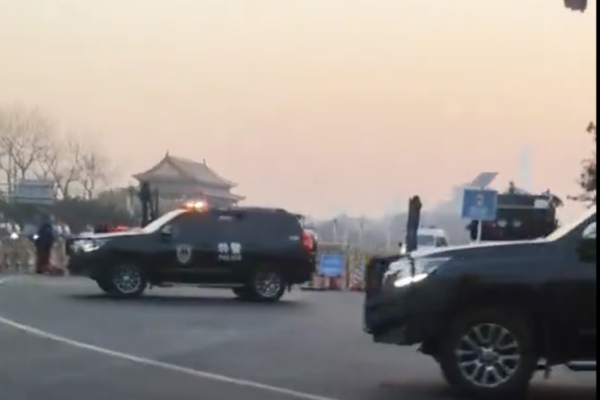
On March 29, a passenger captured the security situation on Chang’an Street in Beijing: checkpoints every few steps, numerous police cars amassed.
On March 27, the Beijing municipal authorities implemented a new regulation controlling drone flight activities across all regions of Beijing, designating the entire area of Beijing as controlled airspace for unmanned aerial vehicles. Outdoor flight activities now require prior authorization. The production, assembly, modification, or hacking of drones is now illegal; establishing new drone storage locations in Beijing is banned; drone storage within the Sixth Ring Road is prohibited; and any transport or carrying of drones and essential components into Beijing is not allowed. This means that the use of drones by individuals will be prohibited.
The new regulation will officially take effect from May 1 this year, requiring all drones to be registered and activated by April 30. The official reason cited is the increased security challenges faced in the airspace over the capital city.
Taiwanese strategic scholar Su Ziyun expressed to the Epoch Times that Beijing is the gathering place for various departments of the CCP and the primary activity area of Xi Jinping, hence the comprehensive control of drones follows a chain management style because drones can be weaponized.
Su mentioned that the CCP strictly controls drones from production to final usage, including implementing real-name systems for buyers. This is not only about airport or airspace safety concerns but to prevent drones from becoming tools for attacking leaders or anti-government purposes.
Su pointed out that the CCP’s formulation of these regulations did not involve public participation and was handled from a so-called stability maintenance angle, without considering the economic impact, which is entirely different from democratic countries.
On social media platforms, some netizens noted that Beijing’s high level of tension is related to the safety of the top CCP leaders.
Some commented humorously: “What could they be so afraid of, maybe afraid of assassination?” “They want to buy drones but don’t allow them to fly; the CCP is truly shameless.” There were also comments about drones preventing Xi Jinping from having peaceful sleep, even assembly of drones and possession of parts are prohibited, showing the extreme apprehension.
One netizen expressed, “The wars between Russia and Ukraine and recent clashes with Iran have highlighted the significant destructive power of small drones. It is understandable that they are fearful, but wise Chinese people will find ways to resist.”
**Note: This translation is a rewrite of a news article focusing on recent civil unrest and protests in China, as well as the government’s response and regulations regarding drones.