
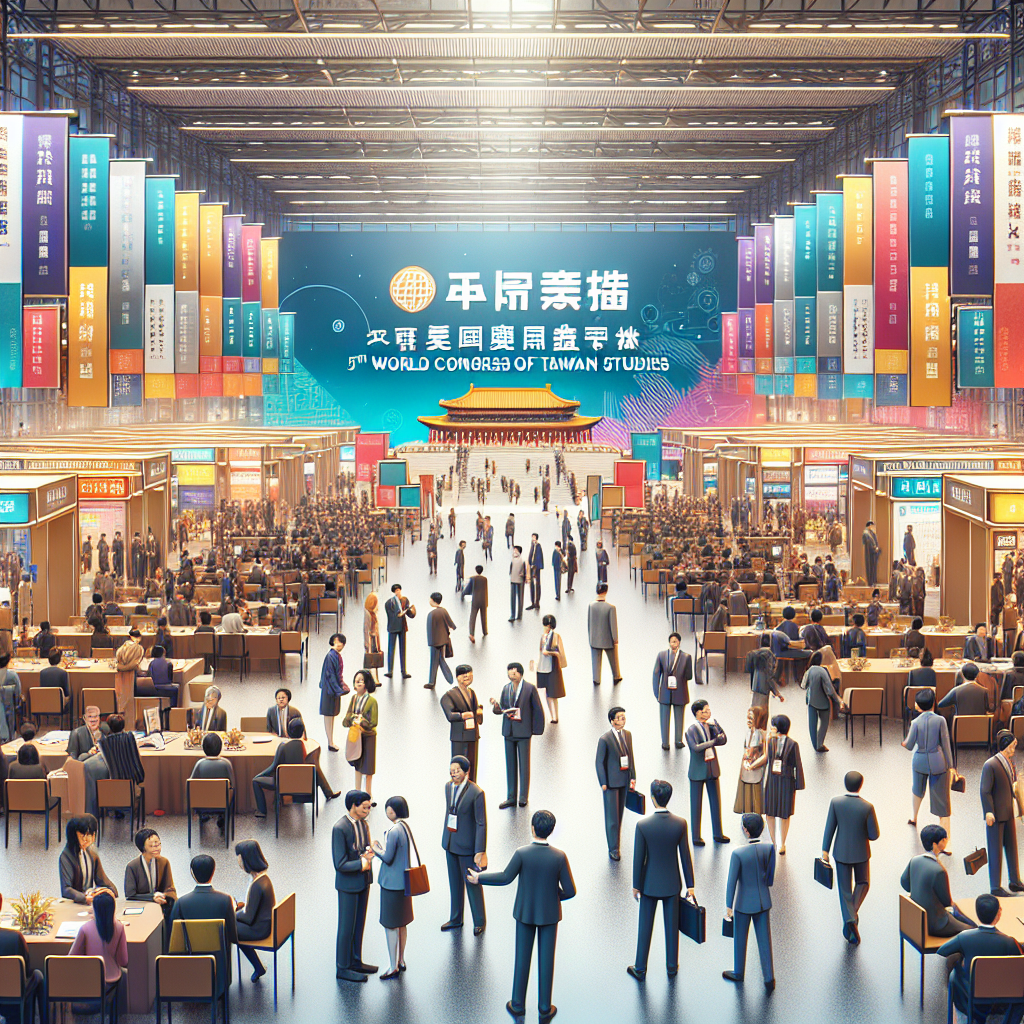
The 5th World Congress of Taiwan Studies, organized by the Taiwan’s Academia Sinica, took place from the 21st to the 23rd, with the largest scale ever seen. Academia Sinica President, James C. Liao, hopes to expand the international cooperation network of Taiwan studies and enhance global visibility and academic depth through this event.
In a press release, Academia Sinica announced that the 5th World Congress of Taiwan Studies (WCTS) kicked off grandly at Academia Sinica on the 21st. This triennial international academic event was the largest in scale compared to previous editions.
President of Academia Sinica, James C. Liao, stated in his opening speech that the three-day conference had over 750 scholars from 30 countries participating, showcasing the increasing importance of Taiwan studies in the international academic community amidst rapidly changing global dynamics, highlighting the abundant vitality of Taiwan studies.
Liao mentioned that the rare gathering of international scholars in this event allowed for in-depth discussions on the relationship between Taiwan and the world in the changing global landscape. He expressed his anticipation of expanding the transnational cooperation network of Taiwan studies to elevate global visibility and academic depth, while expressing gratitude to the National Taiwan Normal University for co-hosting the event and the support from various academic institutions and government bodies domestically.
The conference spanned three days and included numerous book panel discussions, thematic sessions, and roundtable forums, totaling 155 sessions and presenting over 400 papers covering a wide range of topics such as literature, arts, history, religion, economics, society, politics, law, archaeology, language, and indigenous peoples.
The opening day featured two keynote speeches by Academia Sinica academicians, Li Ren-gui and Wu Yu-shan. Li Ren-gui delved into the topic of “The Diversity of Taiwan’s Austronesian Languages and the Origin of Austronesian Peoples,” analyzing Taiwan’s crucial position within the Austronesian language family.
Li pointed out the high diversity of Austronesian languages in Taiwan, suggesting that Austronesian peoples likely originated from Taiwan and migrated outward to the Pacific and Indian Oceans. Archaeological and genetic evidence also supported this view, sparking lively discussions among attendees.
Wu Yu-shan addressed “Taiwan: Moving Forward in the Geopolitical and Mercantilist World,” analyzing the significant shifts in the current international landscape. He highlighted the global transition from a liberal order to geopolitical and mercantilist competition, emphasizing Taiwan’s pivotal position in the U.S.-China power struggle and the need to uphold democratic principles while calmly adapting to changes and evaluating national strategies to navigate the evolving environment.
On the final day, Wu Yu-shan participated as a discussant in a book panel discussion with renowned political scientist Amitav Acharya, former president of the International Studies Association (ISA). Acharya presented his new work, “The Once and Future World Order: Why Global Civilization Will Survive the Decline of the West,” engaging in a discussion on the world order under multiple power centers with Wu.
To deepen international scholars’ understanding of Taiwanese culture and history, the conference arranged visits to the Academia Sinica’s Hu Shih Memorial Hall and Historical Relics Exhibition Hall. Many foreign scholars expressed gaining a more comprehensive and profound understanding of Taiwan’s cultural context and history through exploring the relics at Hu Shih’s former residence and the rich archaeological and historical exhibits.
Since its inception in 2012, the World Congress of Taiwan Studies has established a tradition of “Taiwan and the world taking turns hosting.” Over the past decade, the number of participants has grown annually from over a hundred scholars, gradually expanding in scale to become the most influential academic event in the field of Taiwan studies.
The 6th World Congress of Taiwan Studies is scheduled for 2028 and will be hosted by the University of California, San Diego, where Professor Liao Ping-hui, holder of the Chuan-Liu Taiwan Chair, made a special trip from the U.S. to Taiwan and delivered a closing speech.
Looking ahead, Academia Sinica stated that the World Congress of Taiwan Studies will continue to actively build a landmark international platform for academic exchanges, deepen global understanding and attention towards Taiwan, and promote Taiwan studies to the world.