
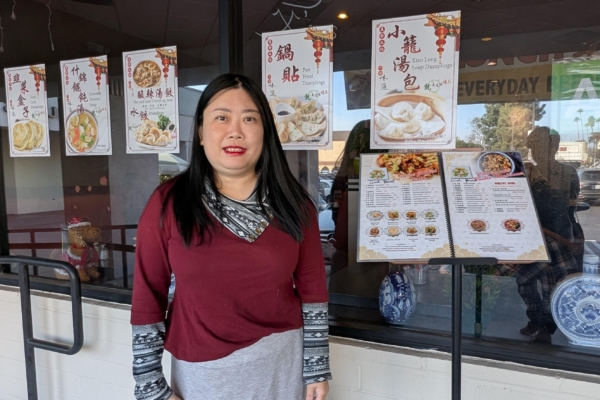
In celebration of the arrival of the new year 2025, the Chinese community in Los Angeles has seen an increase in gatherings to bid farewell to the old year and welcome the new one. Major Chinese restaurants in Los Angeles are bustling with activity. One such restaurant, “Golden China” in Pasadena, owned by Liu Xinjie, has observed a significant increase in both dine-in customers and takeout orders.
After taking over the nearly 40-year-old Golden China restaurant, Liu Xinjie became a restaurant owner without a chef’s certificate but holding an American accountant’s license. She learned cooking from the restaurant’s master chefs specializing in Taiwanese and Cantonese cuisine, and researched and developed various dishes to attract new customers. Despite facing challenges such as rising costs and wages, the restaurant’s revenue surged by 15% in 2024.
Liu Xinjie attributes the growth of her restaurant’s business to breaking through traditional management thinking. Several well-known restaurants in Southern California have recently closed due to heavy rent burdens and poor security, with some being forced to relocate after repeated incidents of vandalism by vagrants. In the face of these challenges, Liu Xinjie remains calm, saying, “There are always more solutions than problems.”
To cope with the rising labor costs, Liu Xinjie chose to invest in upgrading the restaurant’s POS system. Although this incurred an additional expense of about $100 per month, it significantly reduced labor costs over the course of a year. The new system not only saved on manpower but also provided real-time operational data analysis, allowing her to quickly grasp sales trends and daily business conditions, facilitating menu preparation and marketing planning with remarkable results. She recalled that in the past, the restaurant relied on manual ordering and handwritten data analysis, which was not only time-consuming but also prone to errors. Introducing technology has not only increased efficiency but also reduced error rates. On the eve of last Christmas, the restaurant’s daily sales broke through $10,000, a feat that would have been challenging to achieve with the old methods, leaving employees exhausted.
Liu Xinjie also led the restaurant to transition from primarily serving Western markets to offering Chinese cuisine suitable for both Westerners and Chinese customers. She introduced traditional Chinese delicacies such as soup dumplings and chive pockets, as well as Western-favorite dishes like Singapore fried rice noodles. She emphasized that innovating the menu requires giving the market sufficient time to adapt, rather than attempting short-term solutions. The monthly revenue of some new dishes increased from a few hundred dollars at the outset to thousands of dollars after a year, a testament to the success of long-term reputation building.
From last Christmas to New Year’s Day this year, the restaurant experienced a double-digit increase in both dine-in and takeout sales. Liu Xinjie believes this is closely tied to changes in consumer behavior post-pandemic. During the pandemic, takeout and delivery became habits for many people, and lockdown measures limited dine-in options, leading more individuals to embrace the convenience of taking food home. While dining in is convenient, tipping is required, which can be burdensome for families with young children, making home dining a more relaxed and economical choice.
Moreover, the widespread adoption of delivery platforms like Uber Eats, Meituan, and DoorDash has lowered the barrier for restaurants to offer delivery services, enabling consumers to easily browse menus, place orders, and track delivery progress. In order to better serve customers, Golden China has set up its own delivery website, saving on platform fees. Many customers even prefer to call directly to place orders, then come to the restaurant to pick up their meals.