
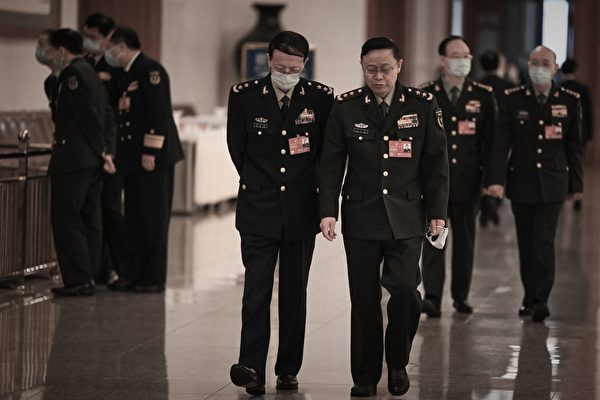
On December 31, 2024, as the People’s Liberation Army of China continued to face purges, a military report recently published an article discussing military reforms, criticizing lax discipline among grassroots officers and soldiers, and emphasizing the need to address violations such as “climbing the wall” (referring to bypassing the Great Firewall to access foreign websites). Analysts suggest that the seriousness with which the military report openly criticizes “climbing the wall” indicates that this behavior is widespread within the military, with soldiers eager to access blocked information. Under the intense pressure of the ongoing purge, the PLA is potentially on the brink of a widespread crisis.
On December 23, 2024, the PLA’s official newspaper published an article titled “Promoting Strict Discipline Throughout the Entire Military Chain of Command as a Normal and Long-term Measure.” The article admitted that there were varying degrees of loose management, relaxed atmosphere, and lax discipline among officers and soldiers, emphasizing the need for targeted crackdowns on issues like “climbing the wall,” drunk driving, improper relationships, and more.
Of particular concern was the mention of “climbing the wall.”
On December 30, the host of the YouTube channel “Chinese Insider,” Yu Tong, mentioned in a program that due to tight restrictions within the PLA, it had been challenging for external parties to understand the true circumstances within the military. However, the recent article in the PLA’s official newspaper essentially revealed many eyes within the army excitedly and eagerly reading information closely related to them, causing a silent but impactful shockwave within the PLA.
Yu Tong pointed out that the public discussion of “climbing the wall” in the military newspaper implies that this behavior has become prevalent within the military. If “climbing the wall” was only done by a few individual soldiers, according to Chinese propaganda rules, it would not even warrant mention, as acknowledging it would mean promoting it. Additionally, the newspaper’s mention of “improper relationships” might stem from a fear of soldiers banding together in rebellion, where such relationships, deemed “improper,” may be seen as justifiable.
In fact, this is not the first time the PLA newspaper has addressed “climbing the wall.” In June of the previous year, the PLA newspaper shared a comic titled “Online Conduct Requires Discipline: Climbing the Wall Will Lead to a Fall,” introducing military readers to what online “climbing the wall” entails and the technical means involved. The article explained that “climbing the wall” refers to actions bypassing IP blocks, content filtering, domain hijacking, traffic restrictions, to access overseas websites prohibited by the country. “Climbing the wall” techniques primarily rely on VPN and SSR software.
The article further stated that behaviors like downloading various “internet accelerators,” VPNs, modifying network settings, or logging into foreign game servers on gaming platforms to download prohibited apps involve “climbing the wall.”
Yu Tong suggested that young soldiers in the army likely found amusement in discovering these “climbing the wall” tools. Given their previous ignorance on the topic, the curiosity sparked by the unaccessible content prompted their interest. Where were they downloading these “climbing the wall” tools from? It seems like the PLA newspaper is enlightening all soldiers on how to “climb the wall.”
Yu Tong believed that the PLA newspaper’s stance against “climbing the wall” is likely related to the recent internal turmoil and purges within the military.
Since last year, there has been a comprehensive clearance and review of high-ranking officials, including two successive Chinese defense ministers, leaders in the Rocket Forces, the Strategic Support Forces, nearly 100 senior officials in the military-industrial complex, and even the Director of the Political Work Department of the Central Military Commission, Miao Hua, was investigated on November 28 this year.
On December 25, official Chinese sources indicated that eight Chinese National People’s Congress delegates were removed from their positions, including former Deputy Commander of the Army You Haitao and the Southern Theater Command Navy Commander Li Pengcheng.
Rumors of many military leaders being investigated have circulated online but remain unconfirmed.
Various signs indicate that significant changes in military morale have occurred within the PLA due to the ongoing purge. Earlier, Yuan Hongbing, a scholar in Australia, revealed that there were internal reports of two incidents within the PLA involving multiple fatalities, one of which resulted in suicide.
Online rumors spoke of Liu Yuan, the son of former Chinese President Liu Shaoqi and a retired general, submitting a memorial to the CCP Central Committee, calling out for the downfall of the party. Regarding the political crisis, Liu Yuan stated that the immediate threat to the CCP’s ruling position lies in the unstable morale within the ranks under the massive purge.
Yao Cheng, a former Colonel Staff Officer of the PLA Navy, expressed in May on the social media platform X that there were various rumors circulating within the PLA, primarily fueled by discontent over the appointment of incompetent and sycophantic individuals to key positions in the military, causing capable and knowledgeable officers to feel disillusioned and seek alternative careers.
On May 25, an insider familiar with military affairs in mainland China, using the alias Tianming, disclosed to Dajiyuan that the forces in the central theater appeared dissatisfied with Xi Jinping. The saying circulating in the barracks during recent heavy rains in Hebei goes, “When water floods the South China Sea, it’s a slap to Xi Jinping.”
CCP leader Xi Jinping has repeatedly stressed, “If we cannot pass the test of the internet, we will not pass the test of long-term governance.”
Yu Tong pointed out that when “climbing the wall” becomes prevalent within the military, it indicates that the CCP not only fails the test of long-term governance but may not even be capable in the short term. Under the intense pressure of the purge, a small spark within the military could ignite widespread discontent, leading to a potential chain reaction.