
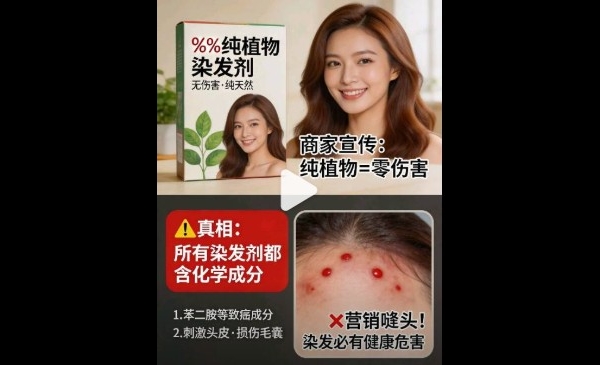
Recent reports have exposed several hair dye products in the Chinese market for false advertising and misleading ingredient claims. Some products are marketed as “plant-based hair dye,” “natural,” “plant extract,” “safe for pregnant women,” among others, on their sales pages. However, the ingredient lists still contain various chemical components.
According to a report by Xinjing News on May 8th, consumers have raised concerns on social media about a product labeled as “Plant Extract Hair Coloring and Care Cream.” The packaging features illustrations of plants like ginseng and is labeled with phrases like “fragrance-free and non-irritating.” Despite this, the ingredient list includes common chemical substances found in hair dyes such as p-phenylenediamine and resorcinol. The company only discloses the presence of p-phenylenediamine in small print at the bottom of the promotional page.
Similar situations are not uncommon. On the Black Cat Complaint Platform, there are multiple complaints related to “plant-based hair dye.” Some consumers have reported that products advertised as “plant hair dyes” claiming to be “scalp-friendly,” “safe for pregnant women,” and “free of chemical agents” are challenging to remove from the scalp after use. The instructions explicitly state that pregnant women should not use the product, and the ingredient list still contains various chemical components.
A random sampling conducted by Xinjing News on multiple products claiming to be “plant hair dyes” revealed discrepancies between the product titles, promotional pages, ingredient lists, and customer service responses. These products prominently feature terms like “plant” and “natural” in their titles, with repeated mentions of “plant extract,” “herbal extract,” and “plant-based hair dye for peace of mind” on the promotional pages. However, the statements from customer service representatives do not align with the promotional materials.
Some customer service representatives admitted that the products are not purely plant-based hair dyes but contain added plant extracts. Others mentioned the inclusion of extracts such as Polygonum multiflorum, ginseng roots, sunflower seeds, along with a small amount of dyeing aids. Most customer service representatives did not directly address the repeated emphasis on “plant-based hair dye” in their responses.
After verifying the ingredient lists of multiple products, Xinjing News found that while these products are marketed as “plant hair dyes,” their formulas primarily consist of chemical components like ethanolamine, propylene glycol, and additives such as emulsifiers and stabilizers. The ingredient lists commonly include oxidizing hair dye components like p-phenylenediamine, resorcinol, p-aminophenol, hydrogen peroxide, and most products require mixing of the dye (Agent I) with the developer (Agent II).
In addition to the discrepancies between promotion and formulation, the actual proportion of “plant ingredients” included in the products has been criticized for being insufficient. Some products list plant extracts such as black truffle, ginseng roots, cypress leaves, black sesame, camellia, etc., prominently on their promotional pages, emphasizing the concept of “plant essence.” However, these highlighted plant extracts often appear towards the end of the ingredient list or in the category of “other trace elements.” Some plant ingredients advertised are not even listed in the ingredient list. Xinjing News cited current labeling regulations stating that ingredients listed under “other trace elements” typically do not exceed 0.1%.
Xinjing News further referenced industry experts stating that there are currently no truly “pure plant-based hair dye products” available in the market.