
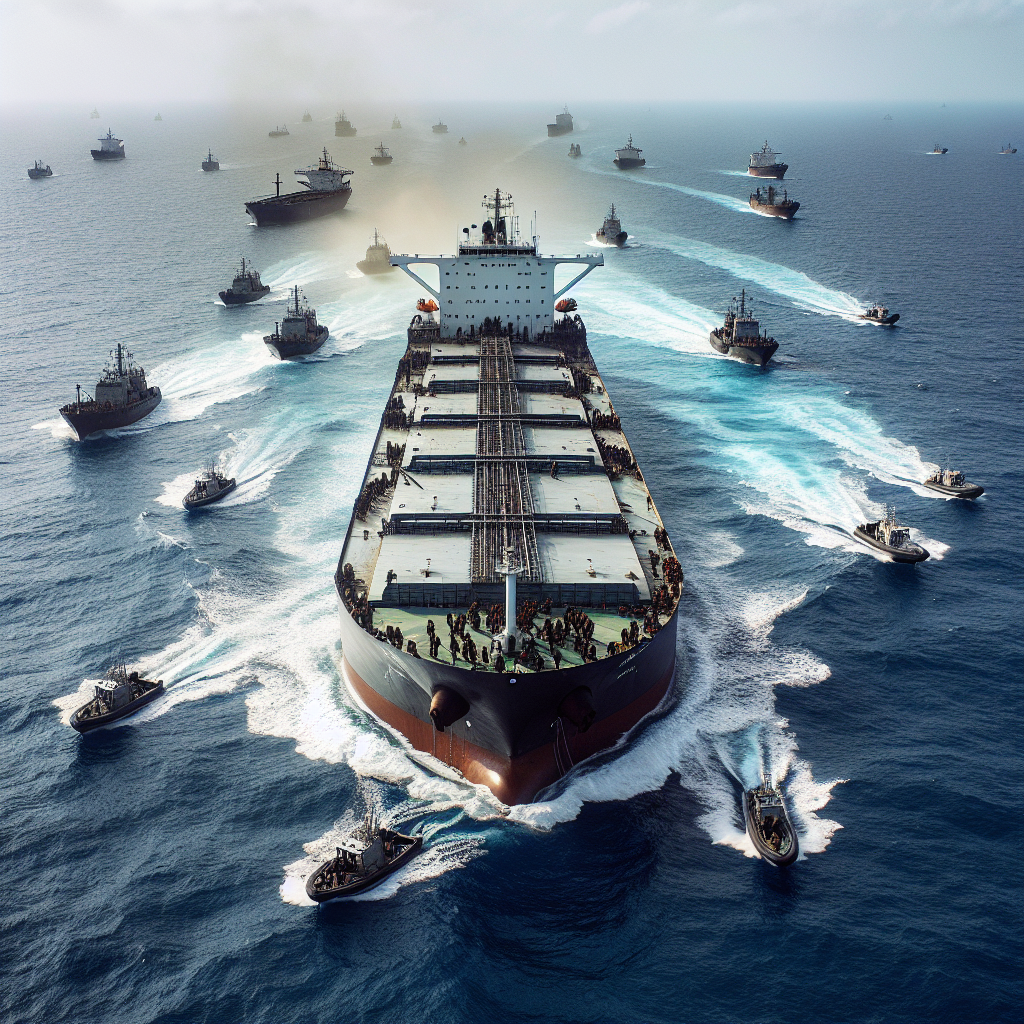
Last Sunday, the United Kingdom Maritime Trade Operations (UKMTO) reported that a bulk cargo ship was attacked by multiple small boats near the Strait of Hormuz. The incident occurred approximately 11 nautical miles (20 kilometers) west of Sirik, Iran, with all crew members onboard reported as “safe”.
The significance of the location is important because territorial waters usually extend up to 12 nautical miles from a nation’s coastline. However, according to the International Maritime Law and the United Nations Convention on the Law of the Sea, as long as foreign-flagged vessels do not engage in threatening behavior, fishing, or other prohibited activities, they are entitled to the right of “Innocent Passage” through territorial waters.
The captain of the northbound bulk carrier reported the attack to UKMTO, stating that multiple small boats approached and exchanged fire. Despite the conflict, UKMTO stated that all crew members are safe and no environmental damage or pollution has been identified.
Authorities have launched an investigation and advised vessels in the area to navigate cautiously and report any suspicious activities. Additionally, in an email response to The Epoch Times, UKMTO mentioned that they do not have further details, including the origin of the small boats.
Iran has previously used fast attack boats to harass or seize vessels in the Strait of Hormuz and its surrounding waters. Therefore, the attack on May 3rd is one of the maritime incidents that has occurred in the region, once again highlighting the safety risks in that area.
According to the latest reports from UKMTO, from the time of the US-led coalition’s strike against the Iranian regime on February 28th to May 2nd, a total of 41 incidents involving vessels operating in the Arabian Gulf, the Strait of Hormuz, the Gulf of Oman, and surrounding waters have been reported.
Of these incidents, 23 have been classified as attacks, 16 as suspicious activities, and 2 as hijackings.
The attack near the Strait of Hormuz is significant as it is one of the world’s most important chokepoints for oil transportation. Approximately 20% of the world’s oil passes through this narrow waterway for shipment. Since the outbreak of hostilities in late February, Iran has maintained control over this critical passage, disrupting the flow of economic essentials such as oil, natural gas, and fertilizers from the Persian Gulf region to global destinations, leading to soaring energy prices and commodity costs.
However, starting from April 13th, the United States initiated a “counterblockade” against Iranian ports, directing vessels engaged in trade with Iran to turn back, while non-trading vessels can transit normally. The US Central Command announced on May 3rd that 49 commercial ships have diverted due to compliance with the blockade, pledging to ensure the full implementation of the blockade order.
On April 8th, President Trump stated that, in response to an urgent request from Pakistani Prime Minister Shehbaz Sharif and senior Pakistani military officials, he agreed to halt airstrikes against Iran. Trump took to the Truth Social platform, declaring that the condition for suspending airstrikes was Iran reopening the Strait of Hormuz for commercial shipping.
However, current negotiations between the Tehran regime and the US government have reached a stalemate. This is primarily due to Iran’s reluctance to relinquish nuclear weapons and the lack of substantial leadership on their side to confirm the specifics of the negotiations with the US.