
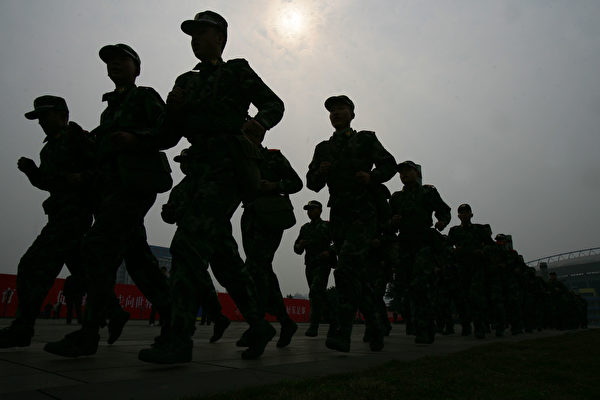
The toppling of former Vice Chairman of the Central Military Commission of the Chinese Communist Party, Zhang Youxia, and former Chief of Staff of the Joint Staff Department, Liu Zhenli, has sent shockwaves through the top ranks of the CCP military and political establishments. What’s intriguing is that some Chinese official websites still maintain reports related to Zhang Youxia, and there hasn’t been the usual rush of public statements from the military following the downfall of high-ranking officials. Analysts believe that this unusual collective silence within the military signals abnormalities and potential power vacuum within the power structure, indicating deeper crises brewing within the CCP system.
The Chinese Ministry of National Defense announced on January 24th that Zhang Youxia and Liu Zhenli were under investigation. The PLA Daily promptly published an editorial accusing the two of seriously violating and undermining the responsibility system of the Military Commission Chairman, severely endangering the CCP’s governing foundation, among other charges. Xinhua News Agency reprinted this editorial, indicating that the authorities have made a clear political judgment on the case.
Observers point out that such harsh language is relatively rare in recent high-level military cases. Some commentators have drawn parallels between this purge and the Lin Biao incident of 1971, suggesting that its political impact should not be underestimated.
After the official announcement of the downfall of Zhang Youxia and Liu Zhenli, several unusual signs have surfaced. For example, over 72 hours after the announcement, the names of Zhang Youxia and Liu Zhenli were still not removed from the list of members of the Central Military Commission on the official CCP government website. Such delays are not common in the Chinese political system.
As of 5:00 am Beijing time on January 28th, Zhang Youxia still appears on the list of the “20th Central Leadership of the CCP” on the Xinhua News Agency official website.
Up to now, the editorial published by the PLA Daily continues to be prominently featured on the official website homepage. Search results for “Zhang Youxia” on the official website show that numerous news reports about Zhang Youxia, including his speeches to military and armed police officers in public occasions, along with news about “Russian President Putin meeting with Zhang Youxia” and “Zhang Youxia meeting with the U.S. National Security Advisor” are still available.
Chinese commentator Zhang Tianliang recently mentioned on his program “Tianliang’s Political Analysis” that compared to the usual reactions following the downfall of high-ranking military officials, the “silence of the entire military after this incident is particularly noteworthy.” He noted that typically, in similar situations, the major military regions and services would publicly pledge loyalty to the top leadership through statements or editorials in a short time frame, but as of now, apart from the unified editorial by the PLA Daily, there hasn’t been a significant response from the five major military regions or primary services.
Zhang Tianliang analyzed that this silence could reflect three scenarios: firstly, senior military leaders are choosing to wait and see until the situation becomes clearer; secondly, the functioning of some command systems may be affected; and thirdly, there might be a temporary “suspended” state in the operation of power.
Canadian Chinese writer and pro-democracy activist Sheng Xue mentioned in an interview with Podcast Fang Fei on January 27th that this phenomenon indicates a challenge to Xi Jinping’s actual control over the military. She believes that Zhang Youxia, with deep experience and extensive connections within the military, being investigated might trigger resistance from some mid to senior military officers, leading them to respond with silence or passivity.
Sheng Xue pointed out that since January 18th, there have been large-scale personnel control actions in Beijing and some military regions involving the army and local security systems. The security level in the core areas of Beijing notably escalated, with rare high-intensity restrictions in the areas of Zhongnanhai and Chang’an Street.
Regarding the reasons behind the rupture of the relationship between Zhang Youxia and Xi Jinping, there have been various interpretations in the public domain.
Sheng Xue mentioned insights stating that the conflict between them might involve the future term arrangement of Xi Jinping and succession issues. Rumors about “family succession” have caused unease within the higher circles, exacerbating tensions between some elders and the current leadership.
Zhang Tianliang shifted the focus to strategic differences in the Taiwan Strait. He believes that Zhang Youxia was seen in the military as one of the few generals capable of presenting differing opinions on the risks of waging war against Taiwan to the highest levels. Zhang advocated for delaying the timeline for potential military actions, while Xi Jinping was considered to lean towards a more aggressive schedule.
Regarding the report by the Wall Street Journal about Zhang Youxia allegedly “disclosing nuclear secrets to the U.S.,” Zhang Tianliang suggested that this claim might be used for internal political struggles, a case of “exporting for internal consumption” in political entrapments.
Analysts caution that Zhang Youxia’s downfall could bring deeper institutional risks. Zhang Tianliang noted that some U.S. defense officials regarded Zhang as a “key figure in understanding the costs of war and strategic consequences.” His absence could increase the likelihood of misjudgments between China and the U.S. or China and Taiwan.
Sheng Xue mentioned that while the ousting of combat-ready military leaders could weaken the CCP’s short-term operational coordination capability, it also means that Xi Jinping might lose an important source of balance and restraint around him. In the backdrop of internal and external pressures, uncertainties in decision-making are on the rise.
Sheng Xue also mentioned that there are reports indicating that some elderly CCP figures are trying to mediate to prevent the situation from further spiraling out of control. However, in an environment of deep mistrust, the effectiveness of such efforts remains highly questionable.
Zhang Tianliang concluded that in the short term, Xi Jinping has conducted a powerful cleansing operation in the political realm; however, in the medium to long term, he may face more complex challenges in military morale, prestige, and governance stability.
He stated that the current situation is rapidly evolving, and there is a possibility of a significant adjustment in the power structure akin to the major restructuring that followed the “8.19 Incident” in the Soviet Union in 1991.