
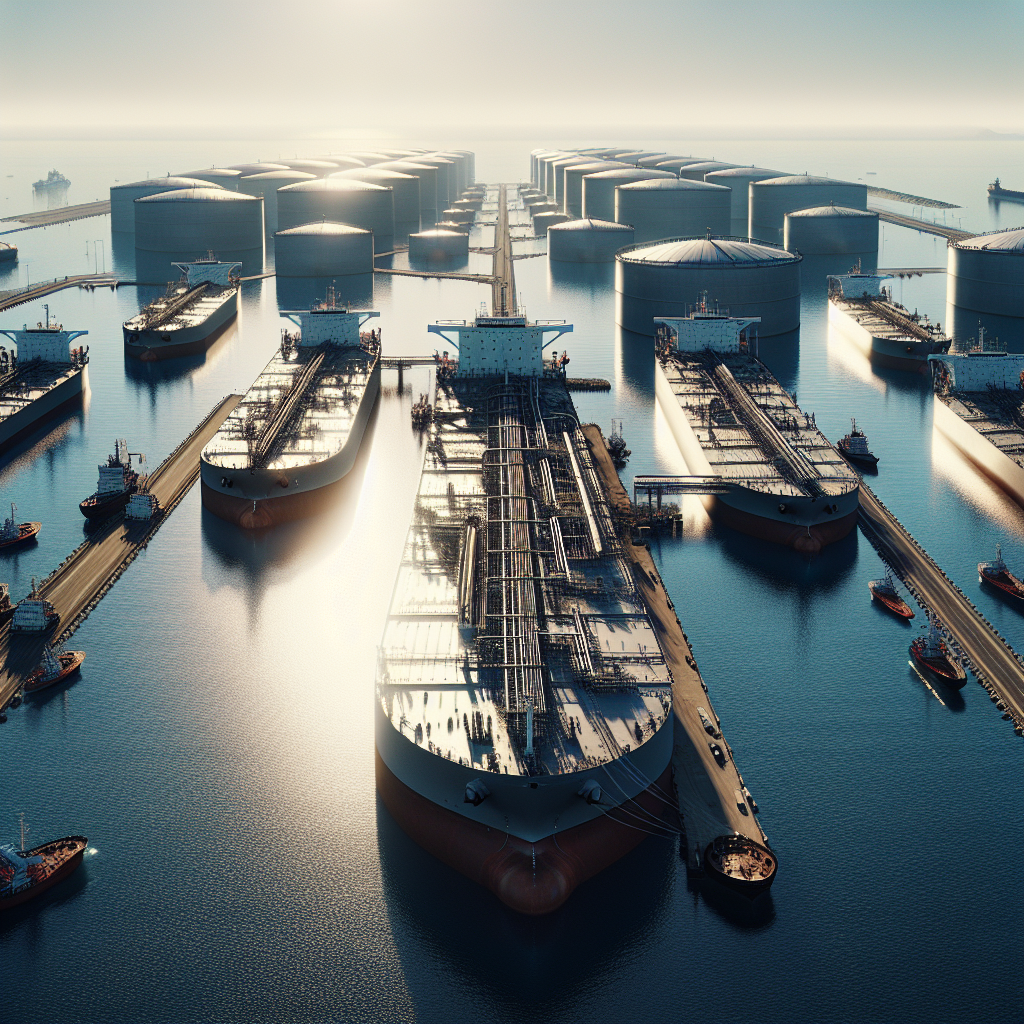
Iran used to export 3.2 million barrels of crude oil per day. However, with the ongoing blockade by the US Navy, the oil tankers carrying this oil remain trapped in Iranian ports, and Iran’s petroleum “storage clock” is ticking as the situation becomes increasingly dire.
The blockade in the Gulf of Oman is part of the US’s pressure strategy and a key component of its global strategy. By blocking Iran’s external sea exports, the US aims to not only cut off Tehran’s monthly revenue of $13 billion but also to force Iran to shut down factories due to the lack of storage space, effectively crippling Iran’s oil industry.
Since the implementation of the blockade by President Trump on April 13, at least 1.5 million barrels of Iranian oil need to be stored daily as they cannot be transported anywhere.
These volumes of crude oil are accumulating. Industry institutions, including the UK-based energy consulting company Energy Aspects, estimate that Iran’s maximum crude oil storage capacity is 122 million barrels. By late April, 68 million barrels had already been filled, leaving only 20-30 million barrels of storage space.
President Trump posted on the Truth Social platform on April 28, stating that this pressure has made Iranian leaders uneasy.
He wrote: “Iran just notified us that they are in a state of ‘collapse.’ As they struggle to sort out the leadership situation, they want us to ‘open the Strait of Hormuz’ as soon as possible.”
The President expressed his belief that Iran will soon agree to his demands, including halting nuclear weapons development, ending support for terrorist organizations, and withdrawing territorial claims and control over the Strait of Hormuz.
Iran will make various concessions due to the “state of collapse.” Calculating when these concessions will emerge, time and space becomes coefficients in a simple mathematical equation. The answer to the time issue is the so-called “storage clock.” It has a key constant: the longer the time, the less the space.
In late April, analysts from Kpler in Brussels and JP Morgan in New York calculated the “storage clock.” They predicted that if Iran cannot transport oil, the country’s oil storage time and space will be exhausted within 15 to 22 days (mid to late May).
“Iran is being pushed into a production shutdown that is driven by its oil storage capacity,” Kpler analyst Homayoun Falakshahi wrote in an analysis report on April 29. “Iran is facing imminent forced production cuts, with storage capacity likely to saturate in 20-24 days, triggering a rapid production decline.”
Energy Aspects predicted in late April that the blockade might take up to seven weeks, meaning Iranian oil companies would only shut down between mid-May and mid-June. Various institutions such as Wood Mackenzie, the Atlantic Council, the Center for Strategic International Studies, and Columbia University’s Center on Global Energy Policy have also provided similar timelines, suggesting that Iran’s oil industry shutdown would occur between mid-May and mid-June.
Some believe that Iran’s oil “storage clock” has already run out. Institutes like ISW and AEI’s Critical Threats Project noted that, as of April 29, Iran’s storage capacity had been exhausted.
FDD estimated that Iran’s oil wells would likely be closed before April 25.
Iran has four oil and gas production areas — Khuzestan fields, West Karoun near the Iraq border, Fars and Bushehr provinces along the Persian Gulf coast, and Persian Gulf oil fields. Kharg Island serves as a central hub for transporting these resources.
While Iran has a robust domestic pipeline network, it can currently only receive oil for refining via cross-border pipelines from Kazakhstan and Turkmenistan, and can export gas through pipelines to Turkey, Iraq, and Armenia.
Despite discussions of using rail transport to China via new corridors, Iran’s expanded capacity for oil exports via rail remains limited by Tehran’s infrastructure.
Unless the US Navy lifts the blockade, Iran will be unable to export oil and gas, putting immense pressure on Tehran. This pressure mirrors the strain Iran has placed on its Gulf neighbors since early March: threatening the Strait of Hormuz, disrupting Gulf trade, and trapping some 20,000 sailors on vessels docked on the Arab side of the Gulf.
The standoff in the Strait of Hormuz has driven up energy costs for the US, with average gasoline prices surpassing $4 per gallon. As the November midterm elections approach, and with the GOP’s slim majority at risk, many analysts believe Iran thinks it can outlast the impatient President Trump.
Iran’s control of the strait not only hampers the region’s exports but has led to production halts due to missile and drone attacks against Arab Gulf states, causing billions in losses and requiring months to restore pre-war levels of production.
On March 18, Iran’s missile strikes destroyed Qatar’s Ras Laffan Industrial City’s Pearl LNG plant, which liquefies natural gas for transport. Qatar’s energy company estimates rebuilding will take up to five years.
According to the UAE Defense Ministry, since the conflict began, the UAE has intercepted 314 ballistic missiles, 1,672 drones, and 15 cruise missiles launched by Iran.
The pressure Iran is exerting in the Strait of Hormuz is exposing rifts in the Persian Gulf region. Some Gulf countries support US actions while others reportedly seek peace agreements with Tehran directly. This friction led to significant developments, notably UAE’s decision to leave OPEC by May 1.
Analysts warn against being overly optimistic about Iran’s willingness to make concessions under the current “countdown narrative.” The risk of long-term damage due to forced shutdowns is real, but outcomes will vary based on specific oil field conditions.
Iran has faced significant challenges in recent years — from sanctions to the COVID-19 pandemic — indicating they may weather the storm before considering concessions with the US.
As tensions escalate, the Gulf faces geopolitical reshuffling that may alter investor confidence and shift resources elsewhere, impacting the region’s economy for years to come.
The conflict has exposed the Persian Gulf states’ vulnerabilities, shattered decades-old illusions of stability, and raised questions about the region’s future. Despite infrastructure repairs being possible, the loss in investor and tourist confidence might prove difficult to regain. As focus shifts to resolving conflicts, the global energy landscape may see significant shifts affecting trade and security.
In conclusion, as Iran’s “storage clock” ticks and pressure mounts, the region faces uncertainty which may have lasting implications on the energy sector and regional geopolitics.