
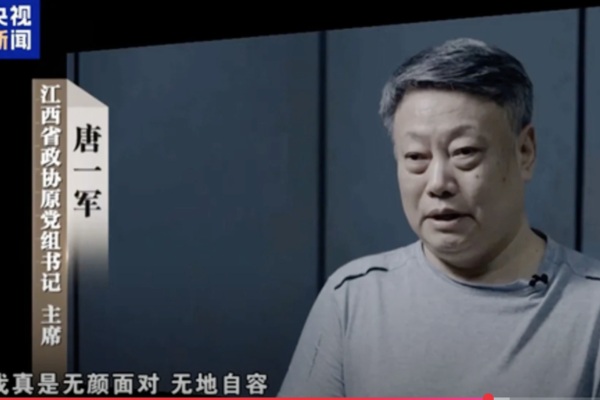
The Chinese Communist Party (CCP) has once again aired confessions on China Central Television (CCTV) to expose the corrupt practices of officials, including Cui Maohu and Tang Yijun, with the latter expressing deep shame. According to Hong Kong media, the public is experiencing fatigue from witnessing these confessions, with some sarcastically referring to these individuals as “actors”. The CCP’s top leader recently acknowledged that “the existing problem of corruption has not been fully eradicated, and new cases continue to emerge”, which is interpreted as an admission of the failure of the anti-corruption campaign.
Cui Maohu, former Deputy Minister of the United Front Work Department of the CCP Central Committee and former Director of the State Administration for Religious Affairs, was sentenced to 11 years in prison last July for bribery by a Shenyang court in Liaoning Province. A recent documentary aired on CCTV focused on Cui Maohu as the first official to confess. CCTV claimed that during his tenure as the Party Secretary of Lijiang City, Cui Maohu was addicted to gambling, with taxi drivers testifying that he neglected his duties to play cards every day. A businessman even provided him with a luxurious suite at a hotel in Shangri-La solely for his gambling activities. After being promoted to Vice Governor of Yunnan, another businessman rented a villa in Kunming for Cui Maohu to continue his gambling activities. Cui Maohu abused his authority to help businessmen secure contracts and interfere in personnel matters, while accepting bribes.
Also featured in the documentary is Tang Yijun, former Governor of Liaoning and former Minister of Justice of the CCP, who controlled 34 companies through investments made by his wife Xuan Minjie, engaging in corrupt practices and accumulating wealth. Tang Yijun claimed in the documentary: “I am ashamed and have no place to hide.”
The documentary pointed out a rise in new types of corruption and hidden corruption within the CCP in recent years, with Tang Yijun and his wife epitomizing this through their involvement in corrupt practices behind seemingly legitimate market behaviors. Tang Yijun’s wife controlled 34 companies through investments, receiving bribes disguised as proceeds from stock market listings and other market-related activities, all under the guise of legitimate market practices while engaging in corrupt exchanges of power and money.
Columnist Gao Xin, from Radio Free Asia, has investigated the crucial role played by Zhao Leji, a member of the CCP Politburo Standing Committee and Secretary of the Central Commission for Discipline Inspection, in promoting Tang Yijun to the position of Minister of Justice.
Former CCP Discipline Inspection Commission writer Wang Youqun once stated in an article for Dajiyuan that after studying Zhao Leji’s career path, it was evident that he was a seriously corrupt individual. Wang questioned whether promoting Tang Yijun, known to be corrupt, was a decision made by another corrupt official like Zhao.
Following the recent Central Commission for Discipline Inspection conference, there was no mention of an “overwhelming victory” in the official statements. Xi Jinping, the top leader of the CCP, emphasized that the struggle against corruption remains severe and complex. He warned that “the existing problem of corruption has not been fully eradicated, and new cases continue to emerge”, cautioning against any hesitation, wavering, or giving up, as it could lead to serious mistakes with subversive consequences.
In response to the CCP’s ongoing practice of airing confessions from officials who have fallen from grace, Hong Kong’s pro-Beijing newspaper, Sing Tao Daily, cynically remarked on January 8th that the public is growing weary of these confessions, leading to diminishing returns in terms of public support.
The article highlighted how recent CCTV broadcasts featuring confessions by former Justice Minister Tang Yijun and former Guizhou Provincial Party Secretary Sun Zhigang have failed to garner the same level of public interest as before, with some observers dismissing them as mere “actors”.
In 2024, a record number of 58 higher-ranking officials under central oversight (mostly at the provincial and ministerial levels) were investigated, surpassing previous years. Notably, numerous members of the Central Committee have been investigated and removed from office in recent years. Despite official claims that the selection criteria for the new Central Committee elected at the 20th CCP National Congress focused on strict political and ethical standards, questions persist regarding why so many members have been implicated in corruption scandals, including prominent figures like Qin Gang, Li Shangfu, and Miao Hua.
The persistent cases of corruption being exposed and the increasing number of new instances suggest that the CCP’s anti-corruption efforts have not been entirely successful, raising concerns about the worsening corruption trends and the potential for destabilizing implications if left unaddressed.