
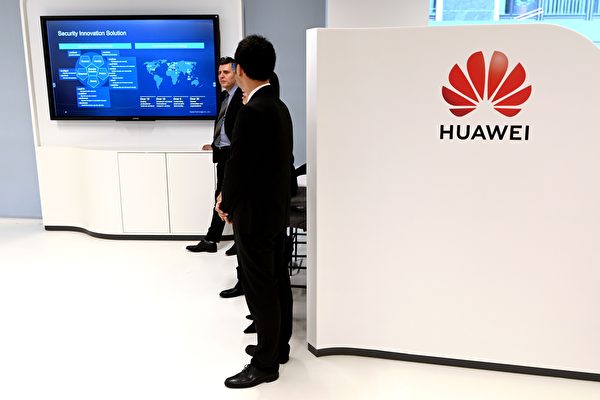
In recent years, Western countries have been exploring the risks of Chinese Communist technology security, including backdoors, espionage activities, and data leaks, but have generally overlooked a more insidious aspect: signing telecom contracts with companies under Chinese Communist control is essentially beginning to fall into the trap of becoming a satellite country of Chinese Communist technology.
President Anatoly Motkin of the StrategEast Center in the analysis article in The Washington Post analogized the Chinese Communist operation as “Silicon Curtain,” akin to the term “Iron Curtain” during the Cold War era.
Unlike the “Iron Curtain,” the “Silicon Curtain” does not have clear geographical boundaries but is defined by procurement decisions, which include signing contracts with suppliers to build the country’s 5G networks, hosting government data platforms, and financing loans for digital infrastructure.
Last year, European police raided over 20 locations across Europe and sealed off two offices within the European Parliament because Huawei, under Chinese Communist control, was suspected of bribing lawmakers with football match tickets, luxury travels, and huge amounts of cash to support using Huawei’s 5G network. This incident revealed that the Chinese Communist Party is willing to use any means to control global digital infrastructure.
The article points out that the Chinese Communist “Silicon Curtain,” like the Iron Curtain during the Cold War era, is characterized by transparent governance, open standards, and competitive markets on one side, and state control, surveillance systems, opaque financing, and systemic exploitation of corruption on the other. Fortunately, unlike the Iron Curtain, today, every country can freely choose a side.
The article analyzes the specific operation of the Chinese Communist Silicon Curtain. After using Chinese Communist-owned equipment, replacements require removing the entire network, which the U.S. government has painfully experienced in the past.
Removing Huawei and ZTE equipment from networks operated by some rural carriers in the U.S. cost nearly $5 billion. Moreover, for underdeveloped countries that are completely reliant on Chinese equipment, complete equipment replacement is even more challenging.
Meanwhile, even if unable to continue using Chinese networks, achieving independence in local technology is impossible without any cheap deals from China. Chinese agreements are structured with hegemonic terms and clauses; local staff only receive equipment user training rather than engineering training. As a result, infrastructure maintenance solely relies on China, and local staff cannot intervene.
Apart from technological dependence, there is also financial dependence. Many countries shoulder huge debts due to reliance on Chinese funds, and these debts are not publicly disclosed. The high loan interest rates from the Chinese government make even substantial hardware discounts insignificant.
For instance, Nicaragua used Chinese funds to purchase Chinese facilities but had to pay a 50% loan interest and commission. Assuming the project costs $10 billion, this cost would accumulate to $2 billion to $4 billion after 20 years.
In 2020, when Zambia defaulted on its debt, the exposure to Chinese debt was more than double the officially disclosed figures, as secretive terms prevented the government from disclosing specific debt amounts.
In contrast, countries that have achieved significant economic success by restricting and resisting Chinese technological hegemony are abundant. For instance, after excluding Chinese suppliers from 5G projects in 2021, India quickly attracted a large influx of Western semiconductor investments. Vietnam seeks trade diversification to break free from reliance on China and establish a $100 billion technology export industry. Rwanda, having attracted investments from Western, African, and Arab nations, achieved a 19% growth in the tech industry in the first quarter of last year.
The diverse experiences of these countries demonstrate that choosing China when building digital infrastructure will only lead to falling into the trap of Chinese control, ultimately a dead end. By staying away from China, not only is the infrastructure safe and secure but the future is also entirely in their own hands.