
Since 2019, some eligible individuals in New York City have been able to benefit from the “Fair Fare” policy, which allows citizens with incomes below 150% of the poverty line to ride public transportation at a discounted rate. However, due to the cumbersome application process and other reasons, only 40% of eligible individuals in New York City currently apply for this discounted fare. Therefore, city council members recently proposed legislation to require relevant government departments to automatically register citizens for the discounted fare card.
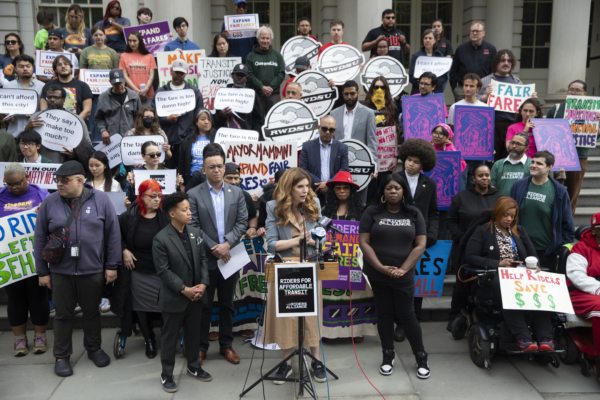
On Wednesday (May 6), prior to a hearing at the City Council on a series of proposals to provide discounted public transit tickets for low-income residents, City Council Speaker Manning and Council Member Hudson, who introduced the “Automatic Registration for Fair Fare” bill (Intro. 0248), gathered outside City Hall to rally support for these proposals.
“Since 2019, the ‘Fair Fare’ program has been a lifeline for low-income New Yorkers, helping hundreds of thousands of residents afford public transportation costs,” Council Member Hudson stated at the rally. “But we must also acknowledge that currently only about one-third of eligible New Yorkers have enrolled in the program… My proposal aims to establish an ‘automatic registration’ mechanism to truly maximize the effectiveness of the ‘Fair Fare’ program; we want to ensure that the program reaches its originally intended coverage scale.”
According to a city council report, there are one million New York City residents eligible for discounted tickets, but only 380,000 have applied for this benefit. Others may have abandoned the registration process due to its complexity or may simply be unaware of the program’s existence.
On May 6, the City Council also discussed proposals including one by Council Member Marte to issue retroactive transportation benefit cards, one by Brooks-Powers to raise the income eligibility threshold for “Fair Fare” to 200% of the poverty line, allowing qualified residents to enjoy a 50% discount when using the Long Island Rail Road (LIRR), New York City Transit, and Metro-North Railroad, and a resolution proposed by Council Member Riley to establish an unlimited transfer mechanism within two hours of paying the fare for pay-per-ride passengers on the Metropolitan Transportation Authority (MTA) subway or bus.
The efforts to expand the “Fair Fare” program come as Mayor Mamdani actively advocates for “free buses.” Compared to the idea of “all free,” stakeholders at the hearing expressed greater support for the “Fair Fare” proposal.
A report released by the non-profit organization Citizens Budget Commission (CBC) indicated that implementing a “free MTA bus” program would require at least $900 million annually. However, expanding the “Fair Fare” policy, such as the new proposal introduced by the City Council a month ago, which would provide free rides on the subway and buses for all eligible low-income residents, would only require $2.21 billion annually.
CBC’s analysis of MTA data revealed that implementing a free bus policy would not effectively reduce transportation costs for the majority of passengers, as 76% of daily commuting trips occur on the subway system. Additionally, 12% of bus passengers still need to transfer to the subway, for which they would still have to pay the subway fare.
According to economists at the Community Service Society, currently one in five New Yorkers cannot afford the subway or bus fare, and this proportion rises to over one-third among low-income working mothers. On average, bus passengers have incomes more than 20% lower than subway passengers.