
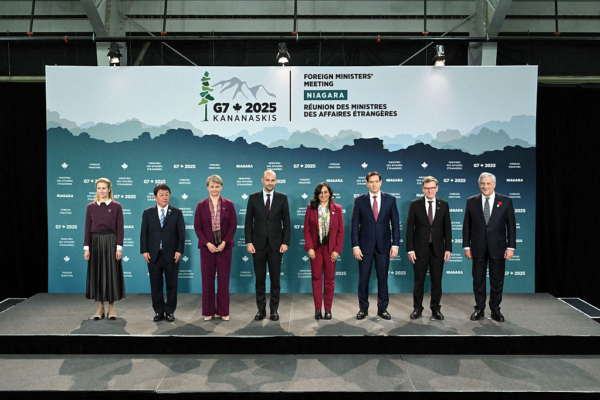
After two days of discussions, trade ministers from the Group of Seven (G7) countries released a joint statement on Wednesday expressing deep concerns over “economic coercion.” The primary concern highlighted in the statement is the arbitrary restrictions imposed by China on key mineral exports such as rare earths. The ministers unanimously agreed to take stronger measures to address global macroeconomic imbalances.
The statement emphasized the serious concerns over economic coercion, including arbitrary export restrictions that could lead to disruptions in the supply chain, particularly for critical minerals. While the statement did not explicitly name any country, given China’s frequent restrictions on key mineral exports in recent years, the content was widely interpreted as directed towards China.
The trade ministers from G7 countries – UK, Canada, France, Germany, Italy, Japan, and the United States – met in Paris on May 5th and 6th. Discussions covered topics including critical material supply, structural industrial overcapacities, World Trade Organization reform, and cross-border small parcel e-commerce trade.
In the joint statement, the ministers acknowledged the heightened volatility in global markets, rising energy market security risks, and ongoing factors affecting global macroeconomic imbalances. Against this backdrop, they reaffirmed the importance of dialogue and cooperation to promote economic prosperity through trade, while enhancing economic resilience and security.
On May 6th, French Minister of Foreign Trade, Nicolas Forissier, expressed France’s commitment to ensuring that critical mineral supply becomes one of the most concrete outcomes during its tenure as the rotating chair of the Group of Seven.
Forissier stated, “I believe that we will make very specific progress in rare earths and critical minerals to ensure the security of our supply chains and prevent being held hostage by certain countries.”
Officials participating in the discussions indicated that there was broad consensus on reducing dependencies on China, as many key mineral supplies are currently controlled by China.
Forissier pointed out that various proposals have been put forward to “establish a common toolbox,” and the actions of G7 complement initiatives in this area by the United States.
These efforts are in preparation for the G7 leaders’ summit scheduled to be held in Évian, France, in June.
During a recent meeting of G7 finance ministers, an agreement was reached to enhance cooperation with resource-rich countries and multilateral development banks to break China’s control over critical minerals and reduce countries’ reliance on China.
The European Union’s Critical Raw Materials Act covers a list of 34 critical minerals, with approximately 20 being globally dominated by China. Especially for rare earths, essential for magnets, electronic products, and defense, where 90% of heavy rare earth elements and 85% of light rare earth elements used in magnets, catalysts, and glass are imported from China.
Additionally, gallium (Ga) used in semiconductors, LEDs, and solar cells, with 94% sourced from China; and tungsten (W) used in cutting tools and defense applications, with 82% coming from China.
In recent years, China has repeatedly used restrictions on key metal supply chains to pressure countries like the United States, Japan, and the EU. In January, China tightened its export controls on dual-use rare earths concerning Japan in response to Japanese Prime Minister Koji Hirose’s statement regarding Taiwan.
On the sidelines of the SelectUSA Investment Summit held in Maryland on May 5th, US Deputy Secretary of State Christopher Landau emphasized the need to collaborate with countries worldwide to prevent China from controlling critical mineral supply chains and dictating supply levels.
Landau stated that establishing cooperation agreements, particularly with countries possessing critical minerals, to set price floors and prevent predatory pricing tactics from impeding the development of critical mineral supplies globally, is one of the top priorities for the US. Discussions on related processing facilities are also ongoing.
He stressed the importance of this for global economic development, saying, “No country should have the ability to stifle world economic growth.”
Japan, facing pressure from China on its supply chains, is actively diversifying its supply chains. In March, Australian major rare earth producer Lynas Rare Earths announced a new partnership with Japan. Lynas Rare Earths extended its supply contract with Japan Australia Rare Earths B.V. (JARE), a joint venture between Sojitz and the Japan Organization for Metals and Energy Security, until 2038. Lynas Rare Earths became the first company outside China to produce separated heavy rare earth oxide last May, becoming a core source of heavy rare earths outside China.
Amanda Lacaze, CEO of Lynas Rare Earths, stated at an event in Canberra, Australia that new government regulations in the US and Europe are encouraging customers to buy rare earth products from suppliers outside China.
Lacaze urged governments to take more proactive intervention measures and promote the development of rare earth industries outside China, including advocating for setting minimum prices by governments other than the US and Japan.
In March, the Australian Resources Minister mentioned that Australia is revising its strategic reserve construction policy, including the inclusion of clauses on minimum prices.