
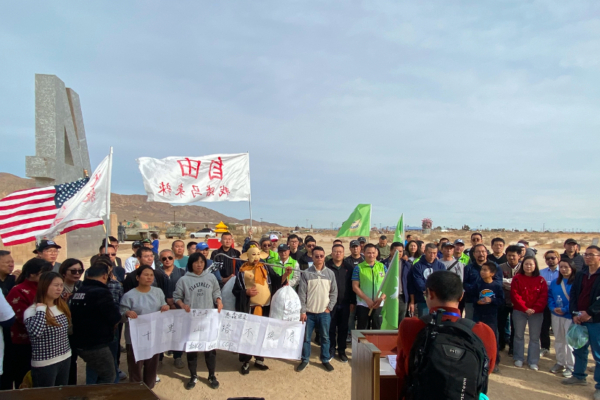
On the last weekend of 2024, the Chinese community in Southern California held multiple gatherings and marches for two consecutive days, exposing the atrocities committed by the Chinese Communist Party (CCP) in persecuting dissidents and ordinary citizens in prisons and mental hospitals. The events also showcased the determination of the Chinese people to pursue freedom and human rights.
Last Saturday, hundreds of Chinese individuals gathered at the Liberty Sculpture Park for the “2024 Annual Meeting and the Inauguration of a New Sculpture,” showing support for overseas democracy activist Wang Bingzhang who is currently imprisoned. Speakers at the event included veteran founder of the China Democratic Party Zhu Yufu, former staff officer of the Chinese Communist Navy Headquarters Yao Cheng, among others.
At the same time, Chinese residents from various parts of California marched in front of the Chinese consulate in Los Angeles, condemning the CCP’s human rights violations. In the afternoon, the China Democratic Party held a protest rally on the Hollywood Walk of Fame, echoing global efforts to support the rescue of Wang Bingzhang.
In front of the “Liberty Bell” sculpture at the Liberty Sculpture Park, the park’s founder and sculptor Chen Weiming shared his ideals and plans during his speech.
“Freedom and democracy are not just spiritual assets of the West but also of the Chinese people,” he said. He emphasized that a free society based on the separation of powers is the wealth of all humanity. He plans to erect a “Freedom Torch” sculpture in the park in 2025 and, in the near future, a 89.64-meter-tall statue of the Goddess of Democracy.
Chen Weiming believes that with the efforts of many like-minded individuals, the day when China achieves democracy and freedom will come soon, just like in Syria.
The event’s host, former senior high school teacher from Chongqing, Zhou Yunlong, emphasized that the Sculpture Park is a base to resist the CCP’s dictatorship and a common home for all those opposing the regime. He stated, “Each sculpture in the park stands as a tangible protest against the CCP and a silent call to anti-Communist activists.”
During the two days of Saturday and Sunday, the Vice Chairman of the China Democratic Party Headquarters, Jie Lijian, organized two consecutive protest rallies in front of the Chinese consulate in Los Angeles. Participants performed street dramas, denouncing the CCP’s ruthless persecution of dissidents and ordinary citizens: authorities now frequently use mental hospitals under the guise of “treating illnesses” to carry out barbaric torture and even killings.
Protesters displayed banners in support of “Ink-Splashing Girl” Dong Yaoqiong, Associate Professor at Nankai University Wu Yanan, and Li Yixue from Nanchang, Jiangxi, who were “mentally ill” twice. Dong Yaoqiong’s father was beaten to death in prison, Wu Yanan was forcibly sent to a mental hospital after supporting students in the “Blank Paper Movement,” and her life status remains unknown. According to online sources, Li Yixue had part of her frontal lobe removed, and her parents were also arrested.
Julie from Kaifeng, Henan, narrated at the gathering that a young woman in her twenties, Ye Tingting, from her hometown was beaten to death after her father had a dispute with village officials. When she complained on social media, the police took her away and sent her to a mental hospital. “The police coerced her into confessing, threatened her with a five-year sentence, and when she refused, she was persecuted as mentally ill,” she said. “These events are not far from us.”
Before leaving the country, protest organizer Jie Lijian was forcibly admitted to a mental hospital by the authorities, where he endured electroshock therapy, beatings, forced medication, and other forms of physical and psychological abuse. He pointed out that whether it was the Kangning Hospital in Shenzhen or the Fangcun Mental Hospital in Guangzhou, they were concentration camps for forced organ harvesting.
He witnessed in Kangning Hospital a young man from Guangdong in his twenties being brought in for the third time, with clear surgical scars on his back. The young man told him that one time he was taken out, and upon waking up, he found himself under a bridge in Dongguan. When he was found and brought to the hospital for treatment, the nurse asked him, “Do you know your organs are gone?” and he had no idea. The young man later disappeared without a trace.
Tang Shasha from Huizhou, Guangdong, expressed in an interview: “As a government that should speak for the people and serve the people, the CCP does the opposite… it actively oppresses the people. It is a very evil organization without ethics and boundaries.”
This article has been rewritten and translated into English to provide a detailed account of the events that took place, shedding light on the struggles faced by Chinese dissidents and ordinary citizens in their fight for freedom and human rights.