
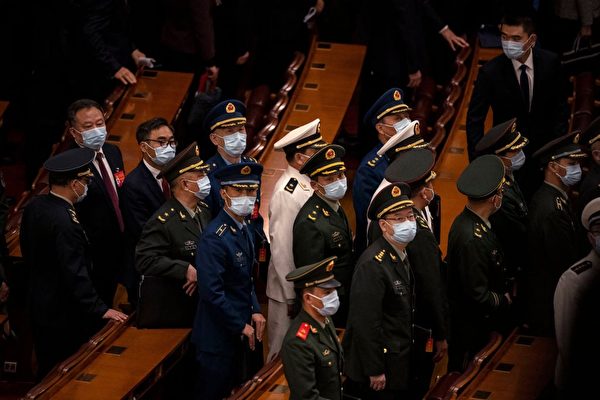
After the Third Plenum in July, signs emerged indicating significant changes in the morale of the Chinese Communist Party (CCP) military due to ongoing purges. It was revealed by scholars that within the CCP, there were internal reports of two incidents of gun violence during investigations within the military, with one person committing suicide afterwards.
In late October, the CCP’s Central Commission for Discipline Inspection and the Military Discipline Inspection Commission jointly issued a document titled “Notice on New Dynamics in the Review Process of Cadres.” This notice involved two cases, as disclosed by legal scholar Yuan Hongbing who has connections within the CCP system.
Yuan mentioned, “In late August 2024, in the Central Theater Command, a Colonel named Liu who was in charge of logistics, used his service pistol to shoot and kill two investigators from the disciplinary commission before taking his own life. In early September, a Navy Colonel in the Southern Theater Command, responsible for equipment management, also used his pistol to shoot and kill four investigators before being shot dead by security guards.”
The official report within the CCP highlighted these incidents, urging investigators to be vigilant and prepared for dangerous situations, even recommending wearing bulletproof vests during investigations which would be provided by the disciplinary commissions.
Yuan pointed out that this report caused quite a stir in the Beijing political scene, as the trend of officials committing suicide may escalate to resisting investigations by resorting to gun violence.
He further stated that animosity towards Xi Jinping among CCP officials has reached a point of hatred. Rather than reflecting on their own corruption, some officials exhibit a rebellious mentality, questioning why they are being investigated instead of focusing on the misconduct of their superiors.
Yuan suggested that this wave of resistance is spreading among party, government, and military officials, especially after the recent military purge.
The mention of the rise in armed resistance among officials is quite shocking, as historically CCP officials tended to resort to suicide under pressure, whereas this shift towards defiance is a new development.
Over the past year, there has been comprehensive scrutiny and purging within the CCP, targeting high-ranking officials across various military sectors. On November 28, Miao Hua, director of the Political Work Department of the Central Military Commission, was investigated, alongside allegations involving Wang HouBin, Commander of the Rocket Force, and Dong Jun, Minister of National Defense.
Yuan also mentioned recent rumors circulating in Beijing regarding Liu Yuan, son of former CCP President Liu Shaoqi and a retired general, submitting a petition to the party central committee expressing grievances. According to sources from conscience-driven insiders, Liu Yuan’s petition was revealed by the “Seeing China” website, outlining concerns about the unstable political climate threatening the CCP’s grip on power under the current wave of purges.
Recently, there were reports of Yu Jianhua, former head of the General Administration of Customs, reportedly committing suicide by gunshot in his office on the night of December 10 after being summoned by the discipline commission the day before. However, the official announcement from the customs administration stated that Yu died suddenly from an illness, leaving the true cause of death a mystery.
Yuan brought to light a new form of corruption in the CCP circles involving the extensive use of cryptocurrency through “cold wallets” for illicit transactions. “Cold wallets” refer to encrypted cryptocurrency wallets stored offline.
He mentioned that officials at county level and below in the military still tend to engage in traditional forms of bribery, while those at higher ranks have started using “cold wallets” for easier transportation of illicit funds, often leading to foreign accounts. The Navy Colonel in the Southern Theater Command mentioned earlier reportedly utilized a “cold wallet” to move funds overseas through his mistress in advance, enabling him to take extreme measures without fear of repercussions.
In 2022, an article published in “Theory and Reform,” a magazine organized by the Sichuan Provincial Party School of the CCP, pointed out that novel forms of corruption within the party posses evasion capabilities against existing anti-corruption measures. Today, corrupt individuals leverage innovative financial products such as bonds, shadow banking, IPOs, internet finance, off-balance sheet activities, structured products, credit marketing innovations, etc., to avoid detection. Furthermore, the utilization of cryptocurrency for corrupt transactions or money laundering through decentralized financial agreements is becoming a prevalent practice within the CCP circles.