
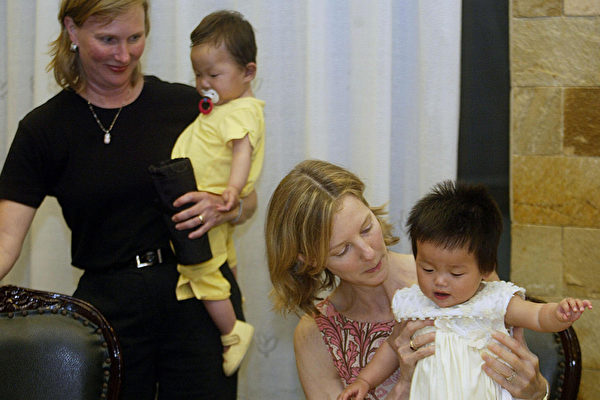
Beijing announced the termination of most foreign adoption of Chinese children, which will leave hundreds of foreign families’ adoption applications in limbo. The Chinese Ministry of Foreign Affairs declared on Thursday (September 5) that Chinese children will no longer be sent abroad for adoption, with the only exception being for foreign individuals adopting children who are relatives within three generations or siblings. This means only foreign individuals of Chinese descent have the possibility of adopting Chinese children.
This ban has brought uncertainty to hundreds of American families currently in the process of adopting Chinese children. Since the early 1990s, China has sent tens of thousands of abandoned children overseas, with approximately half of them reaching the United States. Additionally, China is the largest source of internationally adopted children for Americans.
According to the Associated Press, the US Department of State stated on Thursday that the US Embassy in Beijing is seeking clarification on the new directive from the Chinese Ministry of Civil Affairs in written form.
During phone conversations with American diplomats in China, Chinese officials reportedly mentioned that apart from cases covered by the exemption clause, they “will not further process any stage of the cases.”
The US State Department stated, “We are aware that there are still hundreds of families who have not completed their adoptions, and we sympathize with their situation.”
Since 1979, China has implemented the strict “one-child policy” to control birth rates. This policy has led to a large number of abandoned female infants and disabled children being placed in orphanages.
At the same time, China began engaging in international adoptions and in 1988, relaxed policies related to international adoptions, allowing Chinese-descended individuals, foreign nationals with close connections to China, or long-term residents in China to adopt Chinese children.
The 1992 implementation of the Chinese adoption law further loosened restrictions, allowing foreigners to adopt children in China according to the law. International adoptions gradually expanded during this period, with the number of such adoptions increasing substantially each year.
According to the organization Children of China International, since 1992, over 160,000 Chinese children have been adopted by families around the world, with approximately half being adopted by Americans.
Based on data from the US Department of State, from 1999 to 2023, American parents adopted 82,674 children from China, accounting for 29% of the total number of overseas adoptions by Americans.
Kay Johnson, a professor of Asian studies at Hampshire College, in her 2016 book “China’s Hidden Children,” wrote, “Coercion by the (Chinese) government is at the core of China’s international adoption program.”
Johnson passed away in 2019. Her family was one of the first to adopt Chinese children, and she also interviewed hundreds of biological parents who abandoned their children, many of whom stated they relinquished their own flesh and blood to escape punishment from Chinese family planning officials.
Most of the adoptions of abandoned Chinese children were processed through the US Consulate in Guangzhou, a southern city in China. Before 2013, the consulate was located on Shamian Island, and the nearby White Swan Hotel unexpectedly became a transit station for adoptive families.
Mainland media reports mentioned that there were often sounds of babies crying in the hallways of the hotel, and it was easy to spot many foreign couples pushing strollers with Chinese babies who had black hair and yellow skin. Even many shops around the hotel began to sell baby clothing due to the increase in business from adoption families.
The peak of such adoptions was in 2005 when over 7,900 Chinese children were adopted by American families.
However, the costs for foreigners adopting abandoned Chinese children were not insignificant. A mainland media report in 2003 stated that the cost of adopting a Chinese child was approximately between $15,000 to $30,000.
Nevertheless, according to a notice issued by the US Department of State at the time, Beijing had temporarily suspended international adoptions during the pandemic in 2020.
On May 28, 2020, the Chinese government issued a new adoption policy to be implemented from January 1, 2021, further regulating and restricting adoptions by foreigners.
In 2021 or 2022, no Chinese children were sent to the US for adoption. According to the US Department of State, in 2023, only 16 children were adopted from China.
Videos and posts of Chinese children adopted by American families and living happily in the US often go viral on social media. For instance, an article titled “100,000 abandoned Chinese babies grow up in the US” featured heartwarming stories of Chinese children adopted by Americans being well-cared for after adoption.
The article mentioned that when American families adopt Chinese orphaned children, they typically seek help from intermediary agencies to handle the application, document preparation, home investigations, liaising with the Beijing government, among other tedious tasks. On average, American adoptive families spend $30,000 to $40,000, which includes expenses for children with disabilities or illnesses, with an average waiting time for adoption of two years.
After adopting these children, American families not only care for the children themselves but also ensure they receive medical treatment.
So why are ordinary American families willing to adopt abandoned Chinese children? An article on the US State Department’s social media platform ShareAmerica on July 18 stated, “The process of American families adopting foreign children is not simple, requiring a series of complex procedures. Besides often having to wait for years, adoption costs can be tens of thousands of dollars. Without patience, confidence, and love, it’s hard to imagine so many families willing to cross borders to adopt children. This might be what people often refer to as ‘true love exists in the world.'”
Another article published on ShareAmerica in 2018 stated that among the 78,000 adopted Chinese children, 86% were girls, compared to 61.3% for all foreign children adopted. In terms of age, half of the adopted Chinese children were 1 to 2 years old, accounting for 50%, with those under 1 year old making up 33%.
The article highlighted the story of a couple from Minnesota, the Watsons, who sold their house to adopt a Chinese child with Down syndrome, a journey that took five years to fulfill.
“American families have adopted 78,000 Chinese children. The lives of these children in American families have not only changed their own lives but also impacted the adopting families, their communities, and schools. By adopting Chinese children, more Americans have further understood China. Through these children, Chinese elements have integrated into American families and communities. These tens of thousands of adoptive families and Chinese children serve as grassroots ambassadors promoting cultural exchange, understanding, and friendship between the US and China,” the article stated.
In an effort to curb declining birth rates, the Chinese government announced in 2015 that married couples could have two children. However, after a brief increase in 2016, the national birth rate continued to decline.
In 2021, Beijing further relaxed birth restrictions, allowing for up to three children and providing greater incentives to encourage larger families, including extended maternity leave, tax breaks, and other benefits for families.
However, against the backdrop of high costs of living and education, as well as looming economic uncertainties, ordinary Chinese families remain unwilling to increase the number of children they have, and these policies have yet to show significant effects.
In the past, American adoptions of foreign orphans have been influenced by various external factors. For instance, in 2013, Russia banned Americans from adopting children for political reasons, leading to almost no American families adopting Russian children thereafter. Similarly, the Guatemalan government significantly tightened international family adoption policies in 2007 in the name of anti-corruption, resulting in a sharp decline in the number of American families adopting Guatemalan children.