
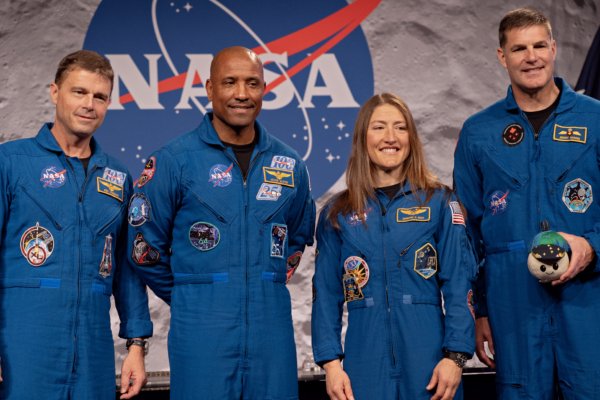
On Thursday, April 16, the four astronauts of the completed lunar mission “Artemis II” shared their overall experience of the mission at a public press conference. They answered various questions from the public, including the occurrence of some carbonization on the heat shield of the Orion spacecraft during its return to Earth.
Last Friday, April 10, the four astronauts of Artemis II safely splashed down in the Pacific Ocean, concluding a nearly 10-day test flight mission. During this journey, they rode the jelly-like-shaped Orion spacecraft around the far side of the moon, setting a record for the farthest human journey into space.
The four astronauts include Commander Reid Wiseman, the first African-American astronaut to participate in deep space flight Victor Glover, the first female astronaut to orbit the moon Christina Koch, and the first non-American citizen to fly to the moon Canadian astronaut Jeremy Hansen.
Artemis II Commander Reid Wiseman expressed at the first press conference after returning to Earth, “This has been such an incredible journey. Thank you to my three companions for supporting me along the way. Everyone in the team has been supporting each other throughout the entire process.”
Subsequently, they fielded questions from the public and the media. Reporter Will Robinson-Smith from “Spaceflight Now” asked Wiseman about the reason behind naming the Orion spacecraft as “Integrity.”
Wiseman replied that they had discussions about integrity and shared a quote they learned from an outdoor school coach: “Integrity isn’t a one or zero, it’s not a matter of whether you have it or not. You can be in a state of ‘integrity,’ or you may be in a state of ‘losing integrity.'”
In a light-hearted tone, Wiseman added, “I must admit, sometimes during the mission, I might have lost a bit of ‘integrity’ because the beauty of the scenery or the human experience would distract me from work. Witnessing everything with my own eyes was just too wonderful.”
He continued, “We named the spacecraft ‘Integrity,’ and it felt like a thread connecting the four of us. If someone gets distracted, there’s always someone else to pull you back, and that feeling is truly amazing.”
Kristin Fisher, a podcast host focusing on space, asked, “When Apollo 14 astronaut Edgar Mitchell returned from the moon, he had a profound experience and devoted the rest of his life to studying the essence of human consciousness.”
She inquired, “Did any of you feel that ‘cosmic connection’ or undergo a transformation in consciousness to some extent?”
Wiseman responded, “I’m not a devout religious person, but when I asked a Navy chaplain to visit us (someone I’ve never met before) and saw the cross on his collar, I immediately burst into tears. It means that we find it very hard to completely understand what we’ve just experienced.”
He added, “When the sun underwent a lunar eclipse, I turned to Victor and said, ‘I don’t think humans can understand what we’re seeing right now.’ It was all so marvelous and otherworldly.”
Glover then added, “The only thing I want to add is that it was a beautiful thing, a very special moment. I am a person of faith, and like everyone else, I truly felt that there was something indescribable in the universe. Perhaps next week after I’ve had time to reflect, I might tell you more.”
Reporter Keith Garvin from Houston’s KPRC 2 asked, “In your most amazing or unforgettable experience, what is something that cannot be adequately conveyed through photos and videos?”
Hansen replied, “I would also like to answer Kristin’s question, I believe the two are related, but I haven’t found the right words to describe it all. All I can say is, when we looked out the window, we experienced the ‘depth’ of the galaxy. It was something I had never experienced before, as if you could see their exact positions in three-dimensional space with the naked eye.”
Hansen added, “At that moment, we were awestruck, feeling so small. I felt a sense of vulnerability and infinitesimal smallness. Although we were tiny and powerless, when we were united, it felt empowering.”
CBC News reporter Sarah Leavitt asked, “Hansen mentioned gratitude, joy, and love in his post-splashdown remarks. I’m curious, as the only four people to have seen the far side of the moon with your own eyes in half a century, have you had any other insights after viewing Earth and the moon from that perspective?”
Hansen responded, “While we may not always maintain integrity, our nature is good, we are willing to treat each other kindly. The little things we saw upon our return not only brought me joy but also filled me with hope for the future.”
When asked if they felt any changes when the spacecraft re-entered Earth’s atmosphere at approximately 32 times the speed of sound (32 Mach), Wiseman replied, “We were coming in at an extremely high speed, and the temperature was very high.” Glover added, “The instruments showed us reaching up to 38.89 Mach (equivalent to 29,839 miles per hour) at one point.” He also mentioned that measuring speed in space is quite challenging, and NASA would likely release new official figures after analyzing the data.
Wiseman noted that during re-entry into the atmosphere, he and Glover “probably saw two minor instances of carbonization peeling off.” When they inspected the recently salvaged spacecraft on the Navy recovery ship, Wiseman mentioned seeing “a little trace of carbonization loss on the edge of the heat shield (part commonly referred to as the shoulder).”
Additionally, from the post-return photos of Artemis II, unusual white patches were observed on the edge of the heat shield.
In response, NASA Administrator Jared Isaacman emphasized that this was similar to the conditions observed during high-temperature testing on the ground. On April 13, during an interview with Reuters, he stated, “There was no block-level loss. The heat shield performed as expected, and now we have finally nailed this down.”
In the coming months, NASA engineers will analyze a vast amount of data to understand the actual performance of the Orion spacecraft.
They will pay particular attention to the spacecraft’s heat shield, a critical protective layer that must shield astronauts from temperatures as high as 5,000 degrees Fahrenheit (2,760 degrees Celsius) during the descent from space. NASA plans to use the same spacecraft next year for another test flight in Earth’s orbit before lunar landing.
During the unmanned Artemis I mission in 2022, the heat shield of the Orion spacecraft suffered damage far beyond NASA’s expectations, showing minor cracks and even burns and peeling on the outer layer during re-entry into the atmosphere, leading to a two-year thorough investigation.
However, this time NASA did not upgrade the heat shield but changed the angle and trajectory of Artemis II to enter Earth’s atmosphere, thereby reducing the impact of high temperatures.
After the atmospheric drag decelerated the spacecraft, the first set of guidance parachutes opened upon entering the lower atmosphere to further reduce speed. Subsequently, the first set of parachutes detached, and the main landing parachute took over, allowing the spacecraft to gently touch the sea at a moderate speed of 17 miles per hour.
Glover recalled the feeling when the first set of parachutes cut away, “We were back in a free fall state. I’ve never done a static line or a HALO jump, but if you’ve ever turned your back and jumped off a skyscraper, that was probably the feeling.”