
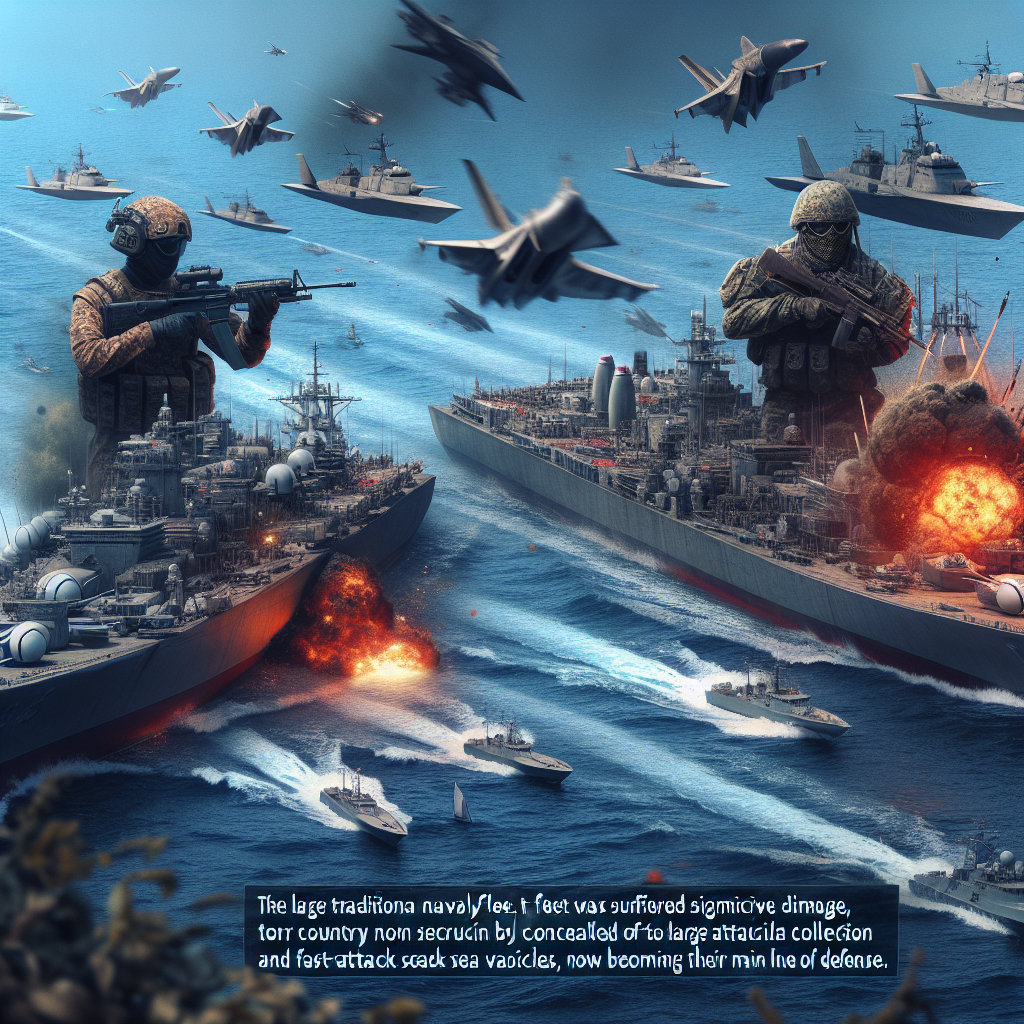
In the joint military operation “Operation Epic Fury” launched by the U.S. and Israel, the Iranian conventional naval forces have suffered devastating blows. With the near destruction of their main conventional fleet, their large and covert fleet of attack and fast-attack craft are now becoming their last line of defense in naval confrontations.
According to the latest assessment from the U.S. side, over 155 Iranian conventional vessels (such as frigates, patrol ships, and other major surface vessels) have been sunk in the U.S.-Israel military actions. As the larger vessels are nearly exiting the battlefield, the Iranian military is now relying on their dispersed, covert, and vast fleet of fast-attack craft for asymmetrical warfare.
Fox News reported that Farzin Nadimi, a senior researcher at the Washington Institute for Near East Policy, estimates that Iran still may possess 3,000 to 4,000 various types of fast craft, with approximately 800 to 900 capable of carrying and launching anti-ship missiles, posing a significant threat to maritime routes.
Iranian fast craft do not rely on individual combat capabilities but engage in “maritime guerrilla warfare” to challenge the U.S. military strategically.
These vessels hide in fortified coastal tunnels, underground facilities, and even disguise within civilian structures in populated areas to evade U.S. reconnaissance.
Taking advantage of the narrow geography of the Strait of Hormuz (only about 20 miles wide at its narrowest point), the fast craft can swiftly assemble from civilian traffic flows and launch swarm attacks, making it difficult for the U.S. military to discern friend from foe in a very short time.
Unlike regular armed fast craft, Iranian fast craft may carry shoulder-launched surface-to-air missiles (MANPADS) and anti-ship missiles, posing a direct threat to U.S. shipborne helicopters and drones.
Facing the threat of Iranian attack fast craft, U.S. President Trump has laid out a “swift and ruthless” response plan.
As the temporary ceasefire agreement expired, and due to the refusal of both the U.S. and Iran to compromise on key terms, negotiations to extend the truce failed. As a punitive measure, the U.S. military officially imposed a comprehensive military blockade on Iranian ports on Monday (April 13). Iran swiftly threatened that if the blockade continues, it would completely cut off the global strategic chokepoint – the Strait of Hormuz.
To ensure the blockade remains impenetrable, the U.S. military plans to implement the “kill system” used since 2025 in countering drug trafficking vessels in the Caribbean Sea.
By utilizing high-density surveillance, rapid location tracking, and precise airstrikes, the U.S. military will no longer passively wait for fast craft to approach. Instead, they’ll monitor the Iranian coastline and enact preemptive strikes upon detecting fast craft mobilization.
On Truth Social, Trump stated that any Iranian vessels threatening the blockade line would meet the same fate as drug trafficking ships – immediate destruction.
Secretary of War Pete Hegseth reiterated multiple times that the U.S. military is ready for action, demanding Iranian leaders to make a “wise choice” between peace agreements or all-out war.