
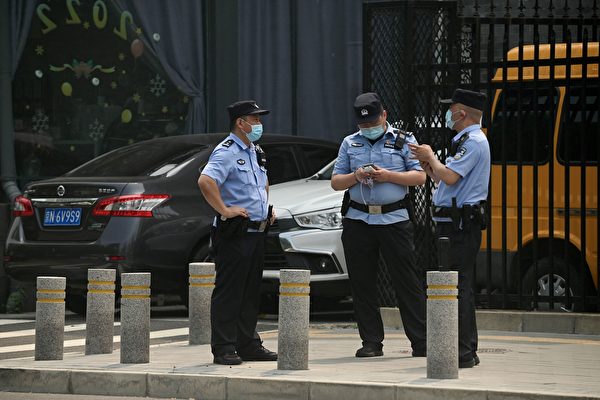
Recently, there has been circulating information on the internet regarding the Chinese Communist Party’s public security system’s “Key Personnel Dynamic Control.” The content shows that seven categories of individuals, including key petitioners, are being included in long-term management within the public security internal network. Once entered into the system, an individual’s travel and daily activities may trigger continuous alerts.
On April 14th, Beijing lawyer Chen Xiuyun stated in a video that the public security authorities have identified seven categories of key individuals within their internal system, including those involved in terrorism, stability concerns, major criminal records, drug-related offenses, fugitives, individuals with mental disorders causing accidents, and key petitioners. Once these individuals are logged, they are subject to dynamic control, where their movements, accommodations, and identity verification processes may trigger public security alerts.
Chen Xiuyun revealed in the video that this type of control is part of the internal operation system of the public security and does not create legal documents externally. Individuals affected often cannot confirm whether they have been included and lack clear channels for appeal or exit. Once included in the system, it is often difficult to remove them, and the actual impact may even exceed that of a criminal record.
She also mentioned that unlike sealed criminal records, these internal lists lack transparency in procedures and oversight pathways, making it difficult for individuals to know who has made the related decisions.
Beijing lawyer Mr. Hao, in an interview, mentioned that he had long heard about a dynamic monitoring list maintained by the police: “In my impression, individuals on this list are questioned wherever they go and may be barred from places that require ID checks for entry, such as government open areas. The concept of ‘key individuals’ deprives many people of their basic rights as citizens.”
Mr. Hao believes that the majority of individuals on the “key personnel” list have not committed any real criminal offenses, not even betraying ethics and conscience. He stated that they may have simply offended certain privileged classes or have been deemed by local authorities as individuals who could potentially disrupt the so-called social stability, such as petitioners and rights defenders.
The Chinese Communist Party’s “Counterterrorism Law” empowers public security to monitor and restrict specific individuals, the “Public Security Administration Punishment Law” provides significant law enforcement discretion, and the “Community Correction Law” regulates the supervision of individuals upon completion of their sentences or on parole. In addition, additional groups of people are included in the management through local comprehensive governance regulations and stability maintenance systems, including petitioners and rights defenders. This mechanism operates independently of judicial rulings, as many of the individuals included have not violated specific laws but continue to trigger alerts during identity checks, leading to long-term restrictions on their movements and personal information.
Mr. Lei, a rights defender from Guangxi who has been included in the control range, stated to reporters: “Regarding the so-called seven categories of people, my experience is profound. My bank card was restricted. The bank told me they received a notification from the public security, but when I asked the national security, they denied it. I then went back to the bank, and they said my card was restricted by public security. I am not a petitioner; I’m a rights defender, advocating for human rights.”
Regarding the continuous operation of this system, Beijing lawyer Mr. Hao told reporters, “I heard from a national security officer that this mechanism is not a single measure but an ongoing system. By using data tags, individuals are fixed in a trackable state, and management is not one-off but long-term.”
In recent years, the Chinese Communist Party has been advancing “digital governance,” combining big data, video surveillance, and grassroots grid systems for so-called risk identification and social management. While these related technological means expand the control scope, they also alter the relationship between individuals and power.
Some netizens commented in the discussion area that nowadays, China has an extremely dense network of surveillance cameras, making it unnecessary to physically track individuals for monitoring; it can be achieved through devices. With mobile phones implementing real-name registration, individuals can hardly disengage from using them, including apps like WeChat, and this data may be used to understand personal situations.
On overseas social media platforms, some netizens expressed that compared to criminal judgments, political labels like “key individuals” possess more continuity and expansiveness due to a lack of clear deadlines and exit mechanisms. Once locked into the Communist Party’s monitoring system, individuals often find themselves in long-term tracking, affecting not only their movements but also their employment, extending further to family and social relationships. Some netizens bluntly stated that the authorities would rather sacrifice the entire society’s freedom to safeguard their faltering rule, reflecting deep-seated fear.