
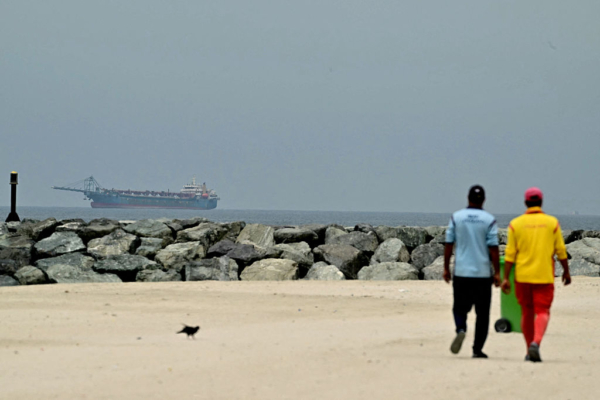
Following the military operations launched by the United States and Israel against Iran on February 28, Iran began to block the Strait of Hormuz and even attacked passing ships. After the breakdown of negotiations between the US and Iran, the US military began to block Iranian ports starting from Monday, April 13. The latest shipping data shows that at least three oil tankers entered the Persian Gulf through the Strait of Hormuz on Tuesday.
According to shipping data from the London Stock Exchange Group (LSEG) and Kpler, the oil tanker “Peace Gulf,” flying the flag of Panama, is heading towards the port of Hamriyah in the United Arab Emirates after charting a new course between Iran’s Larak Island and Hormuz Island.
Previously, two oil tankers under US sanctions, the “Rich Starry” and “Elpis,” also passed through the strait.
The “Rich Starry” is a 36,000-ton chemical and oil dual-purpose tanker, also a vessel flying a fake Malawi flag. The ship initially suspended its outbound journey on Monday. Automatic Identification System data shows that this 2015-built vessel turned west after heading towards the Larak-Gashm route. However, the “Rich Starry” later set sail again at night and sailed out of the strait early on Tuesday.
It is currently unclear whether the “Rich Starry” is carrying Iranian oil. According to the International Maritime Organization database, the owner of the “Rich Starry” is the company “Full Star Shipping,” which shares contact information with Shanghai Xuanrun Shipping Company, which has been on the US sanctions list since March 2023.
Data shows that this Chinese-owned tanker is crewed by Chinese sailors.
According to Bloomberg, based on vessel tracking data, the “Rich Starry” has changed its destination to the port of Sohar in Oman.
Another oil tanker, the “Elpis,” was in the Strait of Hormuz at the time, heading into the Gulf of Oman when the blockade began. It appeared to have stopped outside the narrow waterway near the Iranian coast. Ship tracking platforms Kpler and Vortexa show that the “Elpis” docked at an Iranian port in the Persian Gulf before attempting to pass through the Strait of Hormuz, indicating it could potentially become a target for US Navy patrol craft.
Last year, this vessel, previously named “Chamtang,” was sanctioned by the US due to its involvement in Iranian oil trade.
During the sideline sessions of the International Monetary Fund and World Bank meetings, US Treasury Secretary Benson was asked about the issue of Chinese oil tankers passing through the Strait of Hormuz. He said, “These ships will no longer be allowed to pass through, so they won’t get the oil.”
“The real issue is not just whether ships can pass through the Strait of Hormuz, but what enforcement measures the US warships will take and where they choose to employ those measures,” said Charlie Brown, advisor to the US lobbying and pressure group United Against Nuclear Iran, in an interview with Bloomberg. The organization focuses on Iran-related issues.
More than half of China’s oil comes from the Middle East, especially Iran. According to Kpler data, last year China purchased over 80% of Iran’s oil exports. China imported an average of 1.4 million barrels of crude oil per day from Iran last year.
Since the outbreak of the conflict, ship traffic through the Strait of Hormuz has dropped by over 95%.
According to Kpler vessel tracking data, between February 28 and April 12, a total of 279 ships were known to have passed through the strait, significantly lower than the pre-war average of about 100 ships per day.
A ceasefire agreement was reached between the US and Iran on April 8. Since the agreement came into effect, only 45 ships have entered or exited the strait.
Iran’s indiscriminate attacks on Gulf neighbors have also damaged energy production facilities in the region, leading to a roughly 50% increase in oil prices since the conflict erupted, with Asian buyers being the most affected.
According to Kpler’s vessel tracking data, since the war began, 22 ships have been attacked in the Strait of Hormuz.
Eight of these ships were attacked in UAE waters, six in Omani waters, two each in Iraqi and Qatari waters, and one each in Bahrain, Kuwait, Saudi Arabia, and Iranian waters.
(Partial reference to reporting by Al Jazeera)