
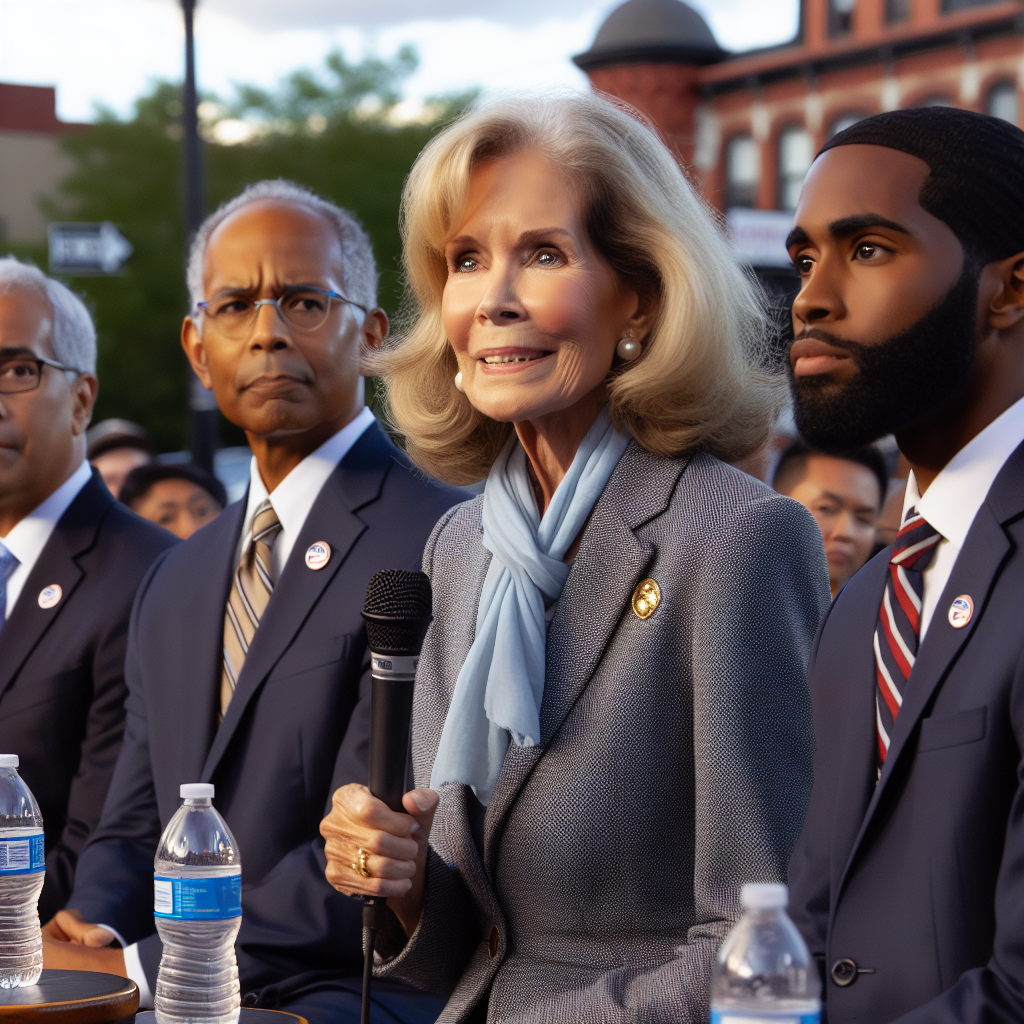
On March 14th, the “Asian Community Congressional Candidate Forum” was held at Victory Hall in Chinatown, San Francisco, where four congressional candidates from the San Francisco district expressed their political views and vied for the Chinese-American votes.
Nancy Pelosi, who has served as the congresswoman for San Francisco for 40 years and was the former Speaker of the House of Representatives, announced last November that she would not seek re-election. This vacancy attracted 11 candidates to run for the position.
The four candidates who participated in the forum debate that day were: California State Senator Scott Wiener, San Francisco City Councilmember Connie Chan, tech entrepreneur Saikat Chakrabarti, and community activist Marie Hurabiell.
The candidates generally expressed respect for Pelosi’s achievements but also acknowledged that they hold differing political views from hers if elected.
Wiener stated that he would prioritize addressing housing issues and make it a focal point of his administration; Chan mentioned that she would continue to communicate directly with the Chinese-American community in Cantonese and Mandarin; Hurabiell emphasized her ability to engage with grassroots communities, interact with various sectors of the community, listen to different opinions, and drive solutions with a focus on practicality; while Chakrabarti pledged to ban congressional stock trading and post-congressional lobbying and advocated for significant cuts in defense spending as a policy focus.
Regarding how to address the affordable housing crisis, the four candidates had differing opinions.
Chan proposed advocating for more federal funding and rental subsidies, as well as reforming related policies to expand the scope of housing assistance; she also emphasized the construction of affordable housing for different income groups.
Wiener, focusing on housing issues, put forward a ten-year federal housing investment plan totaling $1.2 trillion, funded by abolishing most of the tax cuts for the wealthy and large corporations implemented by the Bush and Trump administrations. Additionally, he advocated for increasing the Low-Income Housing Tax Credit (LIHTC) allocation to encourage more affordable housing construction.
Chakrabarti criticized the current housing policies as ineffective in solving the problem. He suggested restoring the model of the “New Deal” and the “Reconstruction Finance Corporation” that played a role during World War II, in which the federal government directly provided financing for affordable housing and participated in construction. He believed that this agency could be responsible for building housing projects that private developers were unwilling to invest in and reducing housing costs by controlling the supply of construction materials and renovating old buildings (such as single-room rentals).
Hurabiell advocated for reducing costs by increasing housing supply and proposed utilizing idle public land for large-scale housing development, such as using sites like the former San Francisco Naval Shipyard for high-density housing.
On immigration policy, the candidates all supported expanding legal immigration pathways and maintaining family reunification policies, but there were clear differences in terms of law enforcement agency reform, fund allocation, and specific policy directions.
Hurabiell advocated for strengthening “family reunification” and modernizing the immigration system, shortening application times, and providing a more convenient pathway for naturalized citizens to reunite with their families in the US. She also supported simplifying some business and professional visa application processes to attract more skilled professionals with innovative capabilities to the US.
Wiener emphasized defending the birthright citizenship guaranteed by the Constitution. He criticized the significant reduction in legal immigration channels under the current administration, resulting in many long-term residents lacking pathways to citizenship. He advocated for establishing clearer paths to citizenship and supporting a swift pathway to citizenship for recipients of the Deferred Action for Childhood Arrivals (DACA) program.
Additionally, he suggested reforming or even abolishing the US Immigration and Customs Enforcement (ICE) and reintegrating relevant functions into the Department of Justice system.
Chakrabarti criticized the government’s review of naturalization processes, which caused unease among many immigrant families. He advocated for strengthening oversight and accountability of US Immigration and Customs Enforcement and criticized its excessive budget, suggesting that more funds should be invested in domestic areas such as housing, education, and transportation infrastructure.
He also called for expanding legal immigration pathways and rebuilding the US immigration system to attract global talent.
Chan emphasized San Francisco’s status as a “sanctuary city” and its long-standing commitment to protecting immigrant rights. If elected to Congress, she pledged to push for more federal resources to be allocated to legal aid and fee subsidies to reduce the economic burden of immigration applications.
The moderator asked the candidates if they supported Nancy Pelosi’s visit to Taiwan in 2022, becoming the highest-ranking US official to visit Taiwan in 25 years, her advocacy for arms sales to Taiwan, and the policies they would adopt if elected to Congress.
Wiener expressed his support for Pelosi’s visit to Taiwan, believing that elected officials have the right to visit any place, emphasizing that the US should stand with democratic societies, including supporting Taiwan’s security and her advocacy for the rights of Tibetans and Uyghurs.
He supported arms sales to Taiwan and advocated for avoiding the escalation of war, urging cooperation with China on issues such as climate change and the economy.
Chakrabarti took a critical stance on Pelosi’s visit to Taiwan, considering it provocative and potentially exacerbating US-China tensions. He believed that the worst scenario at present would be a full-scale war with China. He advocated for reducing confrontation, enhancing cooperation, and collaborating with China on global issues such as climate change, nuclear proliferation, and artificial intelligence.
Born in Hong Kong and spent her childhood in Taiwan, Chan has personal feelings about the relationship between Taiwan, mainland China, and the US. She believes that the US should play the role of a “peace mediator” to facilitate direct dialogue between Taiwan and mainland China.
Hurabiell also supported Pelosi’s visit to Taiwan, stating that “for our national security, we need Taiwan, as they are the world’s largest maker of semiconductors.”
She believed that the US should maintain close relations with Taiwan but also maintain an effective working relationship with China through diplomatic means. She also mentioned that the US’ long-standing policy of “strategic ambiguity” has been very wise in maintaining regional stability.
When discussing the future direction of US diplomacy, while the candidates generally agreed that the US should play a leading role in the world, there were clear differences in how to achieve this goal.
Several candidates criticized the current government’s foreign policy.
Chan stated that the current government had weakened the US’ longstanding role as a “promoter of peace and aid.” She advocated for Congress to restore funding to the US Agency for International Development (USAID) to continue providing humanitarian aid such as food and medical assistance to global allies.
Hurabiell mentioned that the US remains a “beacon country” attracting talents and immigrants from around the world; she believed that to maintain global leadership, the US must strengthen diplomatic cooperation and reform the immigration system, including optimizing the H-1B visa to attract more high-skilled talents for legal immigration.
Wiener suggested that the US should once again take the lead in climate change, artificial intelligence, and global cooperation, in order to rebuild international trust and influence.
Chakrabarti believed that the decline in the US’ international status did not start with the current administration but was a result of years of military intervention policies by both the Democratic and Republican parties.
He criticized the US’s excessive reliance on military force, leading to wars and casualties, and pointed out the bloated Pentagon system, which has not undergone independent audit for years. Chakrabarti advocated for reforming foreign policy, including returning the power to declare war to Congress, significantly reducing military spending, and ending overseas interventions.
The “Asian Community Congressional Candidate Forum” was organized primarily by the Chinese American Democratic Progressive Association (CADC), with several Chinese community organizations as co-organizers. The forum provided Cantonese translation on-site and attracted over a hundred attendees, mainly consisting of Chinese-American residents.