
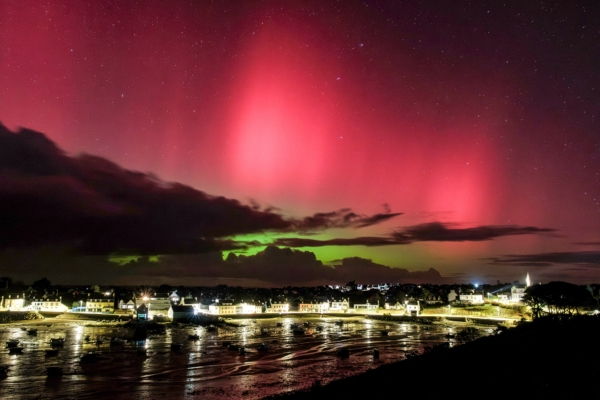
The most powerful solar storm in over twenty years began to hit Earth on Monday, January 19th, putting on a spectacular show of auroras in the skies of Europe and North America. This phenomenon has delighted countless astronomy enthusiasts and astrophotographers alike.
The National Oceanic and Atmospheric Administration (NOAA) of the United States reported significant disturbances in Earth’s magnetic field on Monday, emphasizing that the geomagnetic storm caused by the solar coronal mass ejection (CME) will continue to impact Earth until Tuesday, the 20th, with the potential to temporarily reach the most severe G5 geomagnetic storm level. A coronal mass ejection occurs when the Sun releases a large amount of plasma and magnetic field into the solar system.
Auroras are commonly seen in high-latitude regions such as Iceland, North America, or near the polar circles. However, NOAA pointed out that due to the “extremely rare” intensity of this geomagnetic storm, if weather conditions permit, magnificent auroras might be visible not only in Canada and most northern regions of the US, but even as far south as Alabama or northern California. Nevertheless, NOAA also warned that a storm of this magnitude could impact voltage control systems and satellite operations.
According to the Space Weather Prediction Center of NOAA, the last time such a powerful solar radiation storm, affecting Earth, occurred was in 2003.
The following are the stunning auroras captured by photographers in Germany, France, Belgium, and Austria:
[Translated and rewritten from a news article originally published on January 21, 2026 by an unspecified source]