
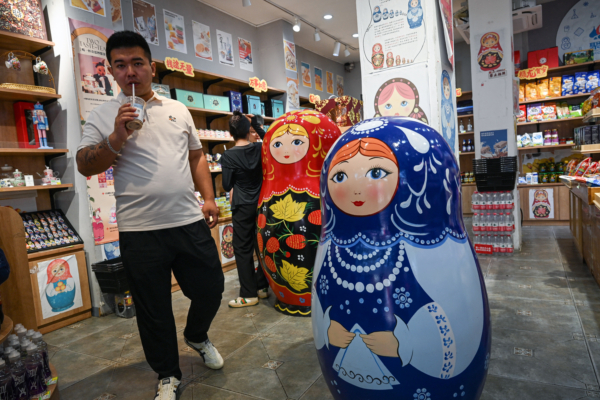
Recently, due to the Russia-Ukraine conflict, Western society has imposed sanctions on Russia. However, in China, Russian product stores mainly focused on selling food are popping up everywhere. Some people say this is a case of deceiving customers, as many of the products are actually manufactured in northeast China.
According to reports from Chinese state media, these stores selling goods claiming to be Russian imports have emerged in various cities in China, including Beijing, Shanghai, Hangzhou, Shenzhen, Chongqing, and Chengdu. In Chengdu alone, multiple Russian product stores or national pavilions from Russia have been set up in busy commercial areas like Chunxi Road, Jianshe Road, Xipu, and Longquanyi. These stores display slogans like “Warrior Nation,” “Authentic Russian Products,” “Russian Premium Selection,” and claim to have clean ingredients and friendly prices, attracting consumers. The stores are densely packed with Chinese and Russian flags hanging everywhere, showcasing a variety of food products such as honey, soy sauce, pasta, biscuits, fruit oats, coffee, powdered milk, Russian-style pure pork sausage, and beef tendon sausage.
The products in these stores feature labels in Russian and have a Russian-style design. For example, a soy sauce brand is called “Eroldo,” a honey brand is named “Amyodet,” and a powdered milk brand is labeled as “Lubzov.” However, these food products are not imported from Russia but manufactured in northeast China. For instance, the powdered milk is produced in Qiqihar, Heilongjiang Province, the Russian-style pure pork sausage is from Mudanjiang, Heilongjiang Province, and the fruit oats are also from Mudanjiang, Heilongjiang Province. Additionally, the instant coffee sold in the stores is from Malaysia.
A blogger uploaded a video on platform X showing that behind a Russian national store in Chengdu is a Chinese company. The sausages and other food products sold in the store are all made in China, with Russian characters prominently displayed on the trademark while Chinese characters are much smaller. The blogger commented that most of the elderly people who shop at the store may be seeking something new and wanting to buy for their families to try. He also expressed concerns that if fake goods were found, it would be challenging to seek recourse.
Some store owners have mentioned that “Russian goods are really popular this year, with a store of 100 square meters generating a monthly revenue of 300,000 yuan, while some stores can reach 500,000 yuan. They inform customers that Russian goods are of good quality, reasonably priced, economically beneficial, and this year, imported Russian goods come without intermediary tariffs, making them affordable and leading to good business.”
A Russian student studying abroad also stated in a video that Russian meat products are not allowed for export, so many products sold in live streaming are mostly branded in Russia and produced in northeast China, resulting in less authentic flavors. Russian-style and genuine Russian imports are entirely different. The light industry in Russia is not as developed as in China, so it is not feasible for a significant amount of food products to be exported to China; importing food products involves complex procedures, tariffs, and shipping costs, making it unlikely for them to be sold cheaply.
A resident of Wuhan, using the pseudonym He Lin, shared with a media outlet, “A few days ago, I visited the Hanjiang Road pedestrian street in Wuhan and saw a large Russian product store. The store was very prominent, with a large area on the first floor displaying a variety of food items. The merchandise includes 500ml Vagus drinks for 15 yuan per bottle, labeled in Russian with a Chinese tag indicating the country of origin and importer. They also sell crisp bread at 19 yuan per bag, produced in Harbin; Moscow sausages at 39 yuan each, produced in Suifenhe; and wild honey priced at 199 yuan per bottle, with Russian branded chocolate biscuits. Many of the candies are high in sugar and calories.”
“The packaging of Russian food products is very distinctive. In addition to food items, they also sell alcohol, flour, and beautiful nesting dolls. Although the stores have many customers, most are just browsing. I estimate that these stores won’t last long – they will close if there is insufficient foot traffic, simply making a quick profit,” added He Lin.
According to a report from the Russian news agency Sputnik on May 16th of this year, the Russian Export Center and the Ministry of Agriculture have established a Good Food Russia promotion center in Harbin, Heilongjiang Province, in northeast China.
A resident of Harbin, using the pseudonym Shen Yanqiu, expressed to a media outlet, “Russian stores cannot open in various parts of China without official support. Even Russians themselves admit that Russia does not produce large loaves of bread, beef tendon sausages, or camel milk – these are all manufactured in northeast China.”