
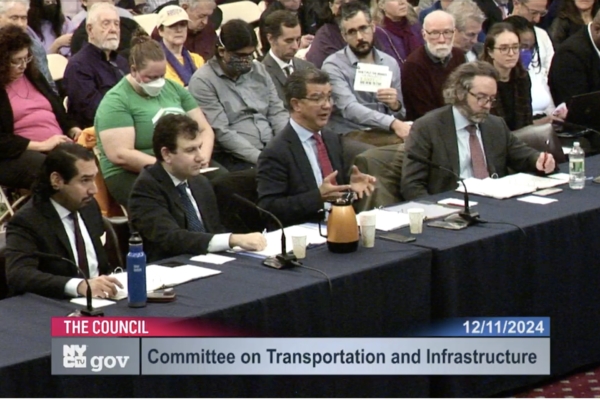
On Wednesday, December 11th, the Transportation and Infrastructure Committee of the City Council held a supervisory hearing to discuss multiple electric scooter regulation legislations, including the “Priscilla’s Law” proposed by Priscilla Law. The hearing primarily focused on the registration, insurance, and usage regulations of electric scooters, attracting voices from various sectors.
“Priscilla’s Law,” also known as Intro. 606, is named after 69-year-old Priscilla Law, former vice principal of the Chinatown Head Start school. She tragically passed away last September in Manhattan’s Chinatown after being struck by an electric bike, with the perpetrator fleeing the scene.
In accordance with Council Member Robert Holden’s proposal, electric scooters and electric skateboards would be required to register with the Department of Transportation and display visible identification numbers, such as license plates, to hold perpetrators accountable for traffic incidents.
Many advocates support this legislation, believing that it would enhance accountability for electric scooter riders and related businesses, especially those whose employees frequently ride recklessly on sidewalks.
Former principal of the Chinatown Head Start school, Lily Shu-Ling, testified at the hearing on behalf of Priscilla Law’s family, expressing support for the legislation. She shared the fond memories of Priscilla Law held by her family and friends, emphasizing that the law could make “future electric scooter riders more cautious on the roads to prevent similar accidents from happening.”
However, the bill did not receive approval from Ydanis Rodriguez, the director of the New York City Department of Transportation. He stated, “We support the intent of this bill, but we do not agree with the specifics. We are willing to collaborate with the chairman, speaker, and others to establish a comprehensive working group to explore more thorough solutions.”
Shimano Williams, a public interest advocate in New York City, mentioned at the hearing that with the increasing use of micro-mobility devices as a popular eco-friendly mode of transportation, safety measures must be ensured. He highlighted concerns that legislation may disproportionately affect low-income, minority, and undocumented immigrant populations, potentially leading them to keep electric scooters indoors rather than charging them outside, increasing fire risks. He proposed expanding existing bike lanes and focusing on promoting responsible businesses to ensure policies do not adversely impact communities.
Council Member Gale Brewer expressed support for registration and insurance measures for electric scooter users. However, she believed that New York City may not be able to implement permits and thus proposed a resolution to require state government to develop permits, emphasizing that applications should bear more responsibility to ensure street safety. Simultaneously, she advocated for slower delivery speeds, stating, “We must find a way for people to obtain permits so we know who is on that bike.”
Director Rodriguez highlighted that electric scooter-related accidents represent a small fraction of all traffic incidents in the city. As of this year, New York City has seen 242 traffic-related fatalities, with 105 pedestrians dying from collisions with cars or large vehicles, while electric scooter accidents have resulted in six deaths.
“Education is key as more and more New Yorkers and tourists are using e-bikes,” he said, noting that the city is currently experiencing a renaissance in bicycle usage. In 2023, bike trips in the city reached 200 million, including 34.5 million electric scooter trips.
Rodriguez supported enforcement actions against illegal riders and enhancing education. However, concerning the proposal to mandate license plates for electric scooters, he cited challenges in implementation and resource constraints.
He pointed out that behaviors such as riding on sidewalks, not yielding to pedestrians, and going against one-way streets are hardly enforced currently, so would simply having license plates change that? Registration systems were considered as potential solutions in cities like Toronto, but were ultimately not adopted.
Council Member Holden argued that electric scooter riders commonly disregard traffic rules, posing serious safety hazards. He criticized the Department of Transportation for not providing sufficient data to support the legislation and called for intensified enforcement efforts to normalize electric scooter usage.
Numerous supporters gathered outside City Hall on the day of the hearing to express their support for the implementation of license plates on electric scooters. Council Member Joann Ariola noted that the bill seemed unpopular within the transportation committee but was favored among the public. She believed that the legislation, along with other laws, complements each other aiming to improve the safety of delivery personnel.