
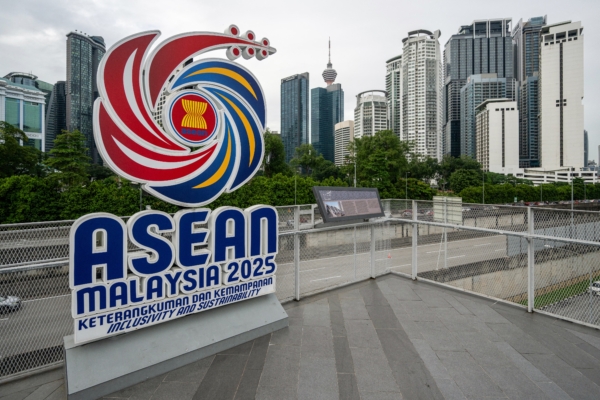
The Association of Southeast Asian Nations (ASEAN) announced the establishment of the ASEAN Maritime Center on May 8th with the aim to uphold security, freedom of navigation, and order in the South China Sea. Additionally, ASEAN plans to establish a joint fuel reserve mechanism to address energy crises caused by conflicts.
The 48th ASEAN Summit in 2026 took place on May 8th in Lapu-Lapu City near Cebu, the Philippines. All 11 ASEAN member countries agreed to support the establishment of the ASEAN Maritime Center as a measure to ensure freedom of navigation in the South China Sea. The Philippines has expressed willingness to host the maritime center.
Current ASEAN Chair and Philippine President Ferdinand Marcos Jr. stated in a post-summit press conference, “As the situation in the South China Sea becomes increasingly unpredictable, establishing a central institution for maritime issues and policies applicable to ASEAN member states becomes crucial.”
President Marcos emphasized that the creation of the ASEAN Maritime Center would help prevent situations like the closure of the Strait of Hormuz. He explained, “The maritime traffic in the South China Sea is incredibly busy. We must determine how to manage and monitor these activities. All maritime nations around the South China Sea are currently doing this but in a disjointed manner.”
The closure of the Strait of Hormuz due to the Iran war highlighted the importance of keeping maritime passages open. ASEAN countries are among the regions most severely impacted by disruptions in crude oil and fertilizer supplies, resulting in skyrocketing consumer prices and economic stagnation.
President Marcos expressed concerns about the inevitable consequences if a similar incident occurred in the South China Sea.
ASEAN member countries include the Philippines, Brunei, Cambodia, Indonesia, Laos, Malaysia, Myanmar, Singapore, Thailand, Vietnam, and Timor-Leste.
The plan to establish the ASEAN Maritime Center may provoke dissatisfaction from China, as the South China Sea holds significant strategic and resource value, including vast reserves of oil and natural gas. Disputes over sovereignty in the South China Sea have long existed among China, the Philippines, Vietnam, Malaysia, and Brunei.
In response, President Marcos stated, “The ultimate goal of setting up this maritime center is not to confront or restrain any single power or country.”
In addition to the maritime center, ASEAN member countries also agreed to establish a joint fuel reserve mechanism to ensure fuel supply during crises and mitigate the impact of surging oil prices.
President Marcos noted that the establishment of the joint fuel reserve mechanism aims to offset sudden increases in energy and power costs. Other measures include approving the latest version of the ASEAN Petroleum Security Agreement, expediting the ASEAN Power Grid, and reducing dependence on fossil fuels.
President Marcos emphasized the need for immediate emergency supplies when events like war, such as the closure of the Strait of Hormuz, occur. He added, “For example, in the Philippines, diesel is the most critical fuel; however, other countries currently lack aviation fuel. Some countries lack gasoline, while others lack natural gas. Therefore, we are trying to balance the differences among countries.”
Energy ministers from each country will be responsible for formulating specific details. While there is a unanimous agreement in principle, discussions on implementation details are still ongoing.
ASEAN was established on August 8, 1967, in Bangkok, Thailand, initially with five countries: Indonesia, Malaysia, the Philippines, Singapore, and Thailand. Other countries subsequently joined, with Timor-Leste being the latest member joining on October 26, 2025.
The ASEAN Summit is the highest decision-making body of ASEAN, composed of heads of state or government leaders of ASEAN member countries. The summit is held twice a year, with the specific timing determined through consultations between the rotating ASEAN Chair and other member countries. The hosting of the summit rotates among ASEAN Chair countries.