
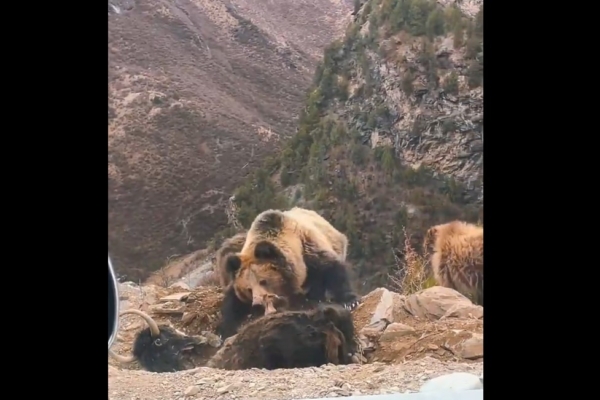
Recently, there have been multiple reports in areas like Chamdo in Tibet of incidents involving Tibetan bears (brown bears) causing harm to people. In response to claims of “bears attacking people,” the Chinese Communist Party officials have publicly denied such incidents. Local residents have expressed to The Epoch Times that the situations of Tibetan bears causing harm, including attacking and even eating people, are true occurrences. Livestock, houses, and even individuals have been affected, but the authorities have long neglected the issue, leaving the residents to fend for themselves.
According to a report by the “Xiaoxiang Morning Post” on May 7, a Tibetan netizen informed the newspaper that besides Chamdo, areas like Nagqu have also seen an increase in sightings of Tibetan bears in recent years. This surge in bear activity comes at a time when locals are collecting caterpillar fungus, raising concerns about personal safety while venturing into the mountains. Videos shared by the netizen even show bears appearing near residential areas.
The “Xiaoxiang Morning Post” also cited statements from Dingqing County government officials, acknowledging that wild bears emerging from hibernation to search for food is a reality in the region. The officials mentioned that bears are more commonly seen in rural areas, stating, “We have not heard of bears appearing in urban areas.” While they admitted that “there might be occasional incidents” of bear attacks on humans, the local government continues to deny the online claims of Tibetan bears harming people.
As reported by the “Xinmin Evening News” on May 3, recent online messages circulating included pleas for national attention to the issue of bears attacking people in Dingqing County, Chamdo City, Tibet. Claims such as “people are eaten every year, sometimes even two or three from a single family” have garnered public concern.
The county’s Forestry and Grassland Bureau denied these claims, stating that there have been no bear attacks on people in recent years — disregarding the widely circulated narrative of annual incidents of bear attacks on humans, particularly the claim of multiple casualties from a single family.
Despite the Chinese Communist Party’s official denial of “bears attacking people,” several interviewed locals have affirmed to The Epoch Times that incidents of Tibetan bears causing harm, including attacking and sometimes consuming people, are not isolated incidents in the region.
A villager from Yushu Zaduo County in Qinghai Province told The Epoch Times that incidents of Tibetan bears causing harm are “real.” He recounted a harrowing event from last June where multiple individuals were attacked by bears, leading to the tragic death of a child who was devoured by a bear, leaving the child’s mother psychologically traumatized. Another person was left with severe injuries after his scalp and face were torn off by a bear, fortunately saved in time to avoid a fatal outcome — the injured person being the villager’s brother-in-law.
The villager mentioned that such incidents are not uncommon and have indeed happened. He further expressed bewilderment at the authorities’ denial of bear attacks on people in Dingqing County.
Another villager from Baqing County in Nagqu, Tibet, informed The Epoch Times that the presence of Tibetan bears and their aggressive behaviors towards humans are genuine concerns. He recounted multiple instances of bears breaking into his home and causing destruction to furniture, food supplies, and even livestock, fortunately when the house was unoccupied.
He noted an incident from his junior high school days where a fellow student was attacked by a bear, resulting in severe facial disfigurement, saved only by the timely arrival of adults. He emphasized that such encounters are widespread and distressing realities in the region.
The same villager from Yushu Zaduo County in Qinghai Province mentioned that almost every year witnesses incidents of bear attacks on residents, with a noticeable increase in occurrences in recent years. Bears are now daring enough to approach residential areas directly, wreaking havoc by damaging homes, assaulting people, and livestock.
He highlighted that herdsmen suffer the most, with many now fearful of going to graze their livestock in the mountains, causing widespread anxiety among the community.
He also noted that the current caterpillar fungus season compels many to venture into the mountains, a known risk factor despite the dangers involved. The income generated from collecting caterpillar fungus remains a vital source for local herdsmen, with annual earnings ranging from tens to hundreds of thousands, depending on market prices.
A non-local man working in Biru County in Nagqu, Tibet, informed The Epoch Times that bears are currently active following their hibernation, posing a significant threat to residents undertaking activities in the vicinity. He cautioned about the inherent dangers faced by villagers while collecting caterpillar fungus, given the presence of bears, wolves, and snow leopards in the area, as well as previous incidents of wild dog attacks on locals.*
He mentioned that local regulations stipulate that a minimum of three casualties must occur before authorities can take measures to hunt or kill the bears, a condition he believes is unjustifiable considering the escalating number of victims.
The villager emphasized that the people in the area have few options but to evade these dangers as no adequate measures are in place to protect them from bear encounters. *