
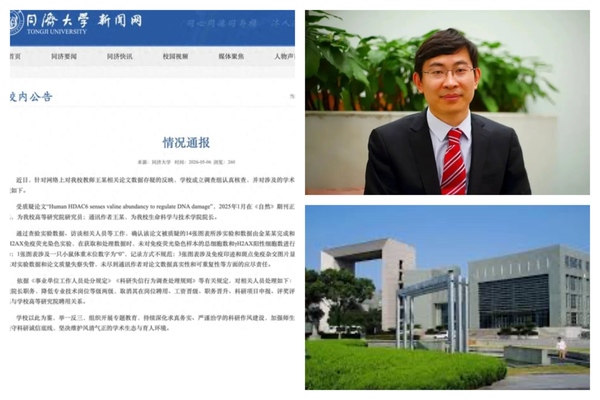
Recently, Tongji University, a prestigious university in China, announced that Wang Ping, the dean of the School of Life Science and Technology, had been dismissed and demoted due to negligence in overseeing the quality of experimental data and papers. Additionally, his relationship with the first author of the paper, Jin Jiali, and the School of Advanced Research Institute has been terminated. The investigation into Wang’s team was triggered by a report made on April 9th by the science and technology blogger “Geng Talks Stories,” accusing the team of publishing a paper with fraudulent data in the top journal “Nature.”
According to the announcement made by Tongji University on May 6th, the questioned paper from Wang’s team was officially published in the journal “Nature” in January 2025. Jin Jiali, the first author of the paper, is a researcher at the School of Advanced Research Institute of the university, while Wang Ping is the Dean of the School of Life Science and Technology.
The report pointed out that the paper exhibited academic misconduct, non-standardized record-keeping, and instances of misrepresentation. Wang was held accountable for neglecting the supervision and management of experimental data and paper quality as the corresponding author, failing to fulfill the responsibilities of ensuring the authenticity and reproducibility of the data.
In response, Wang Ping was relieved of his position as the Dean of the School of Life Science and Technology, downgraded by two levels to become an associate professor, and faced a 24-month suspension of qualifications related to position appointments, salary increments, promotions, research project applications, evaluations, and awards. Jin Jiali’s employment with the School of Advanced Research Institute was terminated.
The paper in question was funded by the National Natural Science Foundation, with approximately one million RMB in funding. The blogger has reported this to the National Natural Science Foundation Commission. It was previously alleged that the paper had used falsified images, with the authors defending it as a result of “using the wrong images.”
Wang Ping had publicly stated that his team’s ability to publish two top-tier papers within a few months was the result of years of accumulated efforts, likening it to the saying “sharpening a sword for ten years.”
In earlier reports by Red Star News on April 16th, researchers had already raised concerns about the fraudulent nature of the team’s papers as early as June 2025. The papers in question were published online in 2024 and in 2025 in “Nature.”
The handling of this incident has reignited public attention. “Qingsong Guteng,” a teacher at Hunan Agricultural University and financial blogger, highlighted that the explosion of paper quantity and prevalence of paper fraud in China are mainly caused by assessment mechanisms that offer significant benefits.
“Black Night Snowball,” a former senior researcher at Xuangubao and a popular Weibo user, remarked that this act was not scientific research but rather a “photo editing competition.” He criticized the subjective fabrication of data to force its way into “Nature,” emphasizing that it not only squanders millions of national funds but also flagrantly violates academic integrity. He called for the removal of the academic giants’ disguises, urging the impostors to pay for their deceit with their professional careers to halt the cycle of focusing solely on papers in research circles.
The recent actions taken by Tongji University raises questions. While it may appear to be a thorough handling of the situation by demoting the dean and dismissing Jin Jiali, a closer look reveals that Jin Jiali can simply continue her research activities at the affiliated Tenth Hospital while Wang Ping’s position downgrade and team restructuring may not result in significant consequences. This situation raises the issue of disproportionately low costs for academic misconduct without facing legal consequences. The manipulation of the rules around power should not become a standard process with a cooling-off period for academic misconduct.
These developments highlight the complex interplay between academic integrity, accountability, and the consequences of academic fraud within research institutions.