
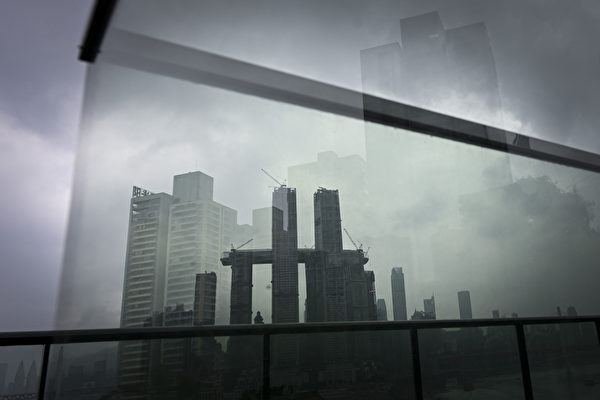
In China’s four major first-tier cities, Guangzhou is the first city to implement “100% cancellation of purchase restrictions.” Originally seen as a benchmark for the real estate market’s recovery, the complete cancellation of purchase restrictions did not bring about the expected rebound in the Guangzhou real estate market. Instead, it is deeply mired in a continued downward trend that seems bottomless.
Despite Guangzhou gradually lifting various past purchase restrictions, according to statistics recently released by the real estate vertical domain public account “Real Estate Data Jun” on the WeChat platform, the second-hand housing market in Guangzhou in April 2026 is undergoing an unprecedented and severe adjustment.
In April of this year, the average transaction price of second-hand houses in Guangzhou was approximately 20,500 yuan per square meter, with a sample size of 4,193 units. Compared to two years ago, the overall housing prices have dropped by 27.6%, equivalent to a depreciation of about 7,800 yuan per square meter. The transaction volume in April decreased by about 20% compared to March, and prices continue to decline.
Of particular concern is that some popular areas and star properties in Guangzhou have seen price declines far exceeding the overall average.
A list of the “top 20 properties with the largest price drops” compiled by local media in Guangzhou shows that prices for most projects have been halved, with some dropping by over 70%.
Ranked by the highest to lowest price drops, the suburb of Zengcheng in Guangzhou stands out as a typical case. This region, which was once hyped by capital due to the concept of “Guangzhou-Foshan integration,” attracted a large number of investors around 2018. The Xie Creek Garden project in the area saw new home prices of 21,000 yuan per square meter in 2018, but by 2025, the average transaction price had plummeted to 4,700 yuan, a staggering 77% drop. Many compare it to Yanjiao in the Beijing market – both areas experienced rapid growth due to the concept of “urban sprawl” but suffered heavy losses for high-level buyers after the market trend reversed.
Areas like Huangpu Knowledge City, Panyu, Laohuangpu, and Tianhe, which were once considered “high-value areas” in Guangzhou, have also not been spared. Several former star properties have dropped by 50% to 70% from their peaks in 2021. Well-known developers’ projects, such as Country Garden, Vanke, and Jinbi series properties, have also seen substantial price corrections.
Financial blogger “Huihu” recently stated that he had been involved in China’s real estate market for 20 years. From the perspective of a veteran real estate professional, he noted that while current house prices may seem tempting when compared to 2021 income levels, the reality is that there is little interest from buyers in the market. The core reason lies in the structural collapse that has occurred in the past four to five years.
He pointed out that what truly changes the logic of the Chinese real estate market is not just the price decline but the overall reversal of economic and social expectations in recent years. The COVID-19 pandemic has become a watershed for the economy. With slowed economic growth, decreased income expectations, worsening employment conditions, and the wealth shrinkage caused by the long-term real estate downturn, the elite 20% who previously supported property prices (private business owners, corporate partners, senior executives) have suffered significant losses in this downturn, with many facing company closures or bankruptcies and massive wealth erosion.
He emphasized that the impact on the part of the “middle to high-income groups” that the real estate market in first-tier cities relied heavily on – entrepreneurs, private business owners, company partners, and middle-class investors – has been particularly severe in recent years. Some faced business closures, disrupted financing chains, or found themselves trapped after buying houses at high prices between 2020 and 2021. The old logic of “buying a house is more profitable than doing business” has become unsustainable. As house prices have continued to decline for five years, what were once assets have turned into liabilities.
He further noted that even with prices halving, for the vast majority of ordinary working-class people, in the context of unstable incomes and bleak future prospects, those who could not afford homes before still cannot afford them now.
“Huihu” remarked that despite Guangzhou completely lifting purchase restrictions and many property prices being halved, there has not been large-scale buying frenzy in the market. The reason is that people’s confidence in future income, asset prices, and economic prospects is waning.
In conclusion, he stated that the Chinese real estate market in 2026 is no longer simply a matter of high or low prices but a complete collapse of market confidence. The Guangzhou case serves as a warning bell for the whole of China: the real estate market is supported by confidence and the liquidity of the wealthy.
The changes in the Guangzhou real estate market are also seen by some observers as a microcosm of the new stage that China’s real estate market has entered.