
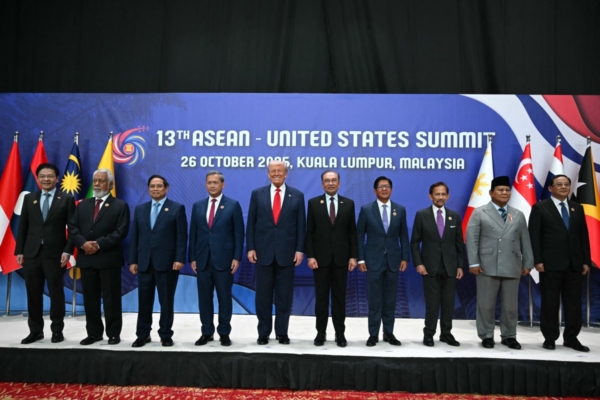
On Thursday, May 7, the summit of the Association of Southeast Asian Nations (ASEAN), which covers nearly 700 million people, was held on Cebu Island in the Philippines. The summit, spanning two days (May 7-8), brought together leaders, foreign affairs, and economy ministers from the 11 member countries. Against the backdrop of the Middle East crisis causing energy threats, the focus of the summit was on regional energy security strategies and food supply issues.
Although the conflicts occur in the distant Middle East, their impact on oil supply poses significant risks for Southeast Asian countries. As a result, the Middle East conflict became the theme of the ASEAN summit. The host country, the Philippines, aimed to promote a regional oil-sharing agreement and strengthen crisis coordination capabilities.
Prior to the summit, ASEAN ministers held a special meeting to discuss these issues. As the host country, the Philippines hoped to approve the “Oil Sharing Framework Agreement.”
On May 7, Philippine Foreign Minister Maria Theresa Lazaro stated at the opening ceremony of the meeting with counterparts from ASEAN countries, “The continuous crisis in the Middle East has led to disruptions in global energy flow, trade routes, and food supply chains.”
She emphasized, “This situation has endangered the welfare of our people. It also reminds us that developments outside the region will have a direct and far-reaching impact on ASEAN. ASEAN now needs to enhance crisis coordination and readiness mechanisms during times of crisis.”
According to a draft statement obtained by Reuters, the summit called for the United States and Iran to engage in goodwill negotiations and ensure that the Strait of Hormuz (a transit route for one-fifth of global oil and gas shipments) remains unobstructed.
“We further emphasize the necessity to ensure the unimpeded flow of energy and essential goods to maintain the economic stability of ASEAN countries and enhance ASEAN’s resilience,” the statement read.
The statement also stressed the importance of food, agricultural inputs, medicines, and fuel as essential items.
It urged all parties to swiftly approve the ASEAN Fuel Share Agreement to ensure its “early entry into force.”
Diplomats and analysts noted that the energy crisis would test the Philippines’ capacity as the rotating chair of ASEAN, forcing it to coordinate regional response measures while preventing internal conflicts within ASEAN from being sidelined. These issues include the civil war in Myanmar and the unresolved conflict between Thailand and Cambodia along their border last year, despite a temporary calm after a ceasefire at the end of last year.
To address these challenges, the Philippines arranged a trilateral meeting between President Marcos of the Philippines and leaders from Thailand and Cambodia later on Thursday to ensure the smooth progress of the summit.
Analyzers noted that the outcomes of previous ASEAN summits often remained at the level of reaching verbal cooperation consensus without concrete strategies or specific commitments. However, the energy crisis might compel ASEAN to take more decisive actions.
Former Philippine diplomat Laura del Rosario remarked that the scale of the energy supply impact was too significant for any ASEAN country to evade and might prompt ASEAN to shift from “verbal commitments” to “actual actions.”
However, Don McLain Gill, a lecturer and geopolitics analyst at De La Salle University in Manila, expressed concerns that plans devised to mitigate economic impacts of the crisis might overshadow other imminent regional issues.
He added that while the civil war in Myanmar and the South China Sea dispute might be discussed, significant breakthroughs were unlikely in the short term.
Another focus of this ASEAN summit is the continuously divisive issue within ASEAN regarding Myanmar. Since the military coup in 2021, a party supported by the ruling military government of Myanmar won recent elections, prompting the nominally new civilian government to seek reestablished connections with ASEAN.
However, ASEAN has yet to acknowledge the election results due to the lack of a strong opposition in Myanmar and the military-backed nature of the winning party. Furthermore, some Western countries see the election process as a “charade” aimed at solidifying military control under the guise of civilian rule.
ASEAN has also not indicated when former military junta leader and current President of Myanmar, Min Aung Hlaing, who was excluded for five years, could return to the ASEAN summit.
Recently, Myanmar has taken several gestures perceived as steps towards reconciliation, including implementing two amnesties, reducing the sentence of ousted leader Aung San Suu Kyi, and placing her under house arrest.
Little is known about the current situation and whereabouts of the Nobel Peace Prize laureate, Aung San Suu Kyi. The Philippines called for allowing its ASEAN special envoy to meet with her, as a symbolic gesture of Myanmar’s genuine commitment to national reconciliation.
Analysts argued that if the Myanmar government supported by the military aims to reintegrate into the international community, it still needs to further convince ASEAN countries of its sincere willingness to cease hostilities and seek dialogue with the “rebel” forces.
ASEAN leaders may once again call for the conclusion of the prolonged negotiations with Beijing on the Code of Conduct in the South China Sea. However, conflicting interests pose challenges to the 2026 target deadline. Beijing will not attend the meeting held in Cebu this week.
Additionally, ASEAN leaders may discuss China’s expansion in the South China Sea. Despite the Permanent Court of Arbitration ruling in 2016 that China’s claims lacked legal basis and were contrary to the United Nations Convention on the Law of the Sea, China continues to assert sovereignty in the region and take unilateral actions, including provocative actions against Philippine vessels and unilaterally declaring fishing bans in parts of the South China Sea, extending into Vietnam’s exclusive economic zone, causing intense dissatisfaction and concern among neighboring countries in the South China Sea region.
(Note: This article is based on Reuters’ report.)