
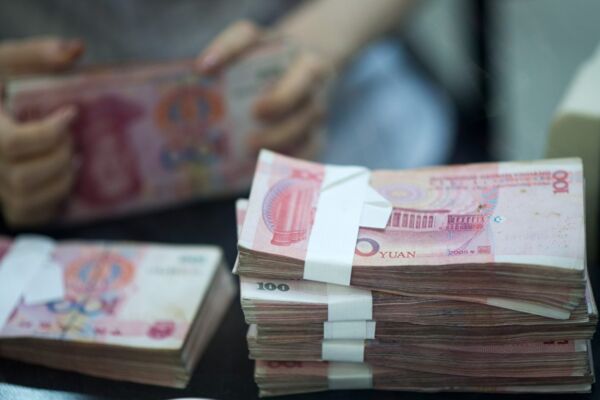
In the first four months of this year, local governments in China have reached a record high level of debt issuance. Local governments have issued bonds worth approximately 3.92 trillion yuan (RMB) during this period, representing a year-on-year increase of about 10.8%, setting a new high for bond issuance during the same period in previous years. Industry insiders believe that this surge in borrowing is a response to the economic downturn.
According to a report by “China Business News” on May 6, data from various local governments in China shows that local government bond issuances in the first four months of this year reached 3.92 trillion yuan. Of this, approximately 1.65 trillion yuan came from new bond issuances, a 10.4% increase compared to the previous year, while approximately 2.27 trillion yuan was raised through refinancing bonds, an 11.1% increase year-on-year.
Of the new bond issuances, around 1.15 trillion yuan was allocated to project construction, while funds from refinancing bonds were used to repay maturing principal of local government bonds and replace existing implicit debts through a “borrowing new to repay old” approach. Out of the 2.27 trillion yuan refinancing bond issuances, approximately 1.18 trillion yuan was utilized to address implicit debt.
The report highlights that the record high level of bond issuance in the first four months of this year was aimed at addressing the economic downturn. The Chinese government hopes to stimulate significant project construction by issuing large-scale local government bonds to boost domestic demand. However, some analysts view this move as a return to the old method of driving GDP growth through infrastructure investment, which may only artificially inflate GDP data in the short term without significant long-term economic benefits.
Professor Zhong Ninghua from Tongji University’s School of Economics and Management stated that the strategy of issuing local government bonds early and utilizing them promptly aims to alleviate the pressure of economic downturn this year. He anticipates a peak in local government bond issuances in the second quarter.
Data from the Chinese Ministry of Finance shows that as of early 2026, the outstanding debt balance of local governments stood at 56.59 trillion yuan. However, official Chinese data often conceals unfavorable situations, and the actual figures may be worse, including undisclosed substantial implicit debts. The International Monetary Fund (IMF) and the Bank for International Settlements (BIS) estimate that China’s government debt reached 100 trillion yuan in 2024.
Chinese-American economist Li Hengqing from the US Information and Strategic Studies Institute previously told a media outlet that the forms of these local government bonds are mostly disguised as public facility projects, such as highway construction or water supply network projects, while in reality, they are issued as corporate bonds under the guise of local government debts. These debts are off the balance sheet and classified as implicit debts of local governments, a practice that is not fully transparent in official Chinese financial data.
Li Hengqing also pointed out that buyers are not very enthusiastic, as they are mostly large state-owned enterprises and banks pressured by the government to make purchases. “Because everyone knows that the government has no intention of repaying these debts, it’s just borrowing new to repay old. How can you guarantee the safety of your assets in such a situation?”