
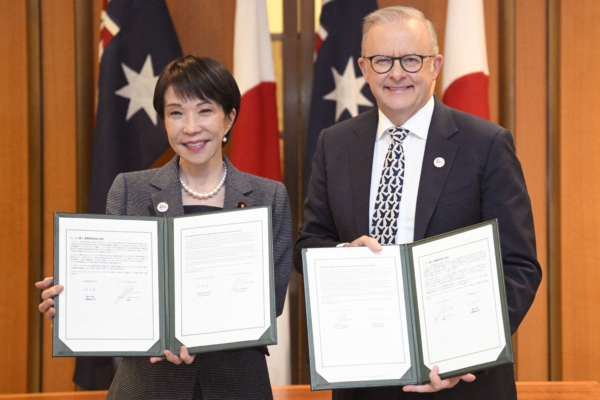
Japan’s Prime Minister Sanae Takaichi embarked on an official visit to Australia from May 3 to May 5, where she held a summit with Prime Minister Anthony Albanese. The two leaders exchanged “musical gifts” and signed a package of agreements covering economic security, critical minerals, energy, and defense sectors.
The summit coincided with the 50th anniversary of the signing of the Basic Treaty of Friendship and Cooperation between Australia and Japan. It also marked Sanae Takaichi’s first official visit to Australia since her victory in the October 2025 election, making her Japan’s first female prime minister.
According to Australian media outlet SBS News, on Monday evening (May 4), the leaders of Australia and Japan had dinner at The Lodge, Albanese’s official residence in Canberra, where they exchanged unique musical gifts.
Albanese presented Takaichi with a drum skin signed by members of the Australian rock band AC/DC, including signatures from Angus Young, Brian Johnson, and others. Takaichi, who was a drummer in a school music club, reciprocated by gifting vinyl records from Japanese bands Man With a Mission and BABYMETAL, along with a Japanese-made record stand.
Additionally, Takaichi presented Albanese with a premium “Crown” rockmelon from Shizuoka Prefecture, a rare variety that Australia had just approved for import from Japan in January. She expressed gratitude for the rockmelon import approval, highlighting its uniqueness as a melon grown from a vine that produces only one fruit, as opposed to the typical 5-6 fruits.
During the exchange, Albanese jokingly asked if he should share the melon with everyone, to which Takaichi suggested sharing it with Jodie, Albanese’s wife. Takaichi also shared her personal connection to Australia, mentioning her scuba diving trip to the Great Barrier Reef during her honeymoon, indicating deep ties with the country.
Albanese later stated, “We will continue to have in-depth discussions on important national issues, including heavy metal music.”
Takaichi took to social media to emphasize that beyond music, the discussions also touched on topics like food culture, emphasizing the opportunity to deepen mutual understanding and build trust between the two countries.
The core outcome of the Japan-Australia summit was an Economic Security Joint Declaration, aiming to establish reliable supply chains, accelerate the development of key technologies such as artificial intelligence, quantum technology, and biotechnology, and support regional economic resilience. Both governments committed to consulting each other in emergencies and exploring measures to reduce risks.
Regarding energy, the joint statement reaffirmed the commitment to “addressing current energy crises” by maintaining open trade flow of essential energy products such as liquid fuels and natural gas.
Currently, the energy relationship between Australia and Japan is deeply interdependent—Australia supplies one-third of Japan’s energy needs, making it Japan’s largest liquefied natural gas market, while Japan is an important supplier of refined oil and diesel to Australia.
In terms of critical minerals, both countries have elevated this area to a core pillar of their bilateral relationship, listing six rare earths including gallium, magnesium, fluorite, nickel, and cobalt that Japan intends to invest in, aiming to reduce dependence on China in their supply chains.
Australian Minister for Trade Don Farrell expressed intentions to travel to Japan within two weeks to further enrich the agreement details, emphasizing Japan’s crucial role as a major investor in Australia’s critical mineral projects and the desire for expanding investments.
The leaders of both countries also agreed to deepen defense cooperation, building on Australia’s purchase of Mogami-class frigates and launching the Strategic Cyber Partnership and the Australia-Japan Leadership Dialogue.
Opposition spokesperson Andrew Hastie supported strengthening diplomatic ties with Japan, emphasizing the critical importance of bolstering relationships with countries like Japan amid escalating tensions in the Indo-Pacific region.