
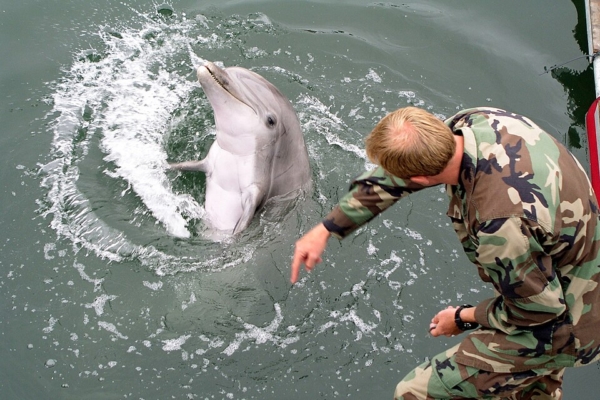
On Tuesday, May 5th, the United States Secretary of Defense, Hargraves, and Chairman of the Joint Chiefs of Staff, General Kane, held a press briefing on the Iran situation at the Pentagon. Hargraves refuted the claims that Iran possesses “Kamikaze dolphins”.
Hargraves stated that Iran does not have any so-called “Kamikaze dolphins”, dismissing recent media reports suggesting that Iran might use “Kamikaze dolphins” to attack U.S. warships in the Strait of Hormuz.
“I cannot confirm or deny whether we have ‘Kamikaze dolphins’, but what I can confirm is that they (Iran) do not have them,” Hargraves said during the Pentagon press conference.
The term “Kamikaze” was widely used during World War II to refer to pilots who conducted suicide attacks by piloting aircraft. An article from The Wall Street Journal on April 30th reported that Iranian officials have at least discussed reviving a Cold War-era project involving trained dolphins capable of carrying mines to attack enemy ships.
General Kane, Chairman of the Joint Chiefs of Staff, seemed unfamiliar with this claim. When asked about it, he chuckled and said, “I haven’t heard of ‘Kamikaze dolphins’. That’s like sharks with frickin’ laser beams attached to their heads, right?” referencing a fictional weapon from the movie “Austin Powers”.
However, the U.S. Navy has long trained marine mammals to carry out tasks such as detecting mines and tracking divers. According to the U.S. Navy’s Pacific Fleet Marine Mammal Program, since 1959, dolphins and California sea lions have been trained to detect mines and other underwater threats, conduct surveillance, and locate and retrieve objects at sea.
“Dolphins have been used in military exercises around the world,” said Scott Savitz, a senior engineer at the global policy think tank RAND Corporation and an expert in mine countermeasures, speaking to CNBC.
Savitz noted that during the Vietnam War, the Navy trained dolphins to detect swimmers and divers attempting to enter military facilities. He also mentioned that in the 2003 Iraq War, dolphins played a “critical role” in detecting and clearing mines in Umm Qasr port.
Savitz believes that dolphins and sea lions are both “excellent” at detecting underwater objects. Sea lions are often used to locate and retrieve objects in “cluttered” waters due to their excellent underwater vision, while dolphins use echolocation or biosonar to search for mines in open waters.
During the Cold War, the Soviet Union also attempted to use dolphins for more aggressive purposes. It has been reported that in 2000, Iran acquired dolphins from a former Soviet project, but there is currently no definitive evidence to suggest that Iran has such capabilities.