
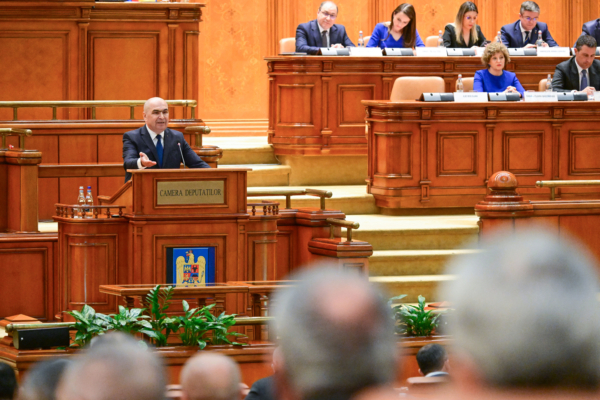
Romanian Parliament on Tuesday (May 5) passed a vote of no confidence against the government, overthrowing Prime Minister Ilie Bolojan’s pro-European Union administration. The political turmoil may put the country’s sovereign debt rating, EU funding access, and currency stability at risk.
Bolojan led a minority coalition government composed of four parties, with the left-wing Social Democratic Party (PSD) withdrawing from the coalition government last month.
According to the Associated Press, official tally results from the Romanian Parliament showed that the motion of no confidence on Tuesday received 281 votes, surpassing the required 233 votes.
Members of Bolojan’s center-right National Liberal Party (PNL) and the governing partners Save Romania Union (USR) and the Hungarian Democratic Union (UDMR) all abstained from voting.
The government’s collapse was driven by the Social Democratic Party, the largest party in parliament, and the far-right opposition party Alliance for Uniting Romanians (AUR).
The Social Democratic Party cited damage to voters’ interests due to Bolojan’s austerity policies as the reason for exiting the coalition government last month, subsequently joining forces with the AUR to submit the no-confidence motion on April 28.
The Romanian Parliament, comprised of the Senate and the Chamber of Deputies, has a four-year term. The current parliament, elected in December 2024, consists of 465 members, including 134 senators and 331 deputies. The Senate is chaired by Mircea Abrudean from the National Liberal Party, and the Chamber of Deputies is chaired by Sorin Grindeanu from the Social Democratic Party.
Bolojan described the no-confidence motion as “intentional and callous,” stating, “It is callous because it did not take into account the situation we are facing. I have taken difficult but necessary fiscal measures, effectively rebuilding confidence in the Romanian government.”
“When I took on the role of prime minister, I knew it came with immense pressure, and I knew I wouldn’t receive the public’s applause. But I chose to do what is urgent and necessary for our country.”
Before the vote, Bolojan questioned lawmakers, “Can someone tell us how Romania will run tomorrow, do you have a plan?”
Social Democratic Party Chairman Sorin Grindeanu stated after the vote, “Life goes on,” and expressed hopes to find a solution quickly, saying, “All options are open.”
However, both Bolojan’s National Liberal Party and the AUR have explicitly stated they will no longer cooperate with the Social Democratic Party in forming a new government.
Romanian President Nicusor Dan urged all parties to remain calm, emphasizing this is a “democratic decision of the parliament,” indicating that negotiations to form a new government are ongoing.
He said, “I rule out the possibility of early elections. After completing these procedures, we will have a pro-Western government.”
With no single party currently having enough parliamentary majority to form a government, there is a high risk of political deadlock.
Bucharest political analyst Cristian Andrei analyzed that the new cabinet currently has two provisional options: either reshuffle the coalition government within the same framework, excluding Bolojan, or have the Social Democratic Party lead a minority cabinet in alliance with a populist small party.
He pointed out, “The formalization of a cabinet led by the Social Democratic Party and the AUR is currently not feasible because the President will not approve it.”
Romania has never held early elections, with the next general election scheduled for 2028. As per a prior power-sharing agreement, the prime minister’s position was originally set to transition from Bolojan to a Social Democratic Party candidate in 2027.
Currently, Romania ranks high among EU member countries in terms of government deficit, facing significant inflation and technical recession. Bolojan’s government had already begun cutting the deficit to barely avoid a credit rating downgrade.
Conflicts between Bolojan and the Social Democratic Party often arose over measures such as tax increases, freezing public sector wages and pensions, and reducing public service positions and other state expenditures.
The Social Democratic Party stated last week that Romania needs a “collaborative” leader and criticized Bolojan for failing to implement any real reforms during his 10 months in office.
Bolojan stressed the importance of the tough fiscal measures taken, stating that they were crucial and had “regained the market’s trust in the Romanian government.”
The ongoing political crisis has made Romania’s economic outlook even more fragile. Prior to the vote, the Romanian leu to euro exchange rate had dropped to a historic low.
Analysts cautioned that the volatile political situation could jeopardize the country’s sovereign debt rating and affect its access to EU funding.
Romania must continue advancing reforms and cutting the deficit before the August deadline to access around 10 billion euros in EU recovery and resilience funds.
Bolojan will continue to govern as acting prime minister but with limited powers until the new government receives parliamentary approval.