
In the first quarter of this year, the operating income of 107 A-share photovoltaic listed companies in China decreased by about 4 billion yuan compared to the same period last year, with a total net profit of only 330 million yuan. The overall profitability of the industry has not fully recovered.
According to a report by “21st Century Economic Herald” on May 4th, Chinese listed companies have successively released their first quarter financial reports. Among them, 109 A-share photovoltaic companies had a total operating income of 271.426 billion yuan in the first quarter, a decrease of about 4 billion yuan compared to the same period last year; with a total net profit of only 3.30 billion yuan. Leading companies such as JinkoSolar, LONGi Green Energy, and Daqo New Energy all saw declines in both revenue and net profit.
Among the 109 photovoltaic companies, 28 A-share photovoltaic companies achieved double-digit growth in both operating income and net profit in the first quarter of this year.
Faced with the industry downturn, some leading companies changed their business strategies in the first quarter of this year. Companies like JA Solar, Tongwei Co., JA Solar Technology, and Xinjiang Goldwind Science & Technology Co. shifted their focus from expanding revenue to ensuring profit recovery, resulting in narrower losses compared to the same period last year.
The report suggests that the current photovoltaic industry is still in a cyclical downturn, and industry reshuffling is not yet over.
According to data from the China Photovoltaic Industry Association, by 2025, the price of photovoltaic modules has fallen by more than 60% from the peak in 2023, with about one-third of the industry experiencing losses.
Morningstar, an international credit rating agency, stated that by 2025, China’s solar photovoltaic capacity had almost doubled the global demand. Even when factoring in the demand growth brought about by the Middle East conflicts, the oversupply situation has not improved.
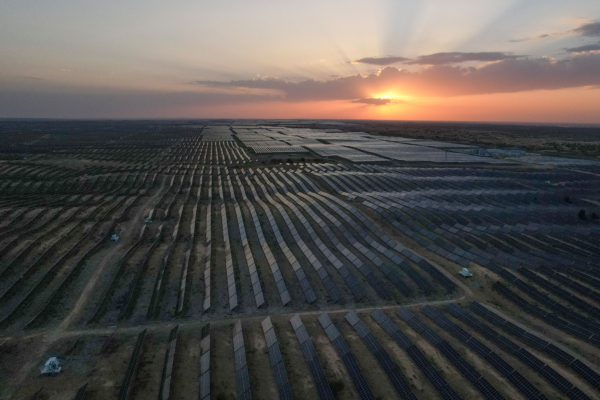
Some analysts believe that the production capacity of China’s photovoltaic industry is severely oversupplied, leading to price wars. Currently, China mainly installs solar panels in the vast, desolate, and desertified lands in the west, where the installed area is already substantial, especially in regions like Xinjiang, Tibet, Qinghai, causing a certain impact on the local ecology.