
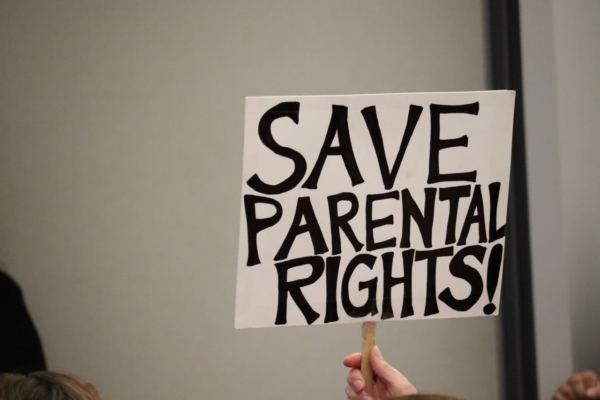
In early March, the United States Supreme Court had to intervene to reiterate a fundamental fact: parents should be the primary decision-makers for children, not schools.
In the ruling of Mirabelli v. Bonta case, the Supreme Court found that California’s law prohibiting schools from disclosing children’s self-professed gender identities to parents violated the constitutional rights of parents, including the religious freedom rights protected by the First Amendment and the decision-making rights over the upbringing of children under the Fourteenth Amendment.
Throughout most of American history, parents have been recognized as the primary authority in children’s lives. However, this authority is now being challenged, especially in public schools.
Across the United States, many families are being excluded from their children’s educational information, unable to access crucial health and personal details, and unable to choose schools that best meet their children’s needs. This is not a minor issue but a fundamental threat to parental authority, children’s well-being, and the future of society.
In many school districts, controversial curricula are being brought in without parents’ knowledge. Parents who request to review classroom materials are either ignored, told that the materials cannot be provided, or asked to submit public records requests. Families speaking out at school board meetings are often labeled as agitators or troublemakers, even referred to as “domestic terrorists.”
Schools increasingly view parental involvement as optional rather than essential. However, when children enter the classroom, parental rights do not disappear. Education exists to serve families, not to replace them.
The issue goes beyond curriculum setting; teachers and administrators are withholding vital medical or personal information about minors from parents. If crucial information is deliberately concealed, parents cannot fulfill their responsibility to care for their children.
These conflicts are not hypothetical. In recent years, more and more school districts have implemented policies that allow or even encourage students to undergo “social gender transitions” at school—using different names or pronouns without notifying parents. In some cases, school staff are even required to conceal this information from parents, creating a barrier between parents and children.
Furthermore, parents are still deprived of substantial decision-making power regarding their children’s school choices. Millions of families are still assigned to specific schools based solely on postal codes. Even when children face academic challenges, bullying, or require a different learning environment, parents often have no choice. This puts the education and well-being of children at risk.
Fortunately, change is underway. States across the country are expanding “school choice programs,” allowing education funding to follow students rather than be fixed within the existing system. Private school scholarship programs, education savings accounts, and tax credits for scholarships are empowering families, enabling them to freely choose learning pathways that meet their children’s unique needs.
Many parents urgently desire to leave the public education system because it has failed to fulfill its core mission of providing quality education, no longer listens to parental voices, and even excludes them in many cases.
Parents must have the ultimate authority over their children’s growth, not school bureaucrats. Parents raise children, know them from birth, and continue to support them long after their academic journey ends. Regardless of good intentions, no teacher or administrator should substitute this role.
This point was self-evident in most of our country’s history. Parents not only have the right but also the responsibility to guide their children’s growth and education, a principle that courts have repeatedly reaffirmed.
However, this authority is now under threat. As evidenced in California, bureaucratic policies are increasingly attempting to supplant parents’ roles in children’s lives.
Excluding parents weakens trust, strips away school accountability, and harms children. When institutions determine what children learn, which personal information should be kept confidential, or even which schools they can attend, families are marginalized, depriving children of guidance from those who understand and care for them most. Schools should operate transparently, and parents should be seen as partners rather than obstacles, with their decision-making rights respected.
Children belong to families, not bureaucratic systems. Various institutions must not forget this. Restoring parental authority is not a radical move but a return to long-standing American principles: families, not government institutions, are the foundation of society and should be trusted to guide children’s growth and education.
Failure to defend this principle could result in cultivating a generation of young people lacking parental guidance and school accountability mechanisms, with fewer opportunities for success. However, when parents are respected and empowered to play a leading role in their children’s lives, families become more solid, and our nation’s future becomes brighter.
It is time to bring parents back to their rightful position—as the primary, most trusted, and most important decision-makers in children’s lives. The Supreme Court’s ruling is a significant step in the right direction.
Author Keri D. Ingraham is a senior fellow at the Discovery Institute, director of the American Center for Transforming Education, and a senior fellow at the Independent Women’s Forum.
This article represents the author’s personal views and may not reflect the stance of “Epoch Times”. ◇