
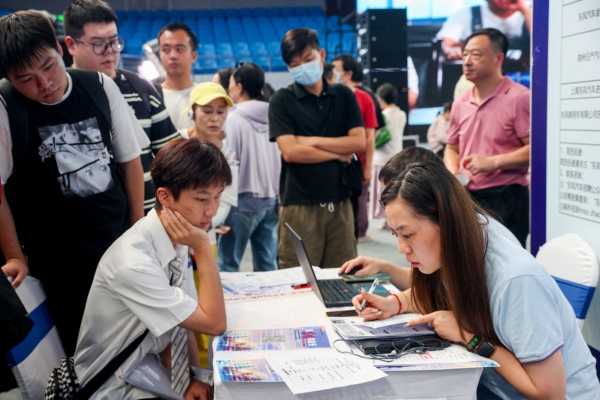
In the past few decades, the brightest graduates from China’s top universities would typically choose to study abroad or join internet technology companies and the financial industry. However, now they are opting for the manufacturing industry, entering state-owned enterprises and defense industry under the banner of “self-reliance” promoted by the Chinese Communist Party, reverting back to employment patterns of decades past, being rebranded as “red engineers.”
The recent release of employment destinations for China’s top university graduates shows a significant shift in employment patterns since 2019. Tsinghua University recently revealed that the proportion of 2025 graduates going abroad was only 8.5%, marking a new low in nearly a decade, while the number entering the manufacturing and energy industries saw a 19.1% increase compared to previous years, with a continuous growth for six years. It is reported that Huawei, state-owned enterprises, and defense enterprises are the main employment destinations for many graduates from prestigious universities.
Graduates from universities like Xi’an Jiaotong University, Tongji University, and Huazhong University of Science and Technology are also predominantly entering the manufacturing, energy, and defense industries.
Last year, Xinhua News Agency reported that over half of the graduates from defense-related universities such as Beijing University of Posts and Telecommunications, Xi’an Jiaotong University, and Harbin Engineering University went on to work in “industry-leading companies and national strategic units.”
Looking at the regions, the number of Tsinghua graduates heading to the western and northeastern regions for employment has been steadily increasing for five consecutive years, with a nearly 26% increase for graduates of Huazhong University of Science and Technology heading to the western regions. 27.65% of Tongji University graduates chose to leave first-tier cities and work in “grassroots and remote areas.”
Professor Xie Tian from the Moore School of Business at the University of South Carolina expressed to Dajiyuan that the changing employment patterns of China’s top university graduates are essentially a forced response. The United States has started restricting Chinese students in key high-tech fields, while China’s financial sector and internet platforms have lost their allure.
He stated that during economic downturns, students are compelled to seek work domestically, leaning towards lower-tier manufacturing and energy industries. “China’s development of AI has led to a rapid increase in the demand for energy and requires manpower. However, these individuals are not the traditional white-collar workers but rather more inclined towards advanced technical talents.”
Lai Rongwei, CEO of the Taiwan Inspiration Association (TIA), mentioned to Dajiyuan that the employment preferences of young people tend to align with the government’s favored policies. They are willing to enter industries where the government heavily invests, ensuring ample funding and job opportunities. Young people also tend to avoid industries suppressed by the government, reflecting a typical career planning based on self-interest. He remarked that the CCP now aims for political loyalty from the citizens and discourages young people from studying abroad to cultivate independent critical thinking, criticizing the Chinese Communist Party-state.
Six years ago, the top choice for graduates of China’s top universities was studying abroad.
The years between 2000 and 2010 were golden years for Chinese students studying abroad. In 2017, the number of Chinese students studying abroad surpassed 600,000 for the first time, not only applying to foreign universities but increasingly becoming an alternative choice for many exam takers and parents apart from the national college entrance examination.
At that time, staying in China after graduating from a top university to start a business, join financial firms, foreign companies, or internet technology companies was often the preferred choice. The lower-paying, bureaucratic state-owned enterprises and defense industry were unable to attract top talents.
Even a few years ago, joining the civil service was a last resort for graduates from the elite 985 Project universities, considered less appealing by these graduates. Particularly in recent years, the popular civil servant examination has made it exceedingly difficult to attract graduates from prestigious universities.
Today, returning from overseas is no longer as appealing, with Tsinghua University’s graduates opting to go abroad at a record low in the past decade.
The percentage of Tsinghua graduates studying abroad has been on a downward trend for over a decade, with numbers decreasing from approximately 16.5% in 2014 to around 16% in 2018, 7.1% in 2022, about 8% in 2023, and roughly 8.5% in 2025.
This trend seems to be regressing to the pre-1980s era, when employment for Chinese university graduates mainly revolved around government departments, state-owned enterprises, and defense companies.
Looking back, Tsinghua University was initially established as a “preparatory school for studying in the United States,” attracting the best Chinese students to study advanced technology in America. However, ever since the CCP took power in 1949, Tsinghua has been transformed into a “cradle for red engineers,” with a high proportion of Communist Party members among its students. Many Tsinghua graduates have ascended to the highest levels of the Communist Party, with the university’s original motto of “Strengthen the self, uphold integrity; Independent spirit, freedom of thought” being truncated to just the first eight words.
After experiencing a surge in studying abroad over the past 20 years, Tsinghua University has undergone a cycle once again, repositioning itself as the “cradle for red engineers.”
Xie Tian commented, “As a graduate of Peking University, I can feel the oppressive atmosphere at Tsinghua when Peking University students go there, lacking the freedom that Peking University offers.”
He noted that this situation has been caused by the CCP, turning Tsinghua into a training ground for producing obedient technicians, molding students to follow orders and nurturing compliant technocrats.
“Tsinghua University attracts exceptionally talented young Chinese students, but under the distorted suppression by the CCP, they are turned into servants rather than genuine talents, which is quite regrettable.”
Lai Rongwei stated that Tsinghua is the leading university in China, serving as a microcosm of all levels of education in the country.
He mentioned that Xi Jinping has a significant aversion to the West, aiming to emulate Mao Zedong and disregarding Deng Xiaoping. Mao once stated that a China with few possessions and barefoot was excellent, likening the people to a blank sheet of paper, where with a large population, discord and chaos exist. Xi hopes for young people to be as pliable as blank paper for him to manipulate.
He added that Xi prefers red engineers, fulfilling his dream of a technologically strong nation while ensuring their obedience. Tsinghua University has transformed into the cradle for red engineers, with red symbolizing political loyalty to the CCP, which, in essence, is synonymous with loyalty to Xi Jinping. It follows Xi Jinping’s ideologies, demanding political loyalty.
Currently, China remains integrated into the global trade and technology networks. However, with the escalation of the U.S.-China trade and tech war, the route where China relied on Chinese students to steal advanced technology is gradually being sealed off. As a result, China’s top graduates, under the banner of “self-reliance,” find themselves in an awkward position.
Lai Rongwei emphasized the importance of innovation relying on a vibrant civil society and not solely on state capital or state control.
He pointed out that the reason the United States is powerful is due to the freedom and democracy ingrained in its soil, allowing young people to have innovative thoughts and unlimited imagination. Conversely, authoritarian regimes and state control operate based on political standards, where civil society and the economy are under the scrutiny of a few party leaders, perpetually restricted and fearful, inhibiting innovation and discouraging individuals from taking risks. Who would dare to innovate in such an environment? This would hinder progress and prevent genuine innovation.
Notably, some individuals may advocate the spirit of “foolish old man moving mountains” and creating new opportunities against the odds. However, amidst adversity, the more likely scenario is internal stagnation, where innovation becomes scarce, mirroring the continuous replication of existing models, generating more meaningless complexities.
He believed that viewing the world as an enemy and deviating from the world leads to isolation and self-imposed restriction.