
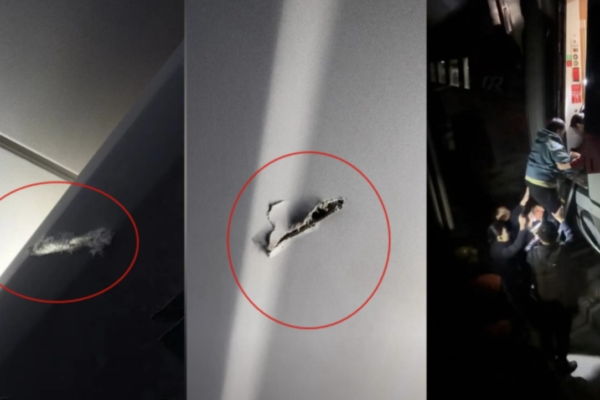
On March 18th, the Beijing-Harbin high-speed railway in mainland China encountered a sudden malfunction, with a train being pierced by an “unknown object” while in operation. This led to the emergency braking of the train, causing delays for multiple trains and leaving passengers stranded. The railway authorities only stated that the incident was caused by a “contact wire fault”.
In the afternoon of March 18th, the Beijing Railway issued a statement reporting that around 5 p.m. on the same day, there was a sudden contact wire fault between Chengde County North Station and Niuheliang Station on the Beijing-Harbin high-speed railway. This resulted in the G178 passenger train having to come to an emergency stop within the section, with temporary power outage inside the train. As a result, some trains passing through this section experienced delays in operations.
Videos circulating online showed a high-speed train being pierced by an unknown object, which resulted in a serious malfunction and the stranding of passengers. Photos indicated that certain equipment on the train seemed to have signs of tearing and puncture marks. Various claims such as the train being “pierced”, “externally impacted”, or “sabotaged” circulated on the internet.
According to a report by mainland media JiMu News on March 19th, the Beijing Railway released a statement in the morning of the same day, announcing that as of 6:19 a.m. on March 19th, after overnight repairs conducted by the railway authorities, the contact wire fault on the upline section between Chengde County North Station and Niuheliang Station on the Beijing-Harbin high-speed railway had been completely resolved, and the line had resumed operation.
The report mentioned a passenger on the G178 train who stated that around 5 p.m. that afternoon near Chengde, the train experienced a fault. They heard a sudden “clink” sound, after which the train came to a stop and the power inside the train went off. After waiting for nearly 3 hours, the passengers were transferred to rescue vehicles.
Another mainland media outlet, Purple Cow News, indicated that videos showed several netizens inside the power-off high-speed train cabin, where the cabin roof appeared to be damaged.
Official reports mentioned that the cause of the accident was a “contact wire fault”, but did not mention any damage to the train cabin.
There were many discussions among netizens on Chinese social media platforms. Some speculated that after the contact wire broke, the train’s pantograph failed to make proper contact for operation, leading to the pantograph losing restraint with the broken wire, causing it to break off and pierce through the train roof.
One netizen commented: “It is said that on G178, the broken pieces of the pantograph pierced the cabin at high speed, causing head injuries and cutting off water and power.” Another said, “Don’t spread rumors, G178 was pierced, and the train stopped online.” “China’s high-speed rail has developed too rapidly in the past decade, and issues of engineering quality and maintenance are beginning to surface gradually. This might just be the tip of the iceberg of systematic hidden problems.”
According to publicly available information, a train contact wire fault refers to incidents of power outage or equipment damage occurring in the special form of power supply transmission lines mounted along the railway track that provide power to electric locomotives. These incidents are mainly caused by various factors such as weather conditions, equipment quality and material issues, and external wear and tear.