
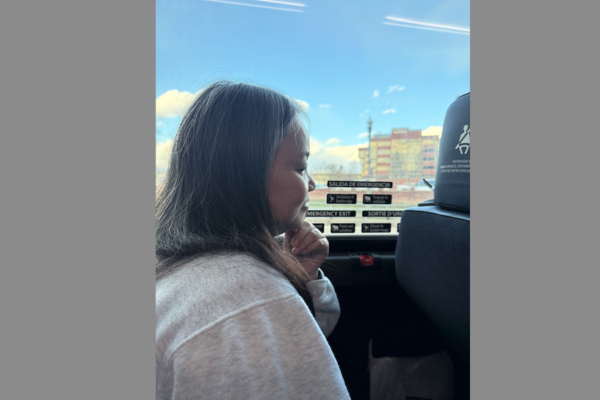
On the evening of March 11th, after being detained by the U.S. Immigration and Customs Enforcement (ICE) for a year and a half, Duanchun Xia stepped out of the immigration detention center’s doors and embraced her long-lost husband, Nijinfang. She was finally released, able to officially enter the United States, bringing joy and reunification to their family of three.
Nijinfang said that since Duanchun Xia arrived at the U.S. border in September 2024, she had been detained in immigration prisons with many twists and turns. In what seemed like a hopeless and dead-end situation, there were unexpected turns, leading to her being able to “see the clear moon after enduring the clouds,” thanks to relentless efforts and appeals from various parties.
Duanchun Xia was arrested when she entered through the U.S.-Mexico border in September 2024 and was not allowed entry. At that time, the Biden administration had announced strict restrictions on asylum seekers entering the country on June 4 of the same year. The Department of Homeland Security and the Department of Justice also issued a “temporary final rule,” severely limiting the eligibility of illegal immigrants to apply for asylum.
She was held by ICE at various immigration detention centers awaiting deportation. Over the following year and more, she was moved between two immigration prisons in Atlanta and Indiana. Her case had many ups and downs: from failing the initial “credible fear interview” and receiving a deportation order, to the cancellation of the deportation order, then obtaining a “deferred departure” (A10 card), and at one point being notified she might be deported to a third country in Africa. Finally, after submitting a request for a protection order to the federal court recently, she was granted release on March 11th, officially entering the U.S.
Nijinfang said that late at night on March 10th, he suddenly received a call from the legal team that the immigration detention center was inquiring about her release address, preparing to release her. “I received the call after one in the morning, I could hardly believe it,” he said. The next morning, just after 7 o’clock, the detention center called again to confirm they could pick her up. Nijinfang wasted no time and immediately booked a flight for later that afternoon, arriving in Indiana at 8:30 in the evening. That night just after 9 o’clock, he finally reunited with his wife.
“We hugged each other, and at that moment, I couldn’t find the words,” Nijinfang said. “After almost four years apart, we finally reunited, and I am very happy.”
Duanchun Xia said, “I am very fortunate. In the immigration prison, I have seen many people being deported, either willingly or unwillingly.”
Recalling her experiences during detention, Duanchun Xia still shudders. She mentioned that after receiving the A10 card in July 2025 (deferred departure, exempt from being sent back to her home country), she thought she would be released soon. However, ICE did not release her, citing that while she might not be deported to China, there was a possibility of being sent to a third country. “Later, I heard they wanted to send me to a third country in Africa; I was so scared that my legs were trembling, and I worried about it even in my dreams. If I were really sent to an African country, I would have no idea how to live.”
A turning point came with recent policy changes. Just as ICE was considering deporting some Chinese nationals unwilling to return to their home country to a third country, the “Guan Heng case” sparked attention, leading to the cancellation of plans to deport Chinese individuals to a third African country. At the same time, after having the A10 card for a full six months, Duanchun Xia was legally eligible to apply for a protection order from the federal court. On March 6, her legal team officially submitted the application to the court. On March 9, the court requested a response from the Department of Homeland Security and specified she should not be transferred to other detention centers. Just two days later, ICE decided to release her.
Nijinfang stated that his wife’s release was a result of ongoing attention and support from various circles. He especially thanked multiple human rights organizations and individuals, including Pastor Fuxiqiu, the Aid Association for Democracies in China, Chen Guangcheng, Wang Juntao, Chen Liqun, the “June 4 Memorial Hall,” the Rock Church, the Democratic Front, as well as several media outlets such as Dajiyuan, Rightsweb, and Guang Media, even for the appeals and support from mainland China human rights activists.
Nijinfang himself had faced oppression in China for supporting human rights lawyers during the “Suzhou 908 Mass Arrest” incident. Over the years, Duanchun Xia had always supported her husband’s human rights activities. Nijinfang had previously arrived in the United States with their daughter.
Activist Yang Maosen, upon hearing about Duanchun Xia’s release, expressed happiness at the good news. He also called for support for other anti-Communist activists who are detained by ICE, hoping ICE would not deport anti-Communist individuals back to China. Yang Maosen pointed out that under the recent intensified enforcement by ICE and the implementation of large-scale deportations, some Chinese individuals who have openly participated in anti-Communist activities in the U.S. face arrest when reporting to ICE or encountering ICE enforcement, leading to deportation risks, such as Youxin Yan. He said, “I hope that ICE and the Department of Homeland Security can show leniency towards those who oppose the brutal rule of the Chinese Communist Party. If they are deported back to China, they will face severe persecution by the Chinese authorities, which I believe is not something the U.S. authorities would want to see.”