
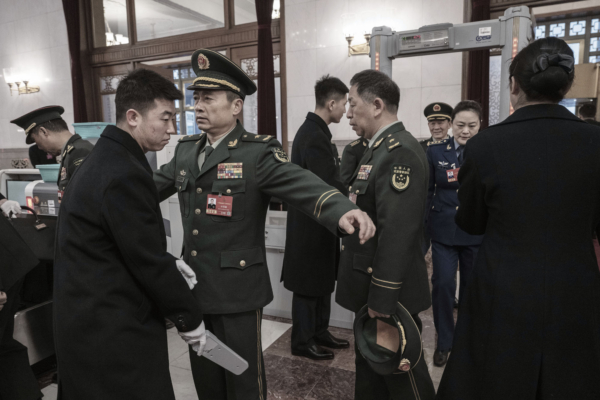
The Chinese Communist Party’s two sessions were held from March 4th to 12th, 2026, with over a hundred delegates and members absent, surpassing previous years. Among them were three vice-ministerial level officials, including Ma Xingrui, and 18 representatives and members of the military, including several generals.
During the two sessions, the number of military delegates to the National People’s Congress drastically decreased, with no deputy group leader appointed for the first time. Public Security Minister Wang Xiaohong made a rare appearance at the military delegates’ conference.
Minister of the United Front Work Department, Li Ganjie, did not participate in the Political Consultative Conference, while Minister of the Organization Department, Shi Taifeng, continues to serve as the Vice Chairman of the Political Consultative Conference. CCP elder Song Ping was announced to have passed away on the opening day of the two sessions. These anomalies in the two sessions reflect the turbulent internal struggles among high-ranking officials, especially the absence of vice-ministerial level officials and senior military leaders.
In the past three years, the number of National Committee members attending the National Political Consultative Conference has gradually declined. In the past three years, 43 National Committee members have been publicly disqualified.
Official reports indicate three current vice-ministerial level officials, CCP Political Bureau member Ma Xingrui, Vice Chairman of the National Committee, Chen Wu, and Vice Chairman of the National People’s Congress, Hao Mingjin, successively missed the opening and closing ceremonies of the National Committee and the Political Consultative Conference.
The session of the National People’s Congress on March 4th saw the absence of Ma Xingrui, a CCP Political Bureau member, from the Presidium list, breaking with tradition.
In the past three years, there have been intensified internal conflicts and purges within the CCP military. 36 senior officials attending the National People’s Congress have been publicly removed from their positions, including 16 generals, 14 lieutenant generals, and 6 major generals. Additionally, two retired or transferred officials were removed from the military delegation to regional delegations.
On March 7th, 2026, CCP leader Xi Jinping attended the meeting of military delegates. Only six generals appeared at the meeting, including Deputy Chairman of the Military Commission, Zhang Shengmin, Minister of National Defense, Dong Jun, and others.
The CCP’s top military officials, Zhang Shengmin, Dong Jun, Han Shengyan, Yang Zhibin, Fan Xiaojuan, and others, attended the National People’s Congress as military delegates. However, 13 generals were absent from the military delegates’ sessions, many of whom were rumored to be under investigation.
In the National Committee of the Political Consultative Conference, out of the 15 military officials, including 9 generals and 6 lieutenant generals, 3 were disqualified.
CCP leader Xi Jinping and Public Security Minister Wang Xiaohong attended the military delegates’ meeting on March 7th, a rare occurrence for Wang Xiaohong in the past two years.
Regarding Vice Chairman Zhang Yuxia and Member Liu Zhenli’s abrupt absence from a high-level workshop in January, rumors of their arrests circulated before their official dismissal.
The death of the 13th Central Political Bureau Standing Committee member, former State Councilor Song Ping, on March 4th, stirred speculation and analysis of the CCP’s political atmosphere.
The article highlights the hidden tensions within the high-level leadership and the strategic timing of Song Ping’s passing to deflect attention and silence potential dissent within the Party.