
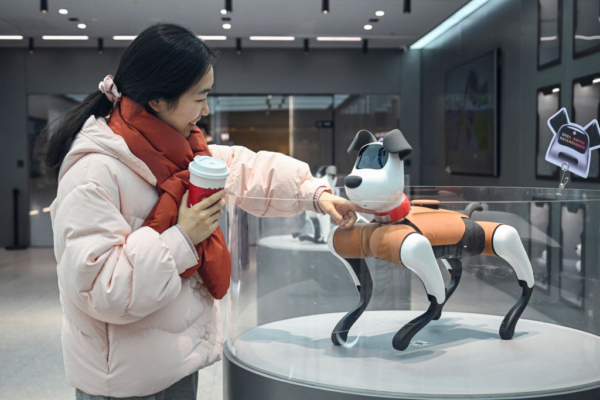
In recent times, AI pets have become popular among young people in China, with their advantages being affordability, novelty, not needing care, yet still fulfilling the need for emotional companionship. Analysis suggests that the popularity of AI pets reflects the current dilemma faced by Chinese young people of both lacking spiritual support and being unable to take care of real pets, and AI pets may also become part of the Communist monitoring system.
According to the official ranking of the “Top Ten Annual Products” for 2025 released by the Chinese e-commerce giant Taobao, AI pets ranked ninth. These AI pets can even write diaries, and many of their owners are women in their twenties and thirties.
An increasing number of tech companies have developed AI pets specifically designed for young singles in China. Huawei launched its first AI chat companion robot named “Smart Goofy” last November, priced at around 399 RMB, while the Shanghai tech company Robopoet has developed the electronic pet Fuzozo.
A report jointly released by the Shenzhen Toy Industry Association and JD predicts that by 2030, the Chinese AI pet market’s size will exceed 1.4 billion US dollars, with an annual compound growth rate of over 70%.
Analysts point out that unlike real pets, AI pets do not come with the burdens of various real-life problems, which may be a significant reason for the rise in popularity of AI pets.
Executive director Lai Rongwei of the Taiwan Inspiration Association (TIA) stated to Epoch Times that keeping pets in China is costly, including taking care of their daily lives, dealing with their waste, providing care if they fall sick, which all add up. With the current economic and job situation in China being unfavorable, job stability uncertain, reduced income, young people find it challenging to take care of themselves, making AI pets an attractive option due to their novelty, low cost, and ability to fulfill the desire to have a pet.
Former Chinese education teacher Geng Lutao mentioned to Epoch Times that the current generation in their twenties and thirties struggle with finding jobs, earning low incomes, and facing high living costs, leading to significant anxiety. Dealing with relationships, marriage is seen as a heavy burden. AI pets conveniently fill this void by being constant companions that talk to you, do not argue, do not bother you, making them popular due to the sheer exhaustion of real life.
Former Shanghai expatriate manager Cao Peng, now residing in the Netherlands, told Epoch Times, “When I was in Shanghai, I had two cats and a dog. AI pets seem less interactive, similar to an upgraded version of the electronic chicken popular when I was young.”
Cao Peng believes that the popularity of AI pets reflects the downgrade of consumption to an almost zero level.
He further stated that young people not only struggle with getting married, buying houses, raising children, even walking the dog, buying cat trees, pet food requires both time and money, costs that many people cannot afford. This led to the emergence of AI pets as a low-cost, always available solution to provide emotional support.
Cao Peng noted that this phenomenon represents the sorrow of an entire generation in China, brought about by the ongoing economic downturn. The abandoned real pets left due to unemployment or moving is a silent protest by young people who cannot cope with the challenges of life.
How long the craze for AI pets will last remains unknown.
The Washington Post reported that some users on Rednote expressed that while interacting with AI pets was fun in the first week, it quickly became repetitive and mundane, raising concerns that AI pets might follow the same fate as the Tamagotchi electronic pets from the 90s that people abandoned eventually.
Chinese media reports indicated that while the sales of AI pets surged in 2024, the return rate also increased to around 35%.
Cao Peng emphasized that despite the advancements in AI technology, AI pets lack the warmth and companionship that real animals like cats and dogs provide. The lack of feeding, time consumption, low interaction novelty of AI pets undermines their emotional value.
Geng Lutao stated that AI pets cannot truly replace real pets. Real pets are living beings with a sense of responsibility, emotional connection that AI cannot replicate. Even though AI pets may seem more attentive and comforting than real ones, ultimately, they are still just machines.
Geng Lutao pointed out that the biggest issue with AI pets is the potential for people to detach from real-life interactions. Over-reliance on AI companions may diminish individuals’ communication skills, making them hesitant to address real relationship conflicts. Spending too much time with AI could weaken interpersonal skills, leading individuals to prefer the comfort of virtual worlds over real human connections.
Cao Peng highlighted that depending on AI pets extensively would significantly reduce interpersonal interactions, impacting problem-solving abilities. Entrusting preferences and thoughts to AI pets exposes individuals to the manipulation of large companies driven by algorithms, granting them control over personal information.
Essentially, AI pets are AI products designed to record conversations, equipped with built-in cameras, microphones, and motion sensors to interpret facial expressions, movements, and tones, creating detailed behavior and thought profiles for users.
Most AI products and companies related to AI that initially developed in mainland China have ties to surveillance.
Cao Peng added that AI will likely become a tool for the Communist government to monitor its citizens. With mass facial recognition and surveillance systems like Hikvision and Sensetime enabled by numerous cameras, every input a person makes daily will be systematically filtered and submitted to the network security system, allowing authorities to control job opportunities, financial restrictions, and opinions to achieve comprehensive societal control.
Geng Lutao emphasized that the Communist Party prioritizes AI development predominantly for better societal and population control.
He explained that without emotional outlets or spiritual support, young people are more prone to protests, questioning the government, demanding structural changes. Promoting AI products, including AI pets, is, in a way, a means to “pacify young people.”
“It serves to distract everyone’s attention, keeping the young generation immersed in virtual worlds, avoiding real-life issues; moreover, during the usage, AI collects a vast amount of personal data, including your thoughts, emotions, preferences, values, and even what you care about daily. These insights are extremely valuable to the Communist regime.”
According to Geng Lutao, with surveillance cameras, facial recognition, phone monitoring, and big data analysis rampant everywhere, AI is likely to evolve into an “invisible control system” in the future. Not only tracking actions but also analyzing thoughts, dissatisfaction, and resistance.
“From this perspective, AI is more than just a technological product; it could potentially evolve into a tool for the Communist Party to strengthen control and prevent protest movements.”
Lai Rongwei stated that China’s development of AI always encompasses political considerations. AI developed in China will not be left to private companies for unrestricted growth; the state and the party will interfere and promote an electronic dictatorship that can sow Communist values deep within users’ minds, including through AI pets.
Cao Peng pointed out that no matter how powerful AI becomes, it cannot eradicate wealth disparities, the trend of young people avoiding marriage and childbirth. As young people face rapid decline, China’s future will be riddled with challenges, including the collapse of the real estate market, the education system, and the job market.
“With China’s deteriorating economy, many incidents in China happen suddenly, with no prior signs. For instance, the large-scale incidents in recent years (such as indiscriminate driving into crowds) are what the Communist Party fears the most. Even relying on technology for stability, it is ultimately vulnerable to the primitive Zhang Xianzhong approach.” ◇