
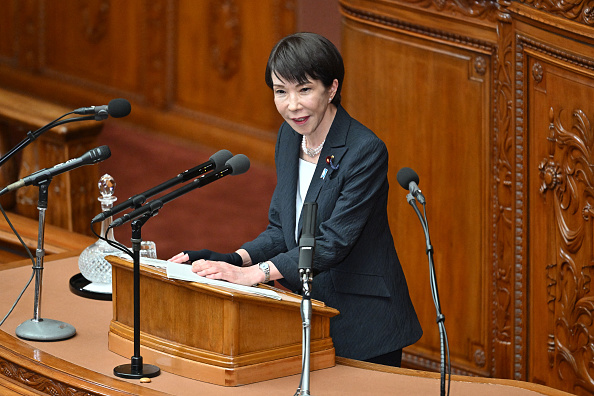
On February 20, Japanese Prime Minister Sanae Takaichi delivered her first policy speech in the Japanese House of Representatives after taking office. She described Japan as facing the “most severe” security environment since the end of World War II, specifically pointing out the military activities and coercion by the Chinese Communist Party (CCP) in the surrounding maritime areas. She also mentioned plans to revise Japan’s three major security documents within the year.
Takaichi stated in her speech, “Japan is facing the most severe and complex security environment since World War II.”
She identified the main threats Japan is facing as coming from the CCP, Russia, and North Korea.
She expressed concern that the CCP’s “coercive behavior is escalating,” and that they are “increasing attempts to unilaterally change the status quo in the East China Sea and South China Sea through force or coercion.”
Takaichi also mentioned the increase in North Korea’s nuclear missile capabilities and their relationship with Russia. North Korea provides military assistance to Russia, and in return, Russia may be transferring various missile-related technologies to North Korea.
In the current situation, Takaichi emphasized the importance of Japan charting its own course with a long-term goal in mind, using diplomacy and defense as the two driving forces to safeguard Japan’s independence and peace. She also highlighted the need to guide the world towards openness and cooperation to play an active role in promoting Japan’s prosperity alongside the global community.
Regarding relations with China, Takaichi referred to China as an “important neighboring country,” stating that the Japanese government consistently promotes a “strategic reciprocal relationship” and is committed to building a “constructive and stable relationship.”
She announced plans to revise Japan’s three core security documents this year to formulate a new defense strategy. Additionally, there will be an expedited review of military export regulations to expand overseas defense equipment sales and strengthen defense industries.
These three key documents include: the National Security Strategy, the National Defense Program Guidelines, and the Mid-Term Defense Program.
Takaichi intends to continue increasing national defense expenses, aiming to raise Japan’s defense spending to 2% of GDP by the end of March, making Japan one of the largest military spenders in the world.
Following the Japan House of Representatives election held in early February, Takaichi led the Liberal Democratic Party and its ruling coalition partner, the Japan Innovation Party, to win a total of 352 seats, exceeding two-thirds of the Lower House’s seats. This indicates that her proposed plans are likely to face minimal resistance.
Takaichi also announced plans to establish a National Intelligence Council, which she will oversee to integrate information collected from various agencies, including the police and the Ministry of Defense.
Japan currently does not have a centralized intelligence agency similar to the United States Central Intelligence Agency (CIA) or the United Kingdom’s Security Service (MI5).
In addition to security issues, Takaichi proposed setting up a Foreign Investment Review Committee, following the example of the United States, to review foreign investments in sensitive areas. She also mentioned plans to review rules related to foreign purchase of land.
She pledged to strengthen supply chains to reduce dependence on “specific countries,” collaborate with allies to ensure access to critical materials (including rare earths), especially around the remote Pacific island of Minamitori.
In conclusion, she stated, “A country that does not dare to face challenges has no future. Politics that seek only protection cannot inspire hope.”