
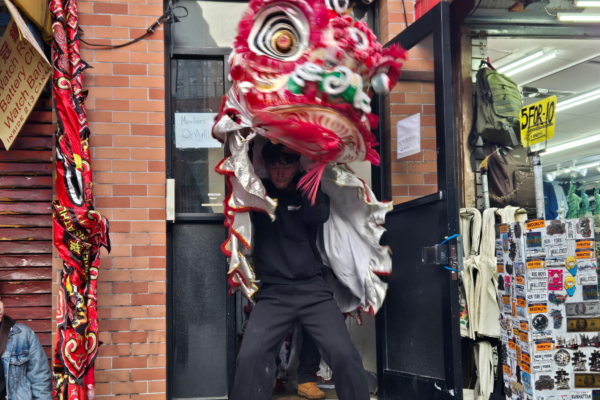
Every Chinese New Year in Manhattan’s Chinatown, the streets are illuminated with thunderous drums and dancing lion shadows. On the first day of the lunar new year and on February 28th, known as “Super Saturday,” over ten lion dance troupes parade through Mott Street, Elizabeth Street, Mosco Street, and Bayard Street, visiting homes and businesses to spread New Year cheer. These scenes have become cultural markers of Chinese celebrations and one of the liveliest winter cityscapes in New York.
Behind the drumbeats and smoky atmosphere, lion dancing is more than just a performance. For many who grew up participating in lion dances in Chinatown, the lion’s head carries traditions of kung fu, discipline, culture, and personal growth. 19-year-old Zhang Jianwei and Chen Jialing, a senior general consultant at the Hong Qing Athletic Association, belong to different generations but share a commitment to this tradition. Their stories embody the culture of lion dancing in Chinatown.
When Zhang Jianwei first entered the Hong Qing Athletic Association at the age of 12 and a half, he didn’t know Chinese and was unaware of lion dancing and the significance of the New Year. He fondly recalls his initial naivety.
Growing up in the U.S., he was a typical ABC (American-Born Chinese). It wasn’t until his sister started learning lion dancing and took him to the martial arts studio on the fourth floor of 211 Canal Street that he began to connect with his own cultural heritage.
Initially, he would sit in a corner watching others practice. At the age of 13, he officially started learning lion dancing, and he did it for six years.
In the traditional context of the studio, “Learn kung fu before lion dancing” was a strict rule. It required mastering fundamental skills before being allowed to handle the lion’s head.
Zhang Jianwei vividly remembers the rigorous lion dance training. “It was definitely tough. I was a bit overweight at the time. I couldn’t even do push-ups or other exercises.”
Training began with horse stances—four-corner stances, horse-stance positions, stance-walking feet apart, maintaining a straight back and low center of gravity. This was followed by bow steps, insert steps, and other lion dance techniques, aimed at building a strong foundation in footwork for stable and agile movements. The training also included abdominal and upper body strength exercises such as sit-ups and push-ups. These basic exercises typically lasted at least two hours.
Given that the lion’s head weighed around 20 to 30 pounds, being able to perform for at least ten minutes required solid leg and arm strength.
After a year of perseverance, he noticed changes in his body. “I used to be stiff, but now I’m much more flexible. I couldn’t do 10 push-ups before, but now 50 are no problem. Previously, I couldn’t hold the lion head for 10 minutes, but now over 20 minutes is also no problem.”
As his body grew stronger, so did his confidence.
More important than physical changes was the sense of belonging the lion dance team gave him.
Coming from a single-parent household, he lacked male role models growing up. He candidly admits, “I didn’t know how to become a mature man.”
When he first joined, he was shy and introverted, afraid to talk to people. But here, he found a group of brothers and friends who treated him like family. “They were good to me, and I could rely on them for anything. Finding a job, choosing a school, I asked them for advice.”
Together, they sweated, trained, and lion danced, forging deep bonds through daily trials and tribulations.
Lion dancing also helped him overcome his shyness gradually. “The first time I performed, I was very anxious, afraid of making mistakes.” After repeated experiences, he could now dance freely amidst the beating drums and crowds.
Training at the Hong Qing Athletic Association is entirely free, though “free” doesn’t mean lackadaisical.
“When you come here, you’re using this space, so you should treat it like your own home.” Organizing equipment, maintaining the venue, upkeeping drumskins, caring for the lion head – all were part of the training.
Every year, the lion head needed a new layer of paper reinforcement. He explains, “The lion head is made of paper, and even a slight bump can damage it, so every year we add a layer to make it sturdier.”
These seemingly mundane tasks taught him a sense of responsibility.
Now in college, he visits the studio less frequently, but he still returns every Friday to teach younger members. “I’ve gone through what they are doing, so I teach them.”
For Zhang Jianwei, every lion dance performance is like a play. When the lion sees the greenery during a performance, it expresses joy through lively leaps, expressive eyes, and tail-wagging. Faced with unfamiliar surroundings, it exhibits curiosity and vigilance, scanning left and right, sniffing, and cautiously stepping forward, showcasing a mix of speed and hesitation – symbolizing overcoming fear and embracing courage.
Once it confirms there is no danger, the lion leaps up, stretches its neck to obtain the hanging “greens,” completing the highlight of the lion’s awakening performance known as “Cai Qing.” This act symbolizes auspiciousness, prosperity, the courage to overcome fears, and embrace good fortune.
“Every performance is different,” Zhang Jianwei says, explaining how performances are adapted according to the occasion. Wedding banquets often include scenes of the “drunken lion,” where two lions indulge in celebratory drinks, acting intoxicated; they even “kiss” each other symbolizing marital harmony and good fortune. Birthday banquets showcase scrolls of blessings or the high-skill “standing lion” acrobatics.
Lion dancing also helped him gradually understand traditional culture. For example, the basic lion dance move called “Three Bows” involves consecutive sequences of lifting the lion’s head, stepping forward, lowering, stepping back, and swaying – an act of respect and symbolizing the dispelling of evil spirits and disaster. During “Cai Qing,” the homeowner hangs red envelopes, lettuce (pronouncing “wealth” in Chinese), and tangerines (symbolizing good luck), while the lion spits out shredded greens, representing prosperity.
In traditional Chinese beliefs, lion dancing is believed to ward off evil spirits and attract blessings, hence its presence during grand celebrations and festivals. The lion colors also carry symbolic meanings: yellow, red, black correspond to the Three Kingdoms characters Liu Bei, Guan Yu, and Zhang Fei, with red lions being the most commonly seen, symbolizing joy and auspiciousness.
For Zhang Jianwei, each performance is a cultural enlightenment process, allowing him to better understand his own heritage amidst actions and rituals.
One of the most memorable experiences for him was the midnight drumming on the thirtieth day of the lunar new year, regardless of snow or rain, marking what ABCs call “Midnight Madness – Chinese New Year’s Eve.”
In traditional lunar new year customs, the midnight lion dance from New Year’s Eve into the first day of the new year symbolizes bidding farewell to the old and welcoming the new. The drumbeats and majestic lion images are believed to dispel evil, drive away plagues, and pray for prosperity, good fortune, and blessing in the coming year.
Typically, after the Lunar New Year’s Eve reunion dinner, lion dance troupes gather at the Hong Qing Athletic Association to hold a ceremony for the newly acquired lion. At 11:30pm, the team sets out, parading along Canal Street to the Hung Mun Civic Association at 22 Mott Street to pay respects to the ancestors and offer tributes. At midnight, the lion dance troupe performs in front of the association, announcing the end of the old year and the beginning of the new, then returns to the athletic association.
Initially restricted to members of the athletic association and the Hung Mun clan, this annual event has now grown into a beloved community tradition, attracting hundreds of residents and tourists each year who congregate to enjoy the sights and sounds of drums and lion dances.
Zhang Jianwei reminisces, “Every year, we would come out at midnight, no matter if it was snowing or raining. It would be past one or two in the morning by the time we finished, and we wouldn’t go home until three. But we enjoyed it; every year, we looked forward to this day, and many family members would also join us.”
For him, this ritual represents the essence of Chinatown, a tradition upheld by the Hong Qing Athletic Association for decades, paying homage to heritage, mentors, and predecessors.
Starting from January each year, the lion dance team enters its busiest period of the year.
“We started last month and will be busy until March,” Zhang Jianwei explains, from the Lunar New Year to around the Lantern Festival, with celebrations like the overseas Chinese spring banquet, corporate Lunar New Year dinners, new store openings, weddings, birthday celebrations, and other events requiring performances almost every week.
With the youngest member of the lion dance team being only fifteen years old, many are tasked with balancing schoolwork and cannot participate in every performance. During such times, senior members who have trained previously and alumni in the workforce often return to support. “When we call, they all come back to help.”
This intergenerational connection makes the lion dance team feel like a big family. With old members returning and new ones growing, the tradition continues naturally through each performance and collaboration.
Over his six years at the Hong Qing Athletic Association, Zhang Jianwei not only learned lion dancing but also learned how to interact with people.
He can now converse fluently with Chinatown elders in Chinese, maneuvering through crowds and streets with a lion head, exchanging greetings with other teams. Chinatown boasts numerous lion dance groups, and every year, in early summer at Columbus Park, they hold dragon and lion dance exchanges, showcasing their skills; during “Super Saturday” after the first day of the Lunar New Year, teams frequently meet at street corners, testing etiquette and coordination.
Based on martial virtue, teams encountered greet each other with respect to avoid any provocation. “We’ll give way or at times, crouch down and lower the lion head, slowly make way for the other team to pass.”
He jests that it is through these lion dance occasions and interactions with people that he gradually overcame his shyness, becoming more outgoing and confident. “You have to speak up. Say, ‘I’m Zhang Jianwei, what’s your name?’ It’s not about wanting to say it but needing to say it.”
As the interview draws to a close, he extends an invitation to peers of his age, encouraging them, “Don’t spend all your time playing games at home. Come out and see what your festival is like. Whether you want to get fit, become healthier, or make friends, you’re welcome to join us.”
The Hong Qing Athletic Association still opens its doors to young people every evening after 4 pm, providing free lion dance and martial arts training, hoping to offer children a place to go after school and enabling more people to engage with and learn from the culture.
Zhang Jianwei describes the Hong Qing Athletic Association as a school and a home. “We have senior uncles, sisters, and brothers who won’t let you be alone.” He says, “It’s like a big family here, welcoming everyone at all times.”
For him, lion dancing is not just a traditional skill but a path for young people to engage with the community, dive into their culture, and foster personal growth.
(to be continued)