
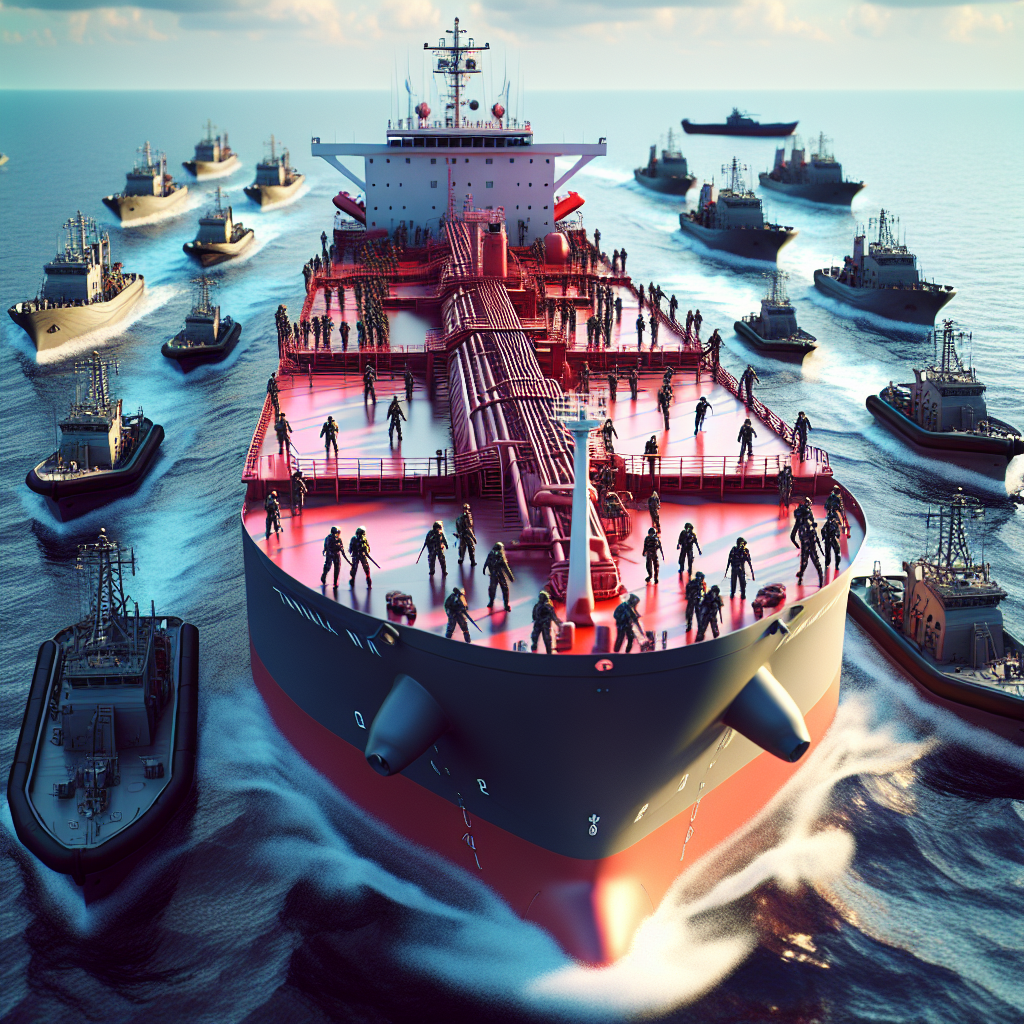
The United States Secretary of Defense, Pete Hegseth, confirmed on Monday, February 9th, that the U.S. military successfully intercepted and boarded an oil tanker named “Aquila II” in the Indian Ocean, suspected of violating sanctions by transporting Venezuelan crude oil to China. This operation unfolded from the Caribbean Sea all the way to the Indian Ocean, spanning half the globe.
Hegseth described the dramatic maritime pursuit on X, stating, “Last night, without any conflict, the U.S. military carried out a maritime interception and boarding inspection (Right-of-visit) of the ‘Aquila II.’ It attempted to escape, but we pursued relentlessly.”
Emphasizing that the Suezmax oil tanker was continuously monitored and hunted by the U.S. military since its discovery in the Caribbean Sea, Hegseth issued a stern warning to any “shadow fleet” attempting to evade blockade, stating, “You cannot outrun us.”
This operation is an extension of the U.S. military’s “Operation Southern Spear” military blockade. Following the capture of Venezuelan President Nicolas Maduro last month, President Trump ordered a comprehensive “oil blockade” against Venezuela.
According to Reuters, based on shipping schedules from the Venezuelan state oil company (PDVSA), the “Aquila II” was carrying approximately 700,000 barrels of heavy crude oil intended for China. Hegseth stated that the War Department tracked and captured this vessel from the Caribbean Sea, openly defying the U.S. “quarantine” measures imposed on sanctioned vessels in the Caribbean Sea.
Currently, the vessel is under U.S. military control. It is unclear from shipping databases the specific registration location of the “Aquila II.”
Since facing U.S. oil sanctions, China has been a major buyer of Venezuelan crude oil. As the Maduro regime needs hard currency support, the Chinese market has become its most critical export destination to circumvent sanctions.
These types of oil tankers usually employ “ship-to-ship transfer” or change identities in Malaysian or Indonesian waters before heading to Chinese ports. The interception point in the Indian Ocean by the U.S. military is a crucial transit route for these vessels heading towards Asia.
Addressing doubts regarding the costs of transoceanic interceptions, Hegseth rebutted in a public statement on January 7th. He pointed out that the global deployment of the U.S. military fleet—from the Mediterranean, Middle East to the Indo-Pacific region—ensures their capability to track from the Caribbean Sea all the way to the Indian Ocean.
Hegseth confirmed that the U.S. military had seized two “stateless” or sanctioned oil tankers overnight before. He explicitly stated that U.S. sanctions and blockades are effective “anywhere in the world,” seizing oil to pressure the transitional authorities in Venezuela to cooperate with the U.S., or else face complete economic collapse.