
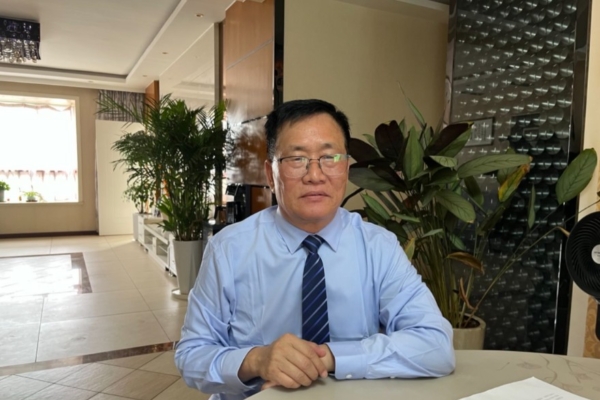
Chinese Investigative Journalist Liu Hu Detained by Sichuan Police, Sparks Concern
Renowned Chinese investigative journalist Liu Hu has recently been criminally detained by the Sichuan police, drawing widespread attention. Human rights lawyer Zhou Shifeng released a public letter on February 8 questioning the handling of the case and calling for the release of Liu Hu.
On February 1, 2026, Chinese investigative journalist Liu Hu went missing on his way to the Wanzhou High-Speed Rail Station in Chongqing and was later confirmed to have been criminally detained by the Chengdu police. On the same day, Wu Yingjiao, a self-media person who had collaborated with Liu Hu for a long time, was taken away by the Sichuan police in Handan, Hebei.
The Chengdu police verbally informed Liu Hu’s family on February 2 that he was suspected of “false accusation and framing” and “illegal business operations” and is currently detained at the Chengdu Municipal Detention Center.
In the days before his detention, Liu Hu and Wu Yingjiao published articles on their WeChat public account “Law and Emotion,” which involved a commercial dispute of a county secretary in Pujiang County, Sichuan. It was reported that related officials had filed a report with the police.
After Liu Hu’s detention, several lawyers and legal self-media individuals expressed their support. In his open letter, lawyer Zhou Shifeng stated that his purpose in writing the letter was not to emotionally defend any individual but to clarify the “rational relationship between citizen supervision and criminal prosecution” as per the Chinese Constitution.
He cited Article 41 of the Chinese Constitution, stating that citizens have the right to criticize, make suggestions, and report on state organs and their staff according to law. If citizens are criminally prosecuted for exercising their supervisory rights, it may weaken the practical effect of relevant constitutional provisions.
Referring to Article 35 of the Constitution, Zhou Shifeng believed that expressions involving public affairs and public power are generally considered more protected forms of expression.
He argued that including such expressions in criminal law could lead to a chilling effect.
Regarding the charge of “illegal business operations,” Zhou Shifeng pointed out in the letter that this offense typically applies to business activities that disrupt market order, whereas investigative reporting does not fall within the category of state-licensed or exclusive operations. Even if there is compensation or platform income, it should be considered reasonable remuneration for informational labor.
Regarding the charge of “false accusation and framing,” Zhou Shifeng stated that this offense requires elements such as knowing the falsity of the facts, fabricating criminal accusations, reporting to authorities, and intending to bring others to criminal responsibility. Liu Hu’s actions involved publishing investigative articles to the public rather than formally reporting to state agencies.
Zhou Shifeng also raised procedural concerns, including differences between the charges and the nature of the behavior, the proximity of law enforcement time to the time of reporting, and measures to control public opinion preceding factual responses. He believed that in the context of international human rights law, these situations are often seen as signals requiring close scrutiny.
In the conclusion of the open letter, he made five appeals, including the immediate release of Liu Hu, holding relevant personnel legally accountable and using this case to clarify the legal boundaries between investigative reporting and citizen supervision.
Currently, the Chengdu police have not issued further public explanations regarding the case of Liu Hu. This incident continues to garner ongoing attention in the Chinese legal and media circles.
Liu Hu, born in 1975 in Wanzhou, Chongqing, previously worked as a journalist for the New Express and gained attention for reporting cases involving former chairman Song Lin of China Resources and Zhang Jiahui, deputy chief of Hainan High Court.
In 2013, after he publicly reported on Ma Zhengqi, deputy director of the State Administration for Industry and Commerce, on Weibo, Liu Hu was taken away by the police, charged with defamation, extortion, and provocation. After being detained for 345 days, the prosecution made a decision not to prosecute him due to “unclear facts and insufficient evidence.”
Subsequently, Liu Hu was blacklisted by the authorities, and several of his social media accounts were closed off, causing him temporary difficulty in purchasing train and plane tickets.
In 2014, Liu Hu was recognized by the international organization Reporters Without Borders as one of the global “Information Heroes.”
After leaving institutional media, Liu Hu became an independent journalist, contributing anonymously to some media outlets.
Zhou Shifeng once served as the director of the Fengrui Law Firm in Beijing. In July 2015, a large-scale arrest operation targeting human rights lawyers and legal professionals took place in various parts of China, known as the “709 Incident.” Zhou Shifeng was detained in the operation and was sentenced to seven years for “subverting state power” in 2016.
Upon his release from prison in 2022 after serving his sentence, he continued to file legal appeals related to relevant cases through legal means. In June 2025, he submitted a complaint to the Supreme Procuratorate accusing multiple public prosecutors and judicial personnel involved in the “709 Incident” of alleged illegal activities.
In the complaint, Zhou Shifeng stated that his accusation was not only for individual cases but also to be a voice for “those who have suffered in silence.”