
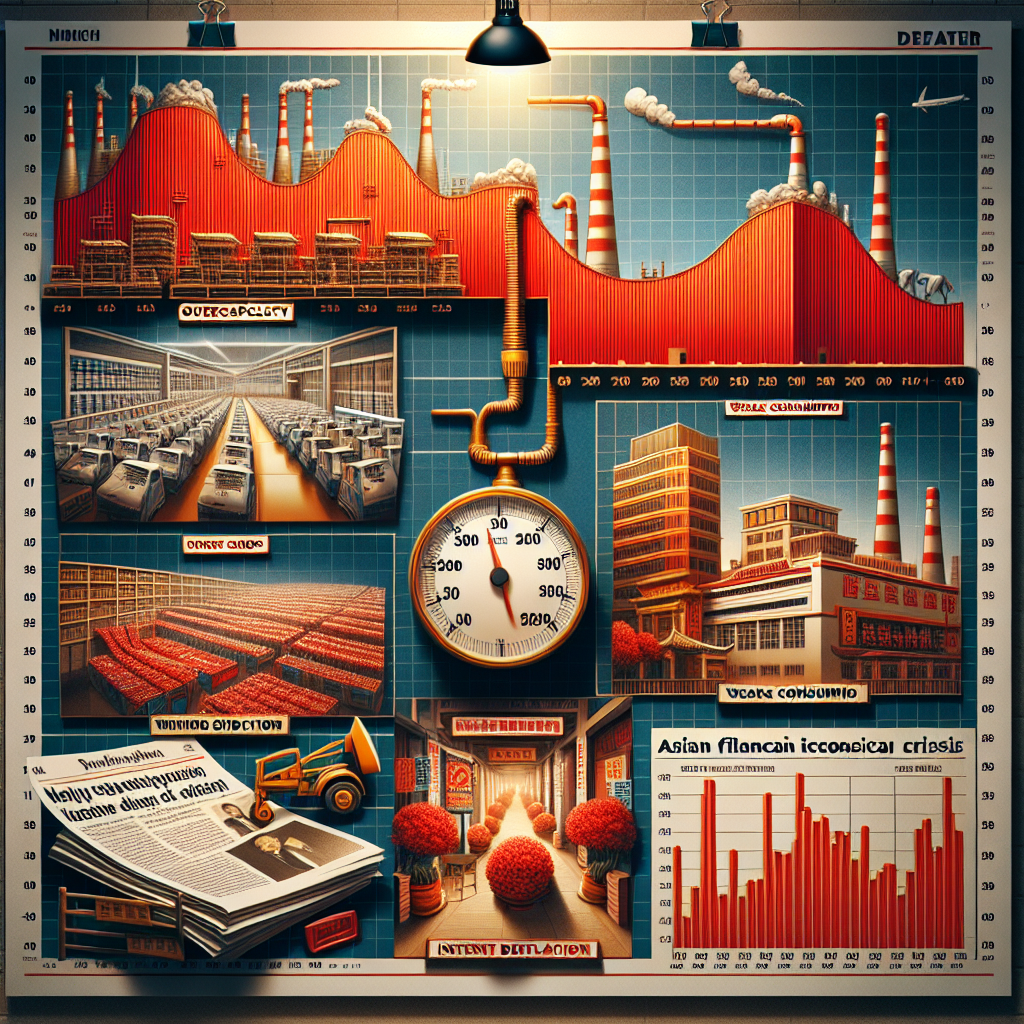
China’s economy is currently facing severe challenges, with overcapacity and weak consumption leading to continuous price declines and increasing deflationary pressures. The average price index has been falling for six consecutive quarters, marking the longest period since the late 1990s Asian financial crisis.
In November, China’s consumer price index (CPI) hit a five-month low, while the producer price index (PPI) has been in contraction for over two years with little sign of recovery.
Despite Beijing’s efforts to stimulate the economy through expansionary monetary and fiscal policies such as lowering interest rates, increasing fiscal expenditure, and boosting loans, the effectiveness of these policies has been limited.
On one hand, these measures primarily aim to prevent financial risks, with minimal impact on boosting consumer spending. On the other hand, Beijing’s continued provision of loans and subsidies to manufacturing and high-tech industries has exacerbated overcapacity issues, further intensifying the downward pressure on prices.
According to a report by The Wall Street Journal, companies like Shandong Chenming Paper, one of China’s largest paper producers, have resorted to price cuts to cope with overcapacity, leading to further losses. The company’s overdue debts have reached $250 million, resulting in lawsuits from creditors and freezing of some bank accounts. This predicament faced by Shandong Chenming Paper reflects the broader deflationary pressures on Chinese enterprises.
Real estate and manufacturing were the industries with the most severe price contractions in the first three quarters of 2024, with prices of cars and gasoline continuously declining. In the automotive market, price wars are escalating, with recent demands from BYD for suppliers to cut prices attracting widespread attention. NIO’s CEO, William Li, mentioned that the Chinese traditional fuel vehicle industry has entered an unsustainable cycle of price cutting, while the country’s automotive production continues to rise.
Deflation refers to a situation where prices of goods and services in the economy decline. Following the COVID-19 pandemic, economies like the United States and Taiwan experienced a surge in consumer demand known as “revenge consumption,” coupled with supply shortages leading to inflation. However, this scenario has not occurred in mainland China.
The sluggish trend in China’s real estate market has shrunk people’s assets, while increased regulatory scrutiny by the Chinese Communist Party on high-paying sectors like technology and finance has led to layoffs and salary reductions, weakening consumer purchasing power. Meanwhile, Chinese authorities continue to focus on the supply side of the economy, promoting “new quality production,” resulting in a surge in manufacturing and high-tech product outputs, despite weak demand forcing businesses to lower prices.
While initially, cheaper goods may seem advantageous to consumers, mainland Chinese are reluctant to spend amidst expectations of further price declines, alongside dwindling confidence in the Chinese government’s shifting policies and the lack of rule of law and contractual spirit in society, delaying consumption.
This delay could further dampen economic activity, exerting pressure on business revenues, potentially leading to job cuts and salary reductions, further decreasing consumer expenditure, and escalating the downward spiral of prices, creating a vicious cycle.
Moreover, once negative deflation expectations take root, various stimulus measures are likely to prove ineffective. Eswar Prasad, a professor of trade policy and economics at Cornell University and former head of the China division at the International Monetary Fund (IMF), noted, “The longer deflation persists, the deeper the negative outlook on the economic future becomes, making it increasingly difficult for economic stimulus measures to be effective.”
Deflation also drives up real interest rates, making business investments more challenging, further suppressing demand and triggering more severe deflation. Some economists believe that this “debt-induced deflation” could lead to economic recessions and depressions, as rising real interest rates make it difficult for people to repay loans, undermining the banking system.
International pressures could exacerbate China’s deflationary situation. If President Trump indeed imposes a 60% tariff on imports from mainland China, excess capacity will continue to accumulate, making it harder to sell Chinese goods in the U.S. market, leading to more domestic oversupply, further driving down prices.